Showing posts with label meditation. Show all posts

Friday, February 17, 2012

Layer 522 . . . Thought Systems, Religions, Beliefs, Worship, Meditation, Enlightenment, Secularism, Civic Life and Law

.
This week's 'In Our Time' on Radio 4 considered the An Lushan Rebellion. In the course of the programme Melvyn Bragg confessed he had no real idea about the richness and diversity of Chinese life and culture. So here we have a knowledgeable and highly intelligent guy who's spent years reading about and discussing philosophy, science and culture in general, and in spite of that huge intellectual effort he's somehow remained ignorant of Chinese history and culture. He's not alone in this. Western education and our Eurocentric culture chooses, for the most part, to ignore the Far East in general - including the history, philosophy and religions of China and Japan. This is a crazy and shameful situation.

http://www.bbc.co.uk/iplayer/episode/b01by8ms/In_Our_Time_The_An_Lushan_Rebellion/

The most interesting part of Melvyn's programme was a simple statement from one of the panel following Mr Bragg's enquiry about the religion of China at the time the An Lushan rebellion took place. The response was, "Religion? It was really a thought system, rather than about worship".

This is a brilliant and concise summation of the differences between Chinese or Japanese approaches to spiritual thought and behaviour and that of the rest of the world, where the worship of God or gods is the dominant mode of engagement with the spiritual and the metaphysical.

The two most ancient systems of spiritual intelligence and philosophy in China were Taoism and Conficianism, neither of which involved gods or worship. The third system, which came to China from India, was Buddhism - which eventually spread to Japan, and evolved another philosophical manifestation which was called Zen.

As we all know, Buddhism is based on developing our spiritual intelligence and ultimately enlightenment through various forms of meditation. There is no worship involved - and certainly no worship of the Buddha, who is seen essentially as an enlightened human being who serves as an inspiration, a spiritual pioneer and a role model. We can all aspire to becoming buddhas and enlightened beings - to a greater or lesser extent.
..................................................

It's perhaps fair to say that the majority of Christians, Muslims, Jews, Sikhs and Hindus aspire to becoming more spiritual and more enlightened. Those who support the use of violence in human affairs, and those who actually advocate it, are obviously very far from enlightened or spiritual. As indeed are all those who can't see that atheists and humanists are just as likely to be spiritually intelligent, virtuous and enlightened as those who call themselves religious.

Even James Corden - not the most cerebral of people - could see (as he explained on Desert Island Discs this week) that the so-called religious community that he was brought up in contained within it many individuals who behaved with a minimal amount of what Buddhists call lovingkindness.

..........................................................
Civic life and law must bind us, not ritual and religion
The Queen and Baroness Warsi might disagree. But there is nothing extreme about demanding church and state be separate
http://www.guardian.co.uk/commentisfree/2012/feb/16/civic-life-law-ritual-religion
by Polly Toynbee
No surprise that the Queen defends the established church, as she is the anointed defender of the faith. In a week of attacks on secularism she has invented a new role: "not to defend Anglicanism to the exclusion of other religions. Instead, the church has a duty to protect the free practice of all faiths in this country." Who is threatening the free practice of any faith? Not any secularists I know.
http://www.guardian.co.uk/uk/2012/feb/15/queen-says-church-misunderstood
Hers is a curiously Jesuitical justification for the CofE's uniquely privileged status, but the faiths are glad to circle their wagons round her against the unbelievers. Each has their own divinely revealed unique truth, often provoking mortal conflict, Muslim v Copt, Catholic v Protestant, Hindu v Muslim or Sunni v Shia. But suddenly the believers are united in defence against the secular, willing to suspend the supremacy of their own prophets to agree that any religion, however alien, from elephant god to son of God, is better than none.
They can all feel their victimhood now, facing what Baroness Warsi called a rising tide of "militant secularisation" reminiscent of "totalitarian regimes". Warsi on the warpath headed a delegation to the Vatican of six ministers, all agreeing the common enemy was not just the secularists but the "liberal elite", too. 
How the Daily Mail and Daily Telegraph loved wallowing in the CofE as victim against the rise of christianophobia, as if the waspish Prof Richard Dawkins had thrown them all to the lions. But in defending religious privilege, they are on their own: Ipsos Mori found 74% of Christians consider religion should be a private matter and should not influence public policy, so even most Christians are secularists. For Cameron, Lady Warsi may be a useful canary-testing if American flag-and-faith culture wars might fly over here. Mercifully, every poll shows the answer is no. The CofE is no longer the Tory party at prayer: polls show its pews filled mainly with the liberal-minded.
The prefix "aggressive" or "militant" is now super-glued to the word "secularist", but as president of the British Humanist Association and honorary associate of the National Secular Society, I find nothing extreme about trying to keep religion separate from the state. Aggressive? You should see this week's "burn in hell" messages to the BHA attacking "that spastic Hawking who denies God", and many more obscene unprintables.
I will defend to the death anyone's right to practice any faith, if it breaks no law, interferes with nobody's rights nor claims undue public policy influence. Church bells, calls to prayer, displays of crucifixes, beards or side-locks are freedoms, alongside bare midriffs and knicker-short miniskirts. Personally, I am affronted by women in face veils, but that's my problem. I will argue against them but freedom of speech, thought and dress are non-negotiable. But so is the right to robust argument that may offend religious sensibilities, including the right to challenge the improbability of the faith itself – and the right to make jokes.
A third of our state schools are run by religions, mainly CofE - oversubscribed as their results are burnished by admissions policies that consign an unfair share of poor or chaotic families to neighbouring schools. Though polls find only minority support for faith schools, the religions are rushing to set up free schools: this week the evangelical Christian Family Schools bid for 10 sites in Sheffield. Meanwhile, faith organisations are given more contracts for social services: once outsourced, clients lose Human Rights Act protection against religious coercion, harassment or discrimination. None of this is trivial.
"Faith and reason go hand in hand," said Lady Warsi. She's entitled to her view.
Odder still is the religious claim to a monopoly on moral authority, as Cameron did in his pre-Christmas "We are a Christian country" speech. Religious and irreligious alike commit atrocities, but faith ferments crusade, jihad and martyrdom. 
Belief makes people neither better nor worse: the latest research by the National Council for Voluntary Organisations found the religious no more likely to volunteer than non-believers. As social animals, thriving through co-operation, the selfish gene vies with a collective instinct for social justice, from the day a child first protests "it's not fair". 
Claiming no special superiority, the view that our fate is in our hands makes humanists naturally progressive, not fatalistic. There is nothing militant about demanding that civic life and law binds us together as equal citizens, regardless of whatever peculiar ideas everyone harbours in their imagination.
.

Wednesday, February 1, 2012

Layer 512 . . . Meditating on Happiness, The Hedonism Archetype, The Nihilism Archetype, and The Happiness Archetype

.
How To Become Happier

Now where was I? Oh yes - happiness. Or rather - how to become happier.

In Layer 509 I said I was reading a new book by Tal Ben-Shahar, which is called 'Happier'.

http://oxzen.blogspot.com/2012/01/layer-509-happier-rat-racers-top-of.html

Here's a few more quotes from the section on the Rat-Race Archetype.
The reason why we see so many rat racers around is that our culture reinforces the belief [that 'one big break' will finally make us happy]. 
We learn to focus on the next goal rather than on our present experience and chase the ever-elusive future our entire lives. We are not rewarded for enjoying the journey itself but for the successful completion of a journey. Society rewards results, not processes; arrivals, not journeys.
Once we arrive at our destination, once we attain our goal, we mistake the relief we feel for happiness . . . the negation of stress or anxiety. The absence of pain is but a momentary relief from an essentially negative experience.
The Hedonism Archetype
A hedonist seeks pleasure and avoids pain. She goes about satisfying her desires, giving little or no thought to future consequences. If drugs produce a pleasant experience, she takes them; if she finds work difficult, she avoids it.
The hedonist errs in equating effort with pain and pleasure with happiness.Without a long-term purpose, devoid of challenge, life ceases to feel meaningful to us; we cannot find happiness if we exclusively seek pleasure and avoid pain.
Mihaly Csikszentmihalji, whose work focuses on peak performance and peak experience, claims that, "the best moments usually occur when a person's body or mind is stretched to its limits in a voluntary effort to accomplish something difficult and worthwhile." A struggle-free, hedonistic existence is not a prescription for happiness.
The Nihilism Archetype
A nihilist is a person who has given up on happiness, who has become resigned to the belief that life has no meaning. This person captures the state of being chained to the past - their past failures to attain happiness.
Such attachment to past failures has been described by Martin Seligman as "learned helplessness". Such thinking leads to despair. 
The rat racer, the hedonist, and the nihilist are all, in their own ways, guilty of a fallacy - an inaccurate reading of reality, of the true nature of happiness and what it takes to lead a fulfilling life. 
The rat racer suffers from the "arrival fallacy" - the false belief that reaching a valued destination can sustain happiness. 
The hedonist suffers from the "floating moment fallacy" - the false belief that happiness can be sustained by an ongoing experience of momentary pleasures that are detached from a future purpose. 
Nihilism is also a fallacy, a misreading of reality - the false belief that no matter what one does, one cannot attain happiness. This last fallacy stems from the inability to see a synthesis between arrivals and floating moments, some third option that may provide a way out of one's unhappy predicament. 
The Happiness Archetype
Instead of asking "Should I be happy now or in the future?" we should ask, "How can I be happy now and in the future?"
Students who truly love learning, for instance, derive present benefit from the pleasure they take in discovering new ideas, and future benefit from the ways in which those ideas will prepare them for their careers. 
To expect constant happiness, though, is to set ourselves up for failure and disappointment. 
The rat racer's illusion is that reaching some future destination will bring him lasting happiness; he does not recognise the significance of the journey. The hedonist's illusion is that only the journey is important. The nihilist, having given up on both the destination and the journey, is disillusioned with life. The rat racer becomes a slave to the future; the hedonist, a slave to the moment; the nihilist, a slave to the past. 
Attaining lasting happiness requires that we enjoy the journey on the way towards a destination we deem valuable. 
Meditating on Happiness
Research . . . reveals the profound effects of regular meditation. Make meditation a ritual. Set aside between ten minutes and an hour each day for meditation. Whenever you feel stressed or upset or when you simply want to enjoy a moment of calm or joy, you can take a few deep breaths and experience a surge of positive emotions. 

Is that really so? Or is it a surge of positive feelings? Does the distinction matter? Should we continue to reflect on this potentially important issue?


My son tells me he has no time for all this 'self-help' stuff. He's dismissive of the whole genre - positive psychology and all. Never having been a reader of self-help books myself I'm sympathetic to his point of view, but on the other hand the whole 'happiness' movement is obviously in the zeitgeist, and it's a subject worthy of study - if only to critique what various psychologists and self-help gurus are saying, and to reach sounder opinions ourselves.

I've no idea where this is going with Tal Ben-Shahar, but I'll carry on with the journey and report back in future blogs.


Website: http://www.talbenshahar.com/

Bringing Happiness to Life
"You will find a whole range of online courses, books, live lectures and workshops, as well as products through which I create a bridge between the Ivory Tower and Main Street — translating the rigorous research conducted in universities into accessible material that most people can apply in their personal and professional lives."
Tal consults and lectures around the world to executives in multi-national corporations, Fortune 500 companies, educational institutions, and the general public. Topics include leadership, education, ethics, happiness, self-esteem, resilience, goal setting, and mindfulness. He is the author of the international best sellers Happier and Being Happy, which have been translated into 25 languages.

.

Friday, January 28, 2011

Layer 431 . . . Meditation, Mindfulness, Miliband, Zen, Soros, Davos, Bankers, Bonuses, Boris, Posh Rock and Egypt

.
It's interesting to observe the awesomely mega-rich as they go about their everyday business, especially if they owe their wealth and status to their own intellectual and creative efforts and not to inheritance, theft, corruption or the corporate gravy train.

Bill and Melinda Gates, for example, these days spend all their time and energy running the Gates Foundation and handing out their billions to good causes - most of them working on health issues in the poorest parts of the planet. Bill is a clever, lucky and somewhat enlightened individual who happened to find himself in the right place at the right time at the birth of the (micro)computer age. He's clearly a decent as well as a powerful man who has no need to connive or talk bullshit with anyone.

You can say pretty much the same thing about George Soros, the billionaire financier.

George Soros is a Hungarian-American financier, businessman and notable philanthropist focused on supporting liberal ideals and causes. He became known as "the Man Who Broke the Bank of England" after he made a reported $1 billion during the 1992 Black Wednesday UK currency crises. Soros correctly anticipated that the British government would have to devalue the pound sterling. - Wikipedia

When Soros says something on the subject of finance and economics we do well to listen. He's been speaking about British monetary policy.

George Soros tells David Cameron: change direction or face recession

Mix of tax increases and spending cuts unsustainable, speculator says, as World Economic Forum gets under way

by Larry Elliott

http://www.guardian.co.uk/politics/2011/jan/26/george-soros-david-cameron-recession

The international speculator George Soros warned David Cameron tonight that the government would push the British economy back into recession unless it modified its hardline austerity package.

Speaking in Davos, Switzerland, the hedge fund owner who famously wrecked the reputation for financial competence of the last Conservative administration on Black Wednesday said the mix of tax increases and spending cuts planned by the coalition was unsustainable.

Soros's suggestion that the UK needed a plan B came only hours after Cameron insisted in fierce Commons exchanges with the Labour leader, Ed Miliband, that there would be no change of government policy following the unexpected news yesterday that the economy contracted by 0.5% in the final three months of 2010.

"They will have to modify it when the effects are felt," Soros said. "I don't think it can possibly be implemented without pushing the economy into a recession." Noting that the initial market reaction to the government's tough stance had been positive, Soros added: "We will have to see it unfold. My expectation is that it will prove to be unsustainable."

.....................................................

Meditation
It's interesting how the use of meditation is becoming more and more mainstream. The Guardian's guide is worth looking at.

An introduction to easy meditation

These three short animations by Headspace will introduce you to the concept
of 'mindful' meditation.

http://www.guardian.co.uk/lifeandstyle/video/2011/jan/20/health-and-wellbeing-fitness

..........................................

How to meditate: Overcoming potential obstacles

Everyone who learns to meditate encounters obstacles. Here are some of the most common ones and a few tips on how to deal with them

http://www.guardian.co.uk/lifeandstyle/2011/jan/22/how-to-meditate-tips-overcoming-obstacles

..................................................

The Headspace meditation podcasts: Day-to-day mindfulness - audio

First of a series of podcasts explaining how to use meditation and mindfulness to reduce stress and increase concentration

http://www.guardian.co.uk/lifeandstyle/audio/2011/jan/24/headspace-mindfulness

Have you ever wondered how you could live your life with a greater sense of calm and clarity? Perhaps a greater sense of emotional stability?

When it comes to practicing the skill of mindfulness it's all about repetition and being familiar with what it means to be in the present moment.

This short exercise from Headspace will show you how you can use everyday activities to help learn this invaluable skill.


It's all very well using meditation as a means of relaxation, to increase concentration, to decrease stress, to improve emotional stability, etc, but there's no sense here, in these articles, that the ultimate purpose of meditation, or Zen, is to move the individual towards states of greater spiritual awareness and intelligence, and towards experiences of satori and enlightenment.

..............................................

Is He A Zen Master?
Ed Miliband is right to keep silent

There are good reasons for Miliband to step back and work on renewing Labour – rather than seek a high profile

by Sunny Hundal

http://www.guardian.co.uk/commentisfree/2011/jan/27/ed-miliband-labour

A frenzy of speculation surrounds Labour leader Ed Miliband. Is his brother coming back? Is Ed Balls planning to move in for the kill? Is he moving too much – or not enough – to the left? Why don't voters rate him more highly?

Lefties complain he isn't doing enough to oppose the government's ruinous agenda, while on the Labour right the usual voices say he isn't doing enough to occupy Tory territory. Is he a Zen master? Does he need more spinners and strategists?

It's absurd. There are at least five good reasons why he should stick to playing the long, waiting game . . .
As I was saying yesterday,

People are starting to understand that we don't want government to be our rulers - we should expect them to do things on our behalf. But first we have to articulate what we really want. It's stupid to just vote for parties on the basis of what they offer in their manifestos. WE have to make demands and expect our elected representatives to act on our behalf.

Sunny Hundal says,

This is the important point. The fightback against the Conservative agenda doesn't necessarily need to be led by Labour . . .
If you're angry about the Tory cuts, as I am, then get organised and mobilise ordinary people to fight back. That will grab attention and will force government ministers to listen, especially if the coalition against the cuts is broad enough (worth noting that the high profile campaign to save UK forests is partly run by Boris's sister Rachel Johnson). There is no reason why the fight against the government's cuts has to be led by Labour; it would be better led by local people from across the country. Don't get angry, get organised.

..........................................

Egypt

In North Africa the people have begun to take to the streets to make their needs and demands clearly known. These are 'popular' movements - and nothing to do with organised political parties or religious groups.

Egypt's Day of Rage goes on. Is the world watching?

The scale of protests in Egypt has shaken a regime that has long relied on citizens' passivity to retain power

 http://www.guardian.co.uk/commentisfree/2011/jan/27/egypt-protests-regime-citizens

Tens of thousands of Egyptian demonstrators took to the streets on 25 January, young and old, Muslim and Christian, rich and poor, educated and not so-educated. They all chanted "Long live Egypt", "Life, liberty and human dignity" and "Down with the Mubarak regime".

The day marked for the celebration of Police Day was dubbed the Day of Rage. The protests, which continued through a second day in almost every part of the country, are showing no signs of abating on the third day, with a million-strong march scheduled for Friday. These demonstrations are sending shivers down the spine not only of the regime but of its friends and allies as well.
For three decades now, Egyptians have been kept on a tight leash, fed more with promises than with bread. They were cajoled into compliance by a media that has the interests of the regime at heart and a religious establishment that owes its allegiance and existence to the state, but were often threatened into submission by the force of the baton if they refused to comply.

Egyptian grievances are numerous. They have seen neither the fruits of peace nor of the huge economic growth that Egypt is reported to be making in international economic indices. What they experience on a daily basis is endless queuing for inedible bread and suffocating traffic congestion as the police force is increasingly burdened with the task of protecting the regime and its men.

There were also demonstrations last month calling for a minimum monthly wage of 1,200 Egyptian pounds (roughly £130). Too much, said the government. It could only promise to institute a minimum wage of 400LE (£43). This is hardly surprising from a government made up of businesspeople who no doubt have a vested interest in keeping wages as low as possible. The spokesmen of the regime shamelessly argued that it was a fair wage to expect.

For some years now, the Mubarak regime has been heading for disaster. With rampant unemployment, soaring prices and a 30-year long state of emergency, its popularity has dropped to an all-time low. But more importantly, it has repeatedly shown its total disregard for public opinion, a disregard that would have amounted to political suicide under any other system.

An obvious example is the rigged parliamentary elections of November 2010, which were perhaps the worst in Egypt's history. The ruling National Democratic party had the audacity to announce that these elections were one of the fairest in Egypt's history. Ahmed Ezz, the iron-tycoon-turned-politician and one of the new guard at the NDP, who is known to have masterminded the electoral operation, triumphantly announced the results. He stated that the landslide victory that secured 98% of the parliamentary seats for the ruling party was the result of its popularity on the streets and the fruit of the hard work of its members.

The initial call for the Day of Rage was made by young Facebook activists inspired by the success of Tunisians in overthrowing Ben Ali. The Facebook invitation for the protests received 95,000 positive responses. Other forces and opposition groups later responded to the call, including the Muslim Brotherhood, whose participation has so far been quite low-key.

For the first time in decades, Egyptian protesters went out in unprecedented numbers across the whole country with one slogan: "People want the regime to fall". They made their demands clear. Mubarak should step down, the illegal parliament be dissolved and emergency law be suspended. The call was for the whole country to rally and unite, and there were no religious chants or slogans.

The reaction of the regime to the protests so far has been pathetically inadequate. It shows that this regime is still in denial. While Mubarak kept his silence, the interior ministry took on the task of communicating with the people, in the only way it knows how to. As it cracked down on demonstrators, it issued statements, banning any further protests and repeating the same old excuses. It blamed the Muslim Brotherhood for what it called riots on the streets and blamed their members for infiltrating the crowds in order to wreak havoc. This is supposed to do the trick of scaring the world about the propsect of an imminent Islamist takeover of Egypt – a fear that the regime has painstakingly been fostering. The interior ministry also blamed the ill-defined but frequently invoked "foreign hands" that are always bent on fomenting trouble and inciting people against their loving and God-fearing rulers. 

I found myself wondering yesterday whether there's a whiff of '68 in the air. It's been a long time since there were worldwide popular protests led by workers, young people and students - primarily against corrupt power elites, warmongering and injustice.

................................................

Davos Watch

It's time for the annual gathering of international the power elites in Switzerland. The whole world's watching, as they said in Chicago, all those years ago. Even more so in the age of 24 hour satellite TV, the Internet and mobile phones.

.................................................

Boris

Having gone in for a fair bit of Tory-bashing recently (!) I have to draw attention to some of Boris's opinions about bankers' bonuses.

Boris Johnson plans bank message at World Economic Forum

http://www.docklands24.co.uk/news/boris_johnson_plans_bank_message_at_world_economic_forum_1_784549

LONDON Mayor Boris Johnson says he will remind banks of their responsibilities when he meets leaders at this week’s World Economic Forum.

“Last year I told them it was time for the masters of the universe to become servants of the people. That is absolutely right and it’s a message I will be repeating this year,” he said.

.............................

Cut 'excessive' bonuses, Boris Johnson tells bank chiefs

http://www.thisislondon.co.uk/standard/article-23796385-cut-excessive-bonuses-boris-johnson-tells-bank-chiefs.do

Boris Johnson today wrote to global banking chiefs urging them to scale back “excessive” bankers' bonuses.

The Mayor said he was “shocked and baffled” the banks had failed to acknowledge public outrage over the multi-billion-pound payouts.

In his strongest criticism to date, he urged the bank chiefs to show “much stronger leadership” on the issue. He told the Standard: “Nobody can possibly defend the huge sums of bonuses being awarded. The banks should not be paying out huge bonuses as though it was business as usual. They have to show they recognise the game changed when the taxpayer bailed them out.”

Mr Johnson suggested the banks should skim money off bonuses to set up a fund to help small and medium-sized businesses in the capital.

“In order for me to champion and support successful financial services, it is crucial that the sector itself demonstrates much stronger leadership.

“Collectively, financial services firms must take much greater account of public opinion and set justifiable remuneration packages accordingly, in the light of the unprecedented support given to the financial system over the last two years.”

......................................................

Rock's Gone Posh
There was a feature on R4 this morning about most pop and rock musicians these days having had a private school or stage school education. Very different to the rock rebels of yesteryear. Rick Wakeman spoke about a 'snobbish culture'.

See Layer 367 re Clegg, Cameron and Radiohead.

http://oxzen.blogspot.com/search/label/Radiohead

.

Friday, January 7, 2011

Layer 416 . . . The Ashes, Test Match Cricket, Night Owls, Digital Lives, Tiredness, Energy, The Winter of our Disconnect, and the Gift of Time

.

'And gentlemen in England now a-bed shall think themselves accursed they were not here'.


So here I am pouring a glass of best malt whisky and breaking open a box of chocolate brazils - by way of middle of the night celebrations. It's all over now. An Ashes victory by three games to one - all three victories by an innings and plenty.

I've never been a massive sports fan, and could never understand the nutters who stay up all night listening to Test Match Special during Ashes series Down Under. So how come I've recently spent hours in the middle of the night following the Over By Over reports on the Guardian website whilst listening to TMS on the Radio 5 site? What's been so special about this team and this series?

I spent some time yesterday looking forward to a good night's sleep tonight - following  the swift removal of the remaining three Aussie wickets before midnight London time. First of all, however, there were the previous day's highlights to enjoy on ITV4 between 10.00 and 11.00 pm. Extremely enjoyable. Now for the main course - the final climax and the final celebrations . . .

Imagine the wretched feeling then - waking up at well past midnight, and realising that I'd fallen asleep and missed it all! The moment of victory! The excitement and the joy! The post-match comments and plaudits! What an idiot!

Except . . . wait! This is amazing! It's been raining in Sydney and play's been held up! Plus - the tail enders have been hanging around and are still in there, still holding on. Thank heavens for those much derided Aussies - Smith, Siddle, Hilfenhaus and Beer.

Then down they went, one after the other - Siddle caught by Anderson, after slogging into the outfield; Hilfenhaus caught behind; Beer getting his stumps smashed down by Tremlett - the perfect ending to a winter-long saga.

Truly a moment to savour. And I wasn't joking in the last blog when I said that Australia is fortunate to have been well and truly beaten by a clearly superior side, and not just pipped by a bunch of equally ordinary players. The Aussie commentators have rightly been able to concentrate on the brilliance of the English, making only passing references to the defeated Australians, relatively speaking.

Most of the English team were interviewed afterwards. How different, and how pleasant, they are - compared to the England footballers. The horrors of Rooney, Gerrard, Terry, Ferdinand et al. (Walcott is the exception - and he wasn't picked for the World Cup Finals. Remember Rooney cursing the English fans as he left the pitch following a diabolical and shambolic performance by both him and the team?) I could go on, as usual, about the importance of intelligence, but I won't.

Swann spoke intelligently about the dangers of hubris, the need to stay grounded, and so on. Strauss made a lighthearted comment about being personally responsible for the victory thanks to  passing on batting tips to Cook. (An antidote to the crass Pietersen comment about how it was him wot won it?)

I felt sorry for Trott - out for a duck in the Test in which his side scored a record total for a single innings by an England team in Australia, with no further opportunities in the series to redeem himself. Collingwood was also a slightly sad figure.

Interestingly Pietersen wasn't on the interview parade. Has he been advised to keep his stupid big mouth shut? Or has he finally worked that one out for himself?

So is cricket the new rock n roll? Er - no. But those of us who are currently enjoying the brilliance of this particular team would seem to have a lot to look forward to. Victory in the World Cup next year - the 50 overs one-day form of the game - would be the perfect follow-up to two consecutive Ashes victories, and the World 20-20 victory in South Africa last year.

Test match cricket may be a minority sport these days, enjoyed mainly by the likes of night owls, retired colonels and the Barmy Army, but it surely deserves better than to have its highlights broadcast at 10.00pm on ITV4 - a TV channel whose rubbish programmes are not even listed in proper newspapers.

The people who run the game should be held responsible for it becoming a minority sport, thanks to selling the broadcast rights to Sky Sports - a minority channel watched only by a few hundred thousand hard-core sports nuts.

Access is vital. I feel sorry for the kids of today, who have no chance of spending lazy summer days with their families watching enthralling Test matches (and Test series) unfold on open-access terrestial television. Maybe the majority of them would do so whilst multi-tasking on Nintendo thumb-twiddlers, and whilst updating Facebook pages on laptops and smartphones, but so what? Some of us also multi-task by making cups of tea, glancing at newspapers and pouring tots of whisky. This is the beauty of Test Match cricket - it's part of your daily life, whether on radio or TV, and not a substitute for it. Day or night.

http://www.guardian.co.uk/sport/2011/jan/07/ashes-england-australia

http://www.guardian.co.uk/sport/2011/jan/07/the-ashes-2010-11-england-australia


...............................................


This week's Book of the Week on Radio 4 has been one of the best. A necessary, original and important book.

The Winter of Our Disconnect

By Susan Maushart. How one mother imposed techno-silence on three angry teenagers for six months

http://www.bbc.co.uk/programmes/b00x79zh

http://www.dailytelegraph.com.au/lifestyle/the-winter-of-their-disconnect-how-susan-maushart-and-her-family-lived-without-technology-for-six-months/story-e6frf00i-1225866993954

"There were lots of reasons why we pulled the plug on our electronic media ... or, I should say, why I did, because heaven knows my children would have sooner volunteered to go without food, water or hair products. At ages 14, 15 and 18, my daughters and my son don't use media. They inhabit media. And they do so exactly as fish inhabit a pond. Gracefully. Unblinkingly. And utterly without consciousness or curiosity as to how they got there.

They don't remember a time before email, or instant messaging, or Google. Even the media of their own childhood - VHS and dial-up, Nintendo 64 and "cordful" phones - they regard as relics, as quaint as inkwells.

They collectively refer to civilisation pre-high-definition flatscreen as "the black and white days".

The most arresting points made by today's extract from the book were about the tiredness brought on by relentless and excessive digital multi-tasking on the part of teenagers (and others), and how much better we become as people when we're not tired and have plenty of mental and physical energy. The point was also well made that time without access to digital media is potentially time available for reflection and meditation, which are also vital for living well.

It's a question of balance . . .
.

Wednesday, January 5, 2011

Layer 415 . . . Ambition, Success, Zen, Rewards, Ashes, Acedia, Helping Others, Self-Development and Enlightenment

.
Ambition

Becoming familiar with Zen, the Tao, the Watercourse Way, etc, helps to explain why quite a lot of us seem to lack personal ambition and haven't striven to become 'successful' either professionally or materially. In our society it's the mainstream view that we ought to be ambitious, set ourselves goals, and achieve as much recognition and reward as our society can offer.

Eastern philosophy, however, sees the development of the self, and seeking enlightenment, as the real goal of life. Through meditation, through becoming authentic and spontaneous, through trying to help others, and so on, we can develop ourselves without having to become wealthy or having to achieve high status. It's often been said that material wealth, worldly 'success' and great personal ambition may, in fact, be handicaps in achieving these other goals. Fully evolved humans appear to have very little regard for either material wealth or high status or personal ambition - other than living well and being the best human being they can be. As ever, Layer 22 for reference.

Self-Development

How to develop the self without becoming self-obsessed and self-centred? The usual things really - Zen practice.

Therefore at the beginning of this new year resolve to do the following:

Eat and drink moderately and well.

Have regular meals - don't snack throughout the day or graze on what's easily available.

This year eat and drink more fresh lemon juice, more honey, more green tea, more powdered vitamin C, more fish, more lentils and chick peas, more garlic, more fresh chillies, more olives, more tomatoes, more home-made soups . . . and drink more water.

Enjoy sensible amounts of meat, cheese, bread, coffee, tea, red wine, spirits, beer, sake, nuts, fruit and chocolate.

Go for more walks and make more contact with nature, the elements, the sky, the sun and the seasons. Meditate as you walk, and also find other times of the day to examine your own thoughts, calm your mind, allow your deepest thoughts and feelings to come to the surface and come into the light of day. Allow the light to turn fears and negative thoughts into something positive, or simply neutralise them.

Have a regular bedtime. Have a regular waking up and getting up time.

-----------------------------

Helping Others

I've been pondering what it means to help other people. Especially those who are nearest and dearest.

You have to accept that in order to help others they must first of all want to help themselves. They also have to genuinely want you to help them.

I know of at least two fairly reclusive individuals, semi drop-outs, who appear to be suffering from acedia.

 Acedia

Acedia (also accidie, from Latin acidĭa, and this from Greek ἀκηδία, negligence) describes a state of listlessness or torpor, of not caring or not being concerned with one's position or condition in the world. It can lead to a state of being unable to perform one's duties in life. Its spiritual overtones make it related to but distinct from depression. Acedia was originally noted as a problem among monks and other ascetics who maintained a solitary life.

Acedia is essentially a flight from the world. It leads to not caring even that one does not care. The ultimate expression of this is a despair that ends in suicide.

As with those who followed him, Evagrius sees acedia as a temptation, and the great danger lies in giving in to it.

- Wikipedia

I presume there's a continuum that runs from extreme acedia right the way over to a state of spiritual joy, or satori.

I presume most people operate mostly or entirely somewhere in the middle - neither knowing nor caring about satori - let alone experiencing it -  but not completely in a state of torpor either.

As for depression . . . how DO most sufferers help themselves through it and get over it? By definition it's a state of feeling that nothing actually matters, that one is essentially worthless, and life is just a crock of pointless shit.

In the medieval Latin tradition of the seven deadly sins, acedia has generally been folded into the sin of sloth. Moral theologians, intellectual historians and cultural critics have variously construed acedia as the ancient depiction of a variety of psychological states, behaviors or existential conditions: primarily laziness, ennui or boredom. The demon of acedia manifests itself in a range of psychological and somatic symptoms that is far broader and more complex than the familiar tradition in the West.

Acedia is indicated by a range of signs. These signs (or symptoms) are typically divided into two basic categories: somatic and psychological. Acedia frequently presents signs somatically. Such bodily symptoms range from mere sleepiness to general sickness or debility . . .

A host of psychological symptoms can also signify the presence of acedia, which affects the mental state and behavior of the afflicted. Some commonly reported psychological signs revolve around a lack of attention to daily tasks and an overall dissatisfaction with life. The best-known of the psychological signs of acedia is tedium, boredom or general laziness.

http://en.wikipedia.org/wiki/Acedia

The Watercourse Way is not passive, and the Tao is not mere adaptability, mutability and passivity. To become one's true self involves actively seeking to discover one's true nature, and to differentiate it from that which we're told by others we ought to be. To use meditation as a aid is a very positive choice. The discovery of the true self is NOT a thing that many people care to actively pursue - out of fear, vanity, egocentricity, false pride, sloth, etc.

Ashes News

Ah yes - the cricket. What a joy it is to see young people who have dedicated themselves to being the very best they can be in life being brilliantly successful in their trade or profession by virtue of their application, concentration, determination, self-examination, selflessness and skill development. To perform as well as these guys are doing you need to be right 'in the zone' for just about 100% of the time - both on the pitch and off it.

Very well done Cook, Bell, Strauss, Prior, Anderson, Swann, Bresnan and Tremlett. Thank you all for living up to expectations yesterday, and also for helping Australians to feel that at least they lost to the better team. Another 500 in the first innings and another victory by an innings will do nicely.

Trott - will continue to improve, and will learn to avoid ducks. Not quite there yet, but soon will be.

Pietersen - MUST do better. Not holding out much hope, though. Too big an ego. Too little EQ and SQ. Let alone IQ. This is a man who seems to believe that this Ashes success is all down to his heroic and selfless act of getting himself sacked from the captaincy. How immense is that? That's enough ego to fill a whole city. This is a man who gets himself out to crappy hook shots when good sense, concentration, hard graft, application and good judgement are needed.

Collingwood - possibly concentrate on becoming a useful medium pace bowler. We still need a good all-rounder at Number 6. As well as all-rounders at 7, 8, 9 and 10. Take a bow Mssrs Prior, Broad, Swann and Bresnan.

We can allow Jimmy Anderson to be in the team purely as a bowler, since he does so well as the night watchman. Tremlett and Finn to be his back-ups.

.

Friday, December 17, 2010

Layer 404 . . . Taoism, Yin Yang, In Our Time, Young People, Spiritual Intelligence, and Discovering The Way

.
Young People

You have to feel sorry for young people today. How are they supposed to make sense of a world so complex, so raucous, so treacherous?

There are something like 500 TV channels in the UK alone. Millions of books, hundreds of magazines, and a billion websites. How do they make sense of any of that? Where to start?

How do they figure out who they are, what they should do, what's worth aiming for? Whose voices are worth listening to? Where is there a reliable compass, and a decent map?

Is it worth going anywhere at all?

Taoism

In Our Time   -   Radio 4


http://www.bbc.co.uk/programmes/b00wlgbg

From the IOT website -

An ancient Chinese tradition of philosophy and religious belief, Daoism first appeared more than two thousand years ago. For centuries it was the most popular religion in China; in the West its religious aspects are not as well known as its practices, which include meditation and Feng Shui, and for its most celebrated text, the Daodejing. (Tao Te Ching)

 http://www.thebigview.com/download/tao-te-ching-illustrated.pdf

http://www.beatrice.com/TAO.pdf

The central aim in Daoism is to follow the 'Dao', a word which roughly translates as 'The Way'. Daoists believe in following life in its natural flow, what they refer to as an 'effortless action'. This transcendence can be linked to Buddhism, the Indian religion that came to China in the 2nd century BC and influenced Daoism - an exchange which went both ways. Daoism is closely related to, but has also at times conflicted with, the religion of the Chinese Imperial court, Confucianism.

The spirit world is of great significance in Daoism, and its hierarchy and power often take precedence over events and people in real life. But how did this ancient and complex religion come to be so influential?


From the programme:

Lao Tzu is the great sage of Taoism, and the author of the key text - the Tao Te Ching

Yin-yang is a key concept.

Taoism is a complex philosophy – not a religion

The Tao includes several concepts in one word:

    * the source of creation
    * the ultimate
    * the inexpressible and indefinable
    * the unnameable
    * the natural universe as a whole
    * the way of nature as a whole

The Tao means The Way, The Path.
The Way of Heaven, The Way of Nature, The Way the Universe operates.
It's more than just a moral code.
The fundamental pattern and harmony of the universe.

Taoism is known as The Watercourse Way since water moves from the heavens to earth, and then flows naturally across landscapes until it becomes part of the great ocean, and prepares to rise again to the heavens as vapour. At least that's MY take on it.

Actionless action is seen as the ideal way of living.

This final point, about 'actionless action', seems to me to be the key and the best test as to whether  'experts', like the guests involved in this programme, really do see through to the essence of Taoism and the notion of 'actionless action'.  The people on this programme failed to convey adequately the idea that it's all about discovering the true essence of oneself and then living in accord with it - which the true self can do instinctively, which is the real meaning of actionless action. Instinctive intelligence allows us to do things without conscious thought and action. But it can take a lot of hard work to develop instinctive intelligence if our upbringing has filled our head with a lot of rubbish that needs to be identified, discarded, and replaced with ideas and ways of living that are more appropriate and more enlightened.

Another key point, I believe, is that we can't act spontaneously and instinctively if we're living lives that are shackled by inappropriate professions and occupations, inappropriate religious beliefs, inappropriate fears and anxieties about punishments by 'gods', inappropriate relationships, inappropriate expectations of ourselves, etc. Finding our true, individual Tao is therefore essential to discovering the path that's appropriate for us as individuals - no matter how deviant, bizarre, off the wall, etc, that path might seem to others.

........................................................

Previous blogs concerning Taoism, Zen and yin-yang philosophy:

Layer 138   http://oxzen.blogspot.com/2009/03/layer-138-class-unhealthy.html

Layer 139  http://oxzen.blogspot.com/2009/03/layer-139-wabi-sabi-yin-yang-and.html


.........................................................

These extracts are from elsewhere on the BBC website:

Taoism at a glance

Taoism is an ancient tradition of philosophy and religious belief that is deeply rooted in Chinese customs and worldview.

Taoism is also referred to as Daoism, which is a more accurate way of representing in English the sound of the Chinese word.

Taoism is about the Tao. This is usually translated as the Way. But it's hard to say exactly what this means. The Tao is the ultimate creative principle of the universe. All things are unified and connected in the Tao.

* Taoism originated in China 2000 years ago

* It is a religion of unity and opposites; Yin and Yang. The principle of Yin Yang sees the world as filled with complementary forces - action and non-action, light and dark, hot and cold, and so on

* The Tao is not God and is not worshipped. Taoism includes many deities, that are worshipped in Taoist temples, they are part of the universe and depend, like everything, on the Tao

 * Taoism promotes:
          o achieving harmony or union with nature
          o the pursuit of spiritual immortality
          o being 'virtuous' (but not ostentatiously so)
          o self-development
    * Taoist practices include:
          o meditation
          o feng shui
          o fortune telling (I Ching)
          o reading and chanting of scriptures

Before the Communist revolution fifty years ago, Taoism was one of the strongest religions in China. After a campaign to destroy non-Communist religion, however, the numbers significantly reduced, and it has become difficult to assess the statistical popularity of Taoism in the world.

The 2001 census recorded 3,500 Taoists in England and Wales.

http://www.bbc.co.uk/religion/religions/taoism/ataglance/glance.shtml

...........................................................
  
This is also from the BBC website:

There is something fundamentally honest and psychologically healthy in being oneself and striding forward with one's vision facing directly ahead, instead of trying at every turn to satisfy abstract standards of goodness established by a reigning orthodoxy. This is what te/de is all about.    -         Professor Victor Mair

The One

The One is the essence of Tao, the essential energy of life, the possession of which enables things and beings to be truly themselves and in accord with the Tao.

Tzu Jan

Tzu Jan is usually translated naturalness or spontaneity, but this is rather misleading.

One writer suggests using the phrase 'that which is naturally so', meaning the condition that something will be in if it is permitted to exist and develop naturally and without interference or conflict.

The Taoist ideal is to fulfil that which is naturally so, and the way to do this is Wu Wei.

Wu Wei

The method of following the Tao is called Wu Wei. This can be translated as uncontrived action or natural non-intervention.

Wu Wei is sometimes translated as non-action, but this wrongly implies that nothing at all gets done. The Tao Te Ching says:

    When nothing is done, nothing is left undone.

    Tao Te Ching

Wu Wei means living by or going along with the true nature of the world - or at least without obstructing the Tao - letting things take their natural course.

So Taoists live lives of balance and harmony. They find their way through life in the same way that a river flowing through the countryside finds its natural course.

    The world is a spiritual vessel, and one cannot act upon it;
    one who acts upon it destroys it.

    Tao Te Ching

This doesn't stop a person living a proactive life but their activities should fit into the natural pattern of the universe, and therefore need to be completely detached and disinterested and not ego-driven.

Perfect activity leaves no track behind it; perfect speech is like a jade worker whose tool leaves no mark.

    Tao Te Ching

And certainly pure Taoism requires individuals to live on the basis that the world is working properly, and that they therefore should not interfere with it.

Yin Yang

Yin Yang is the principle of natural and complementary forces, patterns and things that depend on one another and do not make sense on their own.

These may be masculine and feminine, but they could be darkness and light (which is closer to the original meaning of the dark and light sides of a hill), wet and dry or action and inaction.

These are opposites that fit together seamlessly and work in perfect harmony. You can see this by looking at the yin yang symbol.

The yin yang concept is not the same as Western dualism, because the two opposites are not at war, but in harmony.

This can be seen very clearly in the symbol: the dark area contains a spot of light, and vice versa, and the two opposites are intertwined and bound together within the unifying circle.

Yin and yang are not static, the balance ebbs and flows between them - this is implied in the flowing curve where they meet.

Ch'i

Ch'i or qi is the cosmic vital energy that enables beings to survive and links them to the universe as a whole.

Qi is the basic material of all that exists. It animates life and furnishes functional power of events. Qi is the root of the human body; its quality and movement determine human health. Qi can be discussed in terms of quantity, since having more means stronger metabolic function. This, however, does not mean that health is a byproduct of storing large quantities of qi. Rather, there is a normal or healthy amount of qi in every person, and health manifests in its balance and harmony, its moderation and smoothness of flow. This flow is envisioned in the texts as a complex system of waterways with the "Ocean of Qi" in the abdomen; rivers of qi flowing through the upper torso, arms, and legs; springs of qi reaching to the wrists and ankles; and wells of qi found in the fingers and toes. Even a small spot in this complex system can thus influence the whole, so that overall balance and smoothness are the general goal.

Human life is the accumulation of qi; death is its dispersal. After receiving a core potential of primordial qi at birth, people throughout life need to sustain it. They do so by drawing postnatal qi into the body from air and food, as well as from other people through sexual, emotional, and social interaction. But they also lose qi through breathing bad air, overburdening their bodies with food and drink, and getting involved in negative emotions and excessive sexual or social interactions.

  -  Livia Kohn, Health and Long Life: The Chinese Way

Immortality

Immortality doesn't mean living for ever in the present physical body.

The idea is that as the Taoist draws closer and closer to nature throughout their life, death is just the final step in achieving complete unity with the universe.

Spiritual immortality, the goal of Daoism, raises the practices to a yet higher level. To attain it, people have to transform all their qi into primordial qi and proceed to refine it to subtler levels. This finer qi will eventually turn into pure spirit, with which practitioners increasingly identify to become transcendent spirit-people. The path that leads there involves intensive meditation and trance training as well as more radical forms of diet and other longevity practices. Immortality implies the overcoming of the natural tendencies of the body and its transformation into a different kind of qi-constellation. The result is a bypassing of death, so that the end of the body has no impact on the continuation of the spirit-person. In addition, practitioners attain supersensory powers and eventually gain residence in wondrous otherworldly paradises.

   - Livia Kohn, Health and Long Life: The Chinese Way

Knowledge and relativity

Human knowledge is always partial and affected by the standpoint of the person claiming that knowledge. There can never be a single true knowledge, merely the aggregate of uncountable different viewpoints.

Because the universe is always changing, so knowledge is always changing.

The closest a human being can get to this is knowledge that is consistent with the Tao. But this is a trap because the Tao that can be known is not the Tao. True knowledge cannot be known - but perhaps it can be understood or lived.

So there. They don't teach you this stuff in school.

http://www.bbc.co.uk/religion/religions/taoism/beliefs/concepts.shtml

.

Saturday, November 13, 2010

Layer 378 . . . Remembrance Day, the Value of Silence, Meditation, Spiritual Intelligence, Real Education, Free Schools, Wrecking Balls, Arts Education, Creativity and a Pavement Picasso

.
I meant to mention yesterday the 2 minute silence for Remembrance Day.

I recall being quite affected last year by this annual event. [See Layers 216, 218 and 226, which also contained stuff on spiritual intelligence and on education that's still relevant today.] Remember the beating up that Cameron and Brown got in the press last year for using this day for personal photo ops? Remember the hoo-ha about Cameron taking his 'personal photographer' into the 'Field of Remembrance' outside the Abbey?

Libby Brooks wrote an interesting piece for the Guardian this week.

The transfiguring qualities of silence and solitude

In today's clamouring climate, two minutes' remembrance can feel awkward. But the ability to be quiet is vital to our wellbeing

http://www.guardian.co.uk/commentisfree/2010/nov/11/transfiguring-qualities-of-silence-and-solitude?

For [John] Cage, the imposition of silence on an audience was an act of subversion: 4'33", which premiered in 1952, was his response to the aural bombardment of postwar urban America. More than half a century on, the daily soundscape for the majority of city dwellers and techno-adherents is more cluttered than ever. The call to collective silence at times of national tragedy or remembrance has become a familiar convention but, in practice, can feel as awkward or contrived as it does reverent.

Oxzen posted this:

Why do we so often have our best and most productive thoughts when we're alone and walking, cycling, showering, etc? The ability to pay attention to our internal feedback systems and allow intuitive thoughts to surface is crucial for wellbeing. For thousands of years Taoists, Hindus and Buddhists have stressed the importance of "just sitting, doing nothing". Why do we allow so many of our young people to go through our school system and remain ignorant of the true value of meditation? Levels of creativity, intelligence, academic performance, anxiety, depression, and substance abuse can all be affected by training in meditation. The David Lynch Foundation even advocates the use of meditation techniques in bringing peace to the world.

Bamboo13 posted this -

Even in the densest city a quiet place can be found. The noise of the mind is far more disturbing. It is such noise, that brings many to India. Osho said to his followers,"The only time your mind is quiet, is when you are listening to me"
The mind cannot be tamed. Disturbing thoughts, fear, anger blaming, can rise at any time, and often do. The therapists will analyze them, forming conclusions. Many spiritual teachers, reject therapy out of hand, and teach that IDENTIFYING with them is the trap, and to let them rise and float away, don't follow them.
The key is always awareness. When the mind hooks to some unwelcome thoughts, simply return to here and now. When the mind is pleasantly day dreaming, return to the present moment. This repeated thousands of times will sharpen awareness.
The benefit, is that this moment, is the ONLY reality in it's unfolding. Leave it, and you suffer for it. This moment is lived without blaming, judging, comparing, projecting and belittling. This is our true nature, and you either realise it, or you don't

Osho, or 'the Bhagwan' as we used to know him, was a weird guy in many ways, but you can't really argue with this - "He was an Indian mystic and spiritual teacher who garnered an international following. His syncretic teachings emphasise the importance of meditation, awareness, love, celebration, creativity and humour – qualities that he viewed as being suppressed by adherence to static belief systems, religious tradition and socialisation." - Wikipedia

It must be a zeitgeist thing - Ian McMillan chose John Cage's 4'33" as his Desert Island disc on Radio 4 this week.

Other good tracks chosen by him -
Captain Beefheart & His Magic Band — Moonlight on Vermont
Love — Alone Again Or
Leonard Bernstein — Rhapsody in Blue

The rest of his discs were complete rubbish. Another strange guy, Mr McMillan, though in a different league to the Bhagwan.

http://www.bbc.co.uk/programmes/b00vr9l2#synopsis

..........................................................

Education Oxzen


Peter Mortimore
- yet another strange guy. As an ex-senior academic, a former director of the Institute of Education, no less, you'd expect him to have some original insights to share with us in his regular column in Education Guardian. But you'd be wrong - he never does. After all, he's only an academic - not a philosopher, or an iconoclast, or an original thinker.

More opportunity in education still does not make it fair

Can the education playing field be levelled to make it fairer, asks Peter Mortimore

Yawn. To be fair, this is just a load of waffle. We know it all already.

http://www.guardian.co.uk/education/2010/nov/02/education-opportunities-fairness

Mortimore confines himself to thinking inside the boxes of finance, resources and attainment.

Will there ever come a day when Mr M and his ilk address the bloody unfairness of forcing all children into the same old education factories where cramming for tests and exams is the predominant activity, regardless of children's broader educational needs, and regardless of their human right to develop ALL of their intelligences and not just the academic/intellectual?

Methinks not.

If you want ALL children to be successful at school, and to grow up as positive, rounded human beings who are lifelong learners, then you MUST train teachers to use various teaching styles that cater for the various learning styles of children, and train them to develop ALL of the intelligences, as well as bring out children's  creativity and their innate love of learning for its own sake. A tall order? Maybe. But nothing else will really do if we really want to be fair to all children, even those who are the most and the least 'academic'.

What's more it's actually doable. As I never get tired of saying, these things are already happening in good schools here and especially in places like Denmark and Finland, where the emphasis is on teacher training to Masters level in pedagogy and philosophy of education, and empowering teachers to work for the long-term benefit of the pupils and not the league tables.

............................................

Free Schools?

With reference to Oxzen's piece earlier this week [Layer 375] about the Bromley school that was reported in the Standard as fighting to keep its current status as a mainstream comp, well done to Phil Beadle for getting this piece in Education Guardian:

Are free schools a disaster?

Free schools are a wrecking ball that will destroy other schools and local authorities, says Phil Beadle
 http://www.guardian.co.uk/education/2010/nov/02/free-schools-local-authorities
The sad fact is, there is little new in the way schools are run. The innovations claimed by one provider are rarely in any way new, and have probably been in place at your local school for decades. What is new is the way in which free schools are used to overcome legal obstacles. Simon Jenkins has written in this paper that they are a "madcap" idea. There is nothing mad about them. They are an entirely calculated wrecking ball, intended to break up local families of schools and destroy local education authorities. Where the legal status of these schools prevents them from being given to private individuals or organisations to do with what they will, the free school is riding roughshod and forcing a new school on them, whether or not there is any real case for one. The market, as Ted Wragg appositely put it in 2005, is a "useful servant".

....................................................

Here's another excellent article from Education Guardian:

 School arts to be hit by cuts

The government's axe on arts spending will have a devastating effect on culture and creativity in schools

http://www.guardian.co.uk/education/2010/nov/02/schools-arts-spending-cuts-government

by Janet Murray

By the time Dan Evans started secondary school, he had already been in trouble with the police for arson. For him, school was a "boring place where you sat down and looked at boring textbooks", and his attendance suffered as a result. "I didn't think I'd amount to much," he says.

Ten years on, he works part-time as a dance instructor, has an offer of a place at university, and dreams of starting his own performing arts company. Discovering a passion for the arts changed everything, says Evans, who is now 20. While he displayed a natural aptitude for dance, until he started at Brockhill Park school, in Hythe, Kent, he had never had the opportunity to explore that interest.

The previously school-shy 13-year-old began to spring out of bed in the mornings, anxious not to miss a dance class or rehearsal. He even started pining for school in the holidays, he says.

Evans is one of thousands of young people to have benefited from Creative Partnerships, set up in 2002 by Arts Council England (Ace) following an inquiry into creativity, education and the economy led by the arts education expert Sir Ken Robinson, which argued that creativity should be embedded within the school curriculum.

However, in the recent spending review the axe fell hard on the arts, with a 30% cut for Ace, which distributes funding to arts venues, galleries, theatre groups and other arts organisations. It was also announced that Ace would no longer fund Creative Partnerships. This followed news in June that funding was to be withdrawn for Find Your Talent, another arts programme managed by CCE, which gives young people opportunities to learn to play musical instruments, perform on stage and go to concerts.

Critics say the least well-off have been hit hardest by the spending review. "The more affluent middle classes will always provide opportunities for children to take part in the arts and will continue to do so," says CCE's chief executive, Paul Collard, "but there is a real shortage of opportunities for disadvantaged young people."

He cites the recent PricewaterhouseCoopers study on the economic and social impact of Creative Partnerships, which found that for every £1 invested, the programme delivers £15.30 of benefits to the national economy, generating around £4bn. Previous research from the National Foundation for Educational Research found that young people involved in Creative Partnerships' activities were making, on average, the equivalent of 2.5 grades better progress in GCSE.

The end of Creative Partnerships is "devastating news" for schools, says Evans, who has worked with around 40 primary schools on dance and other projects. The programme is not just about bringing in professionals to work on one-off projects that are forgotten the minute the artist leaves the school, he says. Rather it is about rethinking teaching and learning right across the curriculum, so that creativity is the heart of everything the school does.

Martin Waller, teacher and creative learning co-ordinator at Holy Trinity Rosehill primary school in Stockton-on-Tees, says being involved in the programme – in his case, a project based around building a "greener" school – has helped pupils to broaden their horizons. "Now a lot of our children want to be architects, landscape gardeners or web designers, jobs they'd never have thought about before."

Mark Reid, acting head of education at the British Film Institute, says it is "very sad" that programmes such as Creative Partnerships and Find Your Talent have come to a close. He argues that public subsidies for art "should be about engaging people who wouldn't otherwise have the opportunity to do so". Reid fears that local authority cuts, particularly to youth services, may mean that opportunities to experience art and culture will become few and far between, particularly for those from disadvantaged backgrounds.

The £40m that Creative Partnerships received from the Arts Council represented just 10% of the council's government funding – so does the coalition government think arts education is not important? Not at all, says Collard, but neither the Department for Education nor the Department for Culture, Media and Sport (which previously provided funding for Creative Partnerships) "want to take responsibility" for footing the bill.

CCE will continue in its mission to promote the value of the arts, creative learning and cultural opportunities for young people, but Collard believes the fallout from the end of Creative Partnerships could be felt for many years. "The real tragedy is that until the economy recovers, we are faced with the prospect of a whole generation of young people growing up without experience of and access to art and culture."

..........................................................................

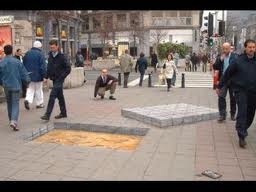
The Pavement Picasso

And another strange guy, but in a good way - is Julian Beever. On Sky Arts 1 there were two programmes about him making his trompe d'oeil pavement art.

               
http://www.google.co.uk/images?q=trompe+d%27oeil&oe=utf-8&rls=org.mozilla:en-GB:official&client=firefox-a&um=1&ie=UTF-8&source=univ&ei=zB7dTP_-BMG3hAfJ0NG-DQ&sa=X&oi=image_result_group&ct=title&resnum=4&ved=0CE8QsAQwAw&biw=1440&bih=625

The first programme showed him creating what looked like an enormous series of earthquake cracks in a pavement in California, with some unfortunate soul apparently trying to climb out of one of the crevaces.  The second showed him using just chalks to create what looked like an Eiffel Tower made of rock and earth, on a pavement in Paris, standing next to what looks like a massive hole from which the building materials had been excavated. Remarkable stuff.

 
http://www.google.co.uk/images?q=julian+beever&oe=utf-8&rls=org.mozilla:en-GB:official&client=firefox-a&um=1&ie=UTF-8&source=univ&ei=y4rcTMDYE86HhQeRj5i1BQ&sa=X&oi=image_result_group&ct=title&resnum=1&ved=0CCwQsAQwAA&biw=1440&bih=625

http://users.skynet.be/J.Beever/pave.htm


.

Wednesday, October 20, 2010

Layer 364 . . . Zen, Enlightenment, Sralick, Rooney, Philosophers, Meditation, Shock Doctrine, Spending Cuts and French Uprising

.
Taking a Break

The prodigal has returned, seemingly fortified by tropical sunshine, wonderful food, large amounts of human intercourse, time to reflect, mental stimulation, spiritual refreshment, soul satisfaction, cheap whisky, good (live) music, the Buddha's blessing, and freedom from everyday chores and worries. We'll see how he gets on with the chopping wood and carrying water from now on.

...........................................

Time to turn our attention to Wayne Rooney. This boy's in deep trouble. Letting go of adolescence is seemingly even harder when you have shitloads of money, a cosseted existence, and happen to kick a ball by way of making a living.

Not that he really needs to make a living, as such, any longer. He's already got more money stashed away than several developing countries have in their central reserves.

It seems his 'advisers' are encouraging him to break away from Sralick - Big Daddy Ferguson, His Ferginess - and decamp to somewhere even more delightful and profitable, like . . . Manchester (City). Or possibly Chelsea. Fair enough, you might think. You can't really imagine Wayne's world transferring itself to more exotic places where they don't parliamo Laddish Northern English, let alone Scouse.

Oxzen is going to do the decent thing and contact Wayne in order to advise him to break away from his current advisers. These are the people - his agents and hangers-on - who have their own personal and financial reasons to get Wayne to further feather his already over-feathered nest, to the detriment of all else.

Oxzen is prepared to take Wayne on a sabbatical to Kyoto, and walk in silent meditation with him down the Walk of the Philosophers. Wayne is possibly a decent kid who just needs a decent break, and a chance to reflect on his fucked-up life. He needs to soak in the atmosphere of the autumn and let it work directly on his spirit. He needs to open his eyes to the reds, yellows and oranges of the Japanese maples, gaze at the koi carp swimming lazily in their pools of fresh, clear water, consider the harmony and beauty of the gardens and the temple architecture, completely cleanse his mind, his soul and his spirit - and meditate on what the fuck's it all about anyway.

Does his ego really need all that money, that adoration, that fame, that pressure, that adrenaline, that 'excitement'? Does he really need his enormous ego?

Has his spirit ever touched base with reality, other than the pseudo-reality of football and lad-culture? Does his actually have a spirit?

Has his soul ever found self-expression, apart from kicking balls and scoring goals? One day it will need to. Maybe that day could be now - particularly since he's currently playing like a turkey.

Yes - Wayne needs a break. He needs to get away - and not just from Man U.

.....................................................

Zen
.                               

I had an interesting conversation recently about the 'mysteries' of Zen, and about the apparent difficulties of reaching Zen enlightenment. Do you need to spend years studying Buddhist texts and participating in temple rituals, or being tutored by spiritual masters, as well as meditating and reflecting on koans, etc?

The answer is - of course not.

Or - maybe. It all depends - on the person, their attitude, their history, their minds sets and their approaches to life and to learning.

In fact we're all born as Zen beings. We immediately do things spontaneously and instinctively; we live in the Now. We don't worry about & preoccupy ourselves with the past, or obsess about the future. We don't have rampant egos and we're not mentally, socially and spiritually fucked up. Our spirits are free, pure and untainted. We spend large amounts of our time-rich days in states of relaxation, reflection and meditation. We wake, we look around, we observe, we listen, we eat, we drink, we smile, we laugh, we find the world is full of awesome and wonderful things, and we sleep. All we need is love. Plus nurturing and protection.

Somewhere along the line we lose it. There's plenty of reasons why. There are failures to love, nurture and protect us. We become brainwashed, and we often need to struggle for survival in so-called realities created by those who are powerful, greedy and selfish. Sometimes our own parents are all of those things. In the past our lives were governed by the whims, violence and greed of feudal kings and warlords. Gradually our societies transformed into governance by royal families, elective dictatorships and political parties run by professional politicians who are too lazy, too stupid and too self-interested to change anything for the benefit of the masses instead of the elites. We become frustrated, and bent out of shape.

How, in the face of all of these things, do we return to states of grace, and cultivate the many virtues? How do we shed so much mental and emotional baggage and find Zen enlightenment?

As I say - it all depends on the person. Reading books on Eastern thought and wisdom might help - but then again it might not. Some might find the Tao Te Ching helpful, whilst others won't. Some will enjoy the many books of Alan Watts and D.T. Suzuki, whereas others might not.

http://en.wikipedia.org/wiki/D._T._Suzuki
http://en.wikipedia.org/wiki/Alan_Watts
http://en.wikipedia.org/wiki/Tao_Te_Ching

Some people undoubtedly benefit from joining a community of people who are seeking greater enlightenment. Others prefer to walk the pathway alone.

Some people have a mind that is intuitive and instinctual, and grasp immediately the essentials of Zen and the Tao. Some people find it easy to meditate, and others don't. Some people find it harder to deal with destructive emotions than others. Some try to intellectualise their way towards enlightenment - which is never going to work.

The only certainty is that there's no avoiding the need to develop spiritual intelligence if we aim to become three-dimensional people and live meaningful and purposeful lives.

    Knowing others is wisdom;
    Knowing the self is enlightenment.
    Mastering others requires force;
    Mastering the self requires strength;
    He who knows he has enough is rich.
    Perseverance is a sign of will power.
    He who stays where he is endures.
    To die but not to perish is to be eternally present.

(Tao Te Ching chap. 33, tr. Feng and English)

............................................................

Today's The Day


Today we find out what Osborne, Cameron and the coalition have in mind for us in the way of austerity and cutbacks. We've had the bonfire of the quangos. Now it's the rest of our public services.

For the Conservatives, this is not a financial crisis but a long-awaited opportunity

In a classic example of 'disaster capitalism', the cuts are being used to reshape the economy in the interests of business – and to trash the public sector

by George Monbiot

http://www.guardian.co.uk/commentisfree/2010/oct/18/conservative-financial-crisis-opportunity

Public bodies whose purpose is to hold corporations to account are being swept away. Public bodies whose purpose is to help boost corporate profits, regardless of the consequences for people and the environment, have sailed through unharmed. What the two lists suggest is that the economic crisis is the disaster the Conservatives have been praying for. The government's programme of cuts looks like a classic example of disaster capitalism: using a crisis to re-shape the economy in the interests of business.

In her book The Shock Doctrine, Naomi Klein shows how disaster capitalism was conceived by the extreme neoliberals at the University of Chicago. These people believed that the public sphere should be eliminated, that business should be free to do as it wants, and almost all tax and social spending should be stopped. They believed that total personal freedom in a completely free market produces a perfect economy and perfect relationships. It was a utopian system as fanatical as any developed by a religious cult. And it was profoundly unpopular. For a long time its only supporters were the heads of multinational corporations and a few wackos in the US government.

In a democracy under normal conditions, those who were harmed by abandoning public provision would outvote those who gained from it. So the Chicago programme couldn't be imposed in these circumstances. As the Chicago School's guru, Milton Friedman, explained, "only a crisis – actual or perceived – produces real change". After a crisis has struck, he added later, "a new administration has some six to nine months in which to achieve major changes; if it does not act decisively during that period, it will not have another such opportunity."

The first such opportunity was provided by General Pinochet's coup in Chile. The coup was plotted by two factions: the generals and a group of economists trained at the University of Chicago and funded by the CIA.

Pinochet used the crisis he had created to imprison, torture or kill anyone who dissented. The Chicago School policies – privatisation, deregulation, massive tax and spending cuts – were catastrophic.

The result was a massive increase in unemployment and the near-eradication of the middle class. But the very rich became much richer, and the corporations, scarcely taxed, deregulated and fattened on privatised assets, became much more powerful.

By 1982, Friedman's prescriptions had caused a spectacular economic crash. Unemployment hit 30%; debt exploded. Pinochet sacked the Chicago economists and started re-nationalising stricken companies, whereupon the economy began to recover. Chile's so-called economic miracle began only after Friedman's doctrines were abandoned. The Chicago School's catastrophic programme pushed almost half the population below the poverty line and left Chile with one of the world's highest rates of inequality.

But all this was spun by the corporate media as a great success. With the help of successive US governments, similar programmes were imposed on dozens of countries in which crises ensured that the population was unable to resist. Other Latin American dictators copied Pinochet's economic policies, with the help of mass disappearances, torture and killings. The poor world's debt crisis was used by the IMF and the World Bank to impose Chicago School programmes on countries that had no option but to accept their help. The US hit Iraq with economic shock and awe – privatisation, a flat tax, massive deregulation – even as the bombs were still falling. After Hurricane Katrina wrecked New Orleans, Friedman described it as "an opportunity to radically reform the educational system". His disciples immediately moved in, sweeping away public schools while the residents were picking up the pieces of their lives, replacing them with private charter schools.

Our crisis is less extreme, so, in the UK, the shock doctrine cannot be so widely applied. But, as David Blanchflower warned yesterday, there's a strong possibility that the cuts programme will precipitate a bigger crisis: "it's a terrible, terrible mistake. The sensible thing to do is to spread [the cuts] over a long time." That's another feature of disaster capitalism: it exacerbates the crises on which it thrives, creating its own opportunities.

So we shouldn't wonder that 35 corporate executives wrote to the Telegraph yesterday, arguing, just as Milton Friedman used to do, for a short, sharp shock, before the window of opportunity closes. The policy might hit their profits for a while, but when we stagger out of our shelters to assess the damage, we'll discover that we have emerged into a different world, run for their benefit, not ours.

See also Oxzen Layers 299, 285, 280, 202, 197, 188, 187, 169, 168, 167, 165, 137, 130, 129, 112, 109, etc.

.....................................................

Vive La France - Liberte, Egalite & Fraternite

Thank goodness there's at least one country in the world where there's a tradition of chopping the heads off arrogant fat cats and would-be rulers who tell the people to eat cake if there's no bread available.

France's future is fighting back

Teenagers' involvement in the strikes may prove to be a tipping point for Sarkozy, and for France

by Philippe Marliere (and see also his other articles in the Guardian for reality checks.)

http://www.guardian.co.uk/commentisfree/2010/oct/19/france-future-fighting-back

Nicolas Sarkozy dreamed of a glorious destiny. His Gallic brand of neoliberal policies would sell the "American dream" to a mistrustful population. Things have not gone according to plan. Sarkozy wanted to be the French JFK; today he looks more like Louis XVI awaiting trial in 1793. He may escape the guillotine, but his presidency is now under siege.

The French are deeply unhappy with the way they have been governed, but their main grievance is about pension reform, which is seen as a cynical ploy to make ordinary people work more for inferior entitlements, while bailed-out bankers and the rich get tax rebates and continue to enjoy the high life. Over the past month, five national demonstrations have gathered together an estimated average of 3.5 million people per action day. The latest, on Saturday, was a big success and another is scheduled for today.

The movement is popular: 69% of the nation back the strikes and demonstrations; 73% want the government to withdraw the reform. And high school pupils have now joined the fray. Over 1,000 high schools are on strike as the youngsters take to the streets to protest against mass unemployment and the raising of the retirement age. The government has patronisingly labelled them as "manipulated kids", but these comments have backfired and served only to galvanise the young, who have hardened their resistance and taken further interest in the reform. When interviewed by the media, pupils come across as articulate and knowledgable. Parents worry about their children's future, so they will not stop them from striking.

In France, strikes and demonstrations are seen as a civilised and effective way to enact one's citizenship. Students are expected to join marches from an early age, receiving by the same token a "political education". France's youth have always scared governments because of their radical potential. Student demonstrations of late have been invariably popular because people know that the young have been badly hit by unemployment over the past 30 years.

University students are preparing to strike as well. Sarkozy, like Louis XVI in 1789, does not seem to have grasped how volatile the situation has become. He should know better. Since May 1968, all governments have been forced on the ropes every time youngsters have entered a social movement. This time it could prove crucial in helping to reach a tipping point; a stage in the conflict where the balance of power switches from the government toward those opposing the pension reform.

Lorry and train drivers are also starting strike actions.

How can the current situation be interpreted? Undoubtedly, the rebellion seems durable and runs deeper than the question of pensions. The reform has triggered a web of collective actions that are now spreading fast. Discontent is fuelled by low incomes and unemployment, but also by the impact of the crisis on people's daily life, the arrogance of the Sarkozy presidency, corruption cases and police brutality.

There is a sense of moral outrage at the imposition of a neoliberal medicine to cure an illness caused by the same neoliberal policies. The French are not hostile to reforms: they just demand those that redistribute wealth and allocate resources to those who need it the most. Any comparison with May '68, however, may be hasty. Then, France was experiencing a period of economic prosperity. Today, events occur in the context of a deep economic depression. This is why the political situation is potentially explosive. Radicalised workers and youngsters are forcing the unions to up their game. The normally toothless Socialist party has pledged to return the retirement age to 60, should it come back to power in 2012.

One can envisage two possible scenarios. Opposition to the reform hardens, in which case Sarkozy may have to water it down or even withdraw it. This would mark the first major popular victory in Europe against the post-2008 neoliberal order. Alternatively, Sarkozy stays put and imposes a deeply unpopular reform, in which case the political price to pay for the incumbent president would be very high, should he decide to run again in 2012.

.................................................................

Spending review: Ya-boo won't work.

Alan Johnson has laid out the basics of an alternative to cuts. It's a solid enough start – but now the real fight begins

by Polly Toynbee

http://www.guardian.co.uk/commentisfree/2010/oct/19/yaboo-wont-work-labour-response-forensic

. . . here begins a lost decade of low growth and high unemployment, bequeathing the next generation public squalor and irreparable social problems.

His plan expects exports to grow twice as fast as imports fall. So far, as these 35 captains of industry know well, despite a 25% devaluation in the pound, exports stubbornly flatline as every country cuts its own consumer demand while dreaming that beggar-my-neighbour exports will help them escape.

If this famous 35 sincerely expect that brilliant outcome, these chief executives from M&S to Carphone Warehouse, from Asda to BT, could prove their faith by pledging between them to arrange the employment of a million people about to be thrown out of work in both public and private sectors next year. That could be their contribution to saving a fortune from the rising Department for Work and Pensions budget. They could also sign a promise to invest in growth, starting tomorrow, all the considerable sums they have hoarded – to the despair of economists. Why are they hoarding so much instead of investing? Because they fear the coming cuts, along with the VAT rise, are about to send consumer demand, jobs and house prices plummeting further in a downward spiral, causing the deficit to rise, not fall.
.