Showing posts with label Madeleine Bunting. Show all posts

Monday, March 26, 2012

Layer 531 . . . The Guardian, Open Weekend and a Festival of Truth and Reasonableness


                                                                               Oxzen Pics

There's a wall inside the Guardian's HQ where various front pages from the paper's illustrious past are prominently and proudly displayed. The one that stands out for me is the one featuring the outcome of the Jonathan Aitken case. The headline says, starkly and simply: 'A Liar and a Cheat'.

Mr Aitken is no longer a liar and a cheat, as far as anyone knows, and his fight with the Guardian ('with the simple sword of truth and the trusty shield of British fair play') was arguably the beginning of his journey towards becoming a decent human being. Had he fraudulently won his case, then there could have been dire repercussions for the Guardian. Had he won his case - then he'd have remained a liar and a cheat for the remainder of his life. However, he lost his case and went to prison for perjury and perverting the course of justice.

Mr Aitken is currently honorary president of Christian Solidarity Worldwide.

..................................................

In post-modern times we understand that 'absolute truth' is difficult to establish, and that individual truth is somewhat relative: it depends to a great extent on one's standpoint and mindset.

What's true to one person is not true to another. For a Christian, God exists. To an atheist, God does not exist - but this doesn't mean Christians are liars. They just see truth differently. Their truth is based on belief, hope, faith, intuition, etc. In other words, "truth" is sometimes  a matter of opinion and belief.

"Comment is free," wrote Guardian editor CP Scott in 1921, "but facts are sacred".

                                                           Oxzen Pics


...........................................

On Radio 4's 'Start The Week' this morning Werner Herzog spoke about "the ecstacy of truth". "Ecstatic truth illuminates something deep inside you."

............................................

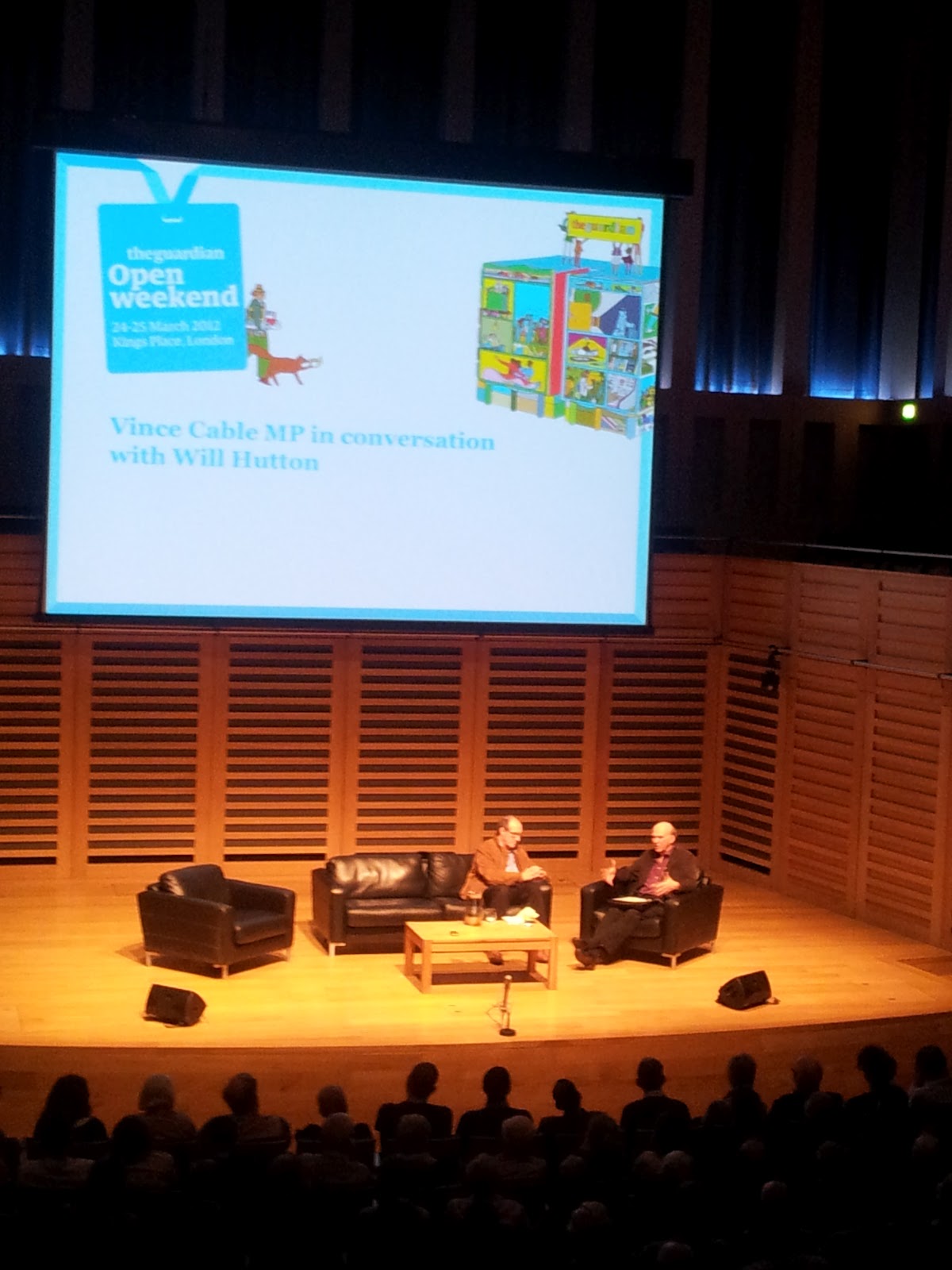
Last weekend the Guardian held its first ever "Open Weekend" at its HQ and the adjoining Kings Place centre.


Will Hutton and Vince Cable                Oxzen Pics

The Guardian's weekend appears to have been a complete sell-out of the hundreds of lectures, seminars, discussions and debates that were on offer - 10 of them per hour throughout both Saturday and Sunday. At £30 per day it wasn't exactly cheap, but compared with an average concert at the O2 or a show in the West End it was, hour for hour, incredible value - and probably far more stimulating and enjoyable than the average concert or show for the kind of people who regularly read the Guardian.

Jayati Ghosh, John Lanchester, Will Hutton, Heather Stewart        Oxzen Pics

The open weekend was organised by a team led by Madeleine Bunting, and they can take enormous credit for the range of things on offer, and also for the festival-like atmosphere, which was no doubt aided by two days of blue skies and sunshine. It was good to see the outdoor areas alongside the canals also being well used for refreshment, relaxation and conversation, as well as for the other attractions on offer, such as various food stalls, narrowboat trips, a cheese barge and a book barge.


Larry Elliott and Jeffrey Sachs                                    Oxzen Pics

Apparently about 5,000 people attended, and watching the crowd walk up York Way from Kings Cross in the morning and back again in the evening, one was reminded of the crowds at other great festivals such as Woodstock and Glastonbury. The Guardianistas' Woodstock, indeed.

http://www.guardian.co.uk/open-weekend

http://www.guardian.co.uk/news/gallery/2012/mar/25/grayson-perry-davidmiliband#/?picture=387850628&index=0

http://www.guardian.co.uk/news/2012/mar/25/guardian-open-weekend-round-up

Guardian Open Weekend: a festival of readers and reasonableness
Imagine if you can Richard Littlejohn's worst nightmare – with cheese, crosswords and Clay Shirky thrown in
by Stephen Moss
"Curiosity and conviviality, the two Cs, were our watchwords," explained Madeleine Bunting, director of the Guardian's Open Weekend.
It was Richard Littlejohn's worst nightmare . . . 5,000 Guardianistas gathered under one roof at Kings Place in London at the weekend for a festival of reasonableness. The weather was perfect, proving that God, whatever the Bible might suggest, is a centrist.
The philosophical starting point for the weekend was, where does the Guardian go from here? How do we carry on in a world where newspapers are dying and social media are becoming ever more central? Here made manifest was the community which might eventually replace the traditional us-and-them relationship.
Should media organisations offer a product, a service, or strive to build a different sort of organisation – a group of like-minded people who thought "God forbid that the Guardian should ever go out of business?" 
It was clear what shape the 300-strong audience thought the Guardian of the future should take. These, after all, were the loyalest of the loyal, people who had given up their lost-hour Sunday to ponder existential media questions and eat a lot of free cheese.
The weekend was principally about those readers, and meeting Cathy Robertson, who had come down from Liverpool with her Guardian-agnostic husband, summed up its purpose.
"It's a fantastic opportunity to get closer to the paper I've read for years," she said. "After this I'll be reading it with new insight. I'll feel closer to it; feel it's even more my paper and that it reflects my values. It's been a wonderful experience."

    Kings Place                                  Oxzen Pics
 .

Gary Younge & Linton Kwesi Johnson                     Oxzen Pics
.
Guardian Open Weekend                    Oxzen Pics

.

Tuesday, June 15, 2010

Layer 325 . . . Empathy, Social and Spiritual Intelligence, Saving the World, Enlightenment, Matt Harvey and Ben Howard

.
Matt Harvey
's a poet who used to be a regular on Radio 4's Saturday Live. The poems he's written for the programme can still be seen on its website:

http://www.bbc.co.uk/radio4/saturdaylive/mattharvey.shtml

It's difficult to choose favourites - all of them are gems.

I saw Matt performing live for the first time on Saturday evening, and he was well worth missing the England game for. For me the best part of the show was his performance of Empath Man - a contemporary superhero he's created who tackles crimes and emergencies by using his "advanced listening skills and his ability to stay open and vulnerable in tight situations . . ."

http://www.youtube.com/watch?v=LkUGS2Hj1i0 - Empath Man
http://www.youtube.com/user/wondermentalist

Website - http://www.mattharvey.co.uk/

http://www.youtube.com/watch?v=9zyu6-_qCvo&feature=related - Torquay Boys

http://www.youtube.com/watch?v=0q90_phxAOk&NR=1 - on Transition Towns

http://www.youtube.com/watch?v=OGIIXG5rWjQ

http://www.youtube.com/watch?v=dZjt5NnDe7A&feature=related  -  Buying Curtains

.............................................................

The point of mentioning the above, before I got carried away by memories of Matt's performance, is the importance of empathy and social intelligence. It's something Oxzen has gone into previously, over a year ago -

http://oxzen.blogspot.com/2009/05/layer-162-social-intelligence-and.html

http://oxzen.blogspot.com/2009/08/layer-183-grace-character-basics-all.html  -  A Force To Be Reckoned With

In yesterday's Guardian Madeleine Bunting wrote another excellent article on Big Issues - Empathy and Enlightenment:

http://www.guardian.co.uk/commentisfree/2010/jun/13/21st-century-enlightenment-revolution-mind

Can empathy save us?

We need to live very differently, argues a bold new text. And that calls for nothing less than a revolution of the mind

Hail the 21st-century Enlightenment. Ideas don't come much bigger

It makes a change to lift eyes from the detail of coalition agreements or the chances in the World Cup and take on board an analysis of the grand sweep of human history, new scientific insights into human nature, and how we can ensure our survival. This is the territory explored in a pamphlet calling for a "21st-century Enlightenment" to be published this week.

http://www.thersa.org/events/our-events/21st-century-enlightenment

[As I write this I'm half-listening to a programme I'm recording from BBC-HD called 'Wild China', part of which  focuses on Tibetan Buddhism and its concern with enlightenment . . . ]

It's an intriguing set of ideas pulled together by Matthew Taylor, in part to sketch out what an institution founded in the 18th-century Enlightenment [the RSA] ought to be doing – the answer being to generate the 21st-century Enlightenment, and this is now the new strapline for the Royal Society of Arts. No small ambition here.

The questions that underlie Taylor's pamphlet are echoed in the soul-searching around Labour's defeat: what do words such as liberal or progressive mean, and what kind of politics do they require?

"Progress in human knowledge and culture" is the slogan emblazoned round the RSA's auditorium. But can we still have faith in an idea of progress when the very inventions and ways of life that were thought would bring it about – market capitalism and individual freedom – are wreaking unprecedented environmental destruction?

We need to live very differently, and that requires thinking very differently. What's required is another revolution of the mind, a paradigm shift in human consciousness.

This is where [Taylor] becomes quietly optimistic. He believes this is possible to achieve – though not easy. The first source of his optimism lies in the research emerging from fields such as neuroscience and evolutionary psychology, showing how deeply social our brains are. The perception of us as sovereign individuals, making independent and rational decisions, is a delusion; we are profoundly influenced by those around us, and prey to emotions which we only partly understand.

Just as the scientific insights of the 17th century led to the Enlightenment's profound shifts in the understanding of the individual, and the idea that the social order could and should be changed, so Taylor hopes science can prompt dramatic shifts in self-awareness, in how we understand human behaviour so that we replace individualism with more socially connected relationships of solidarity.

The second source of his optimism relies on heavy borrowing from the recently published The Empathic Civilisation, in which Jeremy Rifkin argued that history is marked by human beings' increasing empathy for others – which can be briefly summarised as from family to tribe to nation. The question is whether our capacity for empathy can expand to the human species, the globe and the biosphere in time to prevent the destruction of the environmental resources on which we depend. Empathy can save us, believes Taylor; it is vital to negotiations on how we share out natural resources, and vital to ensure harmonious co-existence on a crowded planet. But he acknowledges: "There are reasons to ask whether the process of widening human empathy has stalled, and just at the time we need to accelerate it."

If it has stalled in Britain, and it clearly has, it's in no small measure due to the changes in classroom practice in places like England, where teaching, in many of our schools, has again become a business of teacher-centred cramming for tests instead of a child-centred process which allows pupils to interact and collaborate in their learning so that their social and emotional intelligences are allowed and encouraged to develop.

But what of spiritual intelligence? Bunting goes on to say this:

The third element essential to the 21st-century Enlightenment is a "reassertion of the fundamentally ethical dimension of humanism", argues Taylor. What kind of human beings we want to be, what kind of society we want, are always ethical questions, he insists. Again, he cites scientific research that shows how deeply rooted ethical understanding is in the human brain.

Ethical reasoning and debate need to be resurrected. We need an ethics that challenges the dominant logics of market, bureaucracy, and scientific and technological development. Just because something will sell doesn't mean it should be sold; just because something can be discovered and developed doesn't mean it should be – now so painfully evident in the Gulf of Mexico disaster. It's a powerful, urgent argument.

Does this amount to a credible account of the possibility of future human progress? Although intrigued, I'm sceptical of the claims made for empathy, and anxious that arguments for ethics may fail to gain traction.

"Intrigued"? I find this conclusion very strange, and out of keeping with the whole tone of this piece. You have to wonder whether Madeleine has actually read Daniel Goleman's books on social intelligence and emotional intelligence? If so, what the hell is there to disagree with there? It's not a question of "making claims" for empathy. It exists. Without it we can't begin to develop what Buddhists call lovingkindness.

Has she read anything by the Dalai Lama, or anything on Buddhist Ethics? Is she even aware of the concept of spiritual intelligence? If even our leading journalists and intellectuals are lacking in such fundamental forms of understanding, then what hope is there for us becoming a more enlightened society?

Without emotional, social and spiritual intelligence there can be no enlightenment. Without enlightenment there can be little human progress. Without an education system that enables young people to develop these key intelligences, as well as creativity and imagination, we have no prospect of becoming a more enlightened society.

...................................................

Ben Howard

Ben Howard apparently dropped out of a journalism degree in order to pursue a career as a singer, musician and composer. He shared a gig last weekend with fellow Totnesian Matt Harvey, and played a great acoustic set in Dartmouth in company with a double bass player and a cellist (India Bourne) who also sang backing vocals.

Ben's a young guy who's rapidly maturing as an artist, as can be seen by a number of videos and audios on sites like YouTube. The quality of the vocal harmonies and musical arrangements, as well as the playing, seems to go up in leaps and bounds. None of what's currently on the Internet is as good as what he's currently doing, but it's worth checking out all the same, and it's well worth trying to see him play live.

http://www.youtube.com/watch?v=uPfhqTUkPgU&feature=related - These Waters

http://www.youtube.com/watch?v=pPpgeF1SV4s&feature=related

http://www.youtube.com/watch?v=Ew7jafO9JOs&feature=related

http://www.youtube.com/watch?v=Efilu1CVVAk&feature=related
.

Monday, May 31, 2010

Layer 321 . . . Contempt for New Labour, Finding A Purpose, Radical Education, Schools, Teaching & Learning, The Case for Working With Your Hands, The Buddha, and Peace

.
Madeleine Bunting's latest column is, as ever, well worth reading.

There can be no short-circuiting Labour's essential backroom stocktake

New Labour's contempt for its own party's history now makes the central task of opposition all the more difficult

http://www.guardian.co.uk/commentisfree/2010/may/30/labour-leadership-opposition-values-debate?

This is precisely the point when politics becomes really interesting. Away from the glare of intense media coverage, and the carefully packaged soundbites and polished evasive formulations, glimpses of a real political debate are emerging among Labour and its fellow travellers. At the risk of sounding hyperbolic, it feels it could become the most searching debate on the left for a generation. I can't remember a time in my adult life when discussions on what leftwing politics is really about have been so open-minded. Perhaps it was like this in the 1980s, but then New Labour emerged and vigorously closed down debate and distanced the party from its history; both helped hollow out the party, and contributed to it becoming a highly centralised and relatively effective vote winner. Now, it is not even the latter. So what is it?

This is a subject of passionate interest to a relatively small proportion of the population. People will start listening again when Labour has something interesting to say. In the meantime, it is a time when Labour can't avoid a degree of introspection because it is faced with a series of big questions – and on none of them is there any settled consensus.

All of these debates are difficult for leadership contenders to navigate. How quickly can you disavow the policies that you were passionately defending a few weeks ago? There is a screech of brakes and U-turns. How can you passionately argue for something now and have done so little to advance it when actually in power?

All that the contenders have to offer are their political skills, they are all creatures of New Labour. That makes them likable, good communicators and very clever; but the drawbacks are equally evident. They are all youngish men who have grown up inside the distortions of the adrenaline-fuelled life of government. Rethinking assumptions on which you have built a career is never an easy task, it takes time, mental agility and considerable emotional maturity.

You can see them struggling to find a new language to replace the managerialism and technocratic competence that deadened the nation's soul.

...................................................................

One thing I never want to hear again is that Blair and New Labour had a brilliant electoral strategy to win the 1997 election.

In 1997 the landslide victory wasn't a vote for Blair and Brown and New Labour - we didn't give a damn about Blair and Brown and New Labour - we voted against the policies that had ruined industry and under-funded public services, sold off social housing, neglected schools, politicised education and health, supported casino banking and created so much poverty and inequality. Maybe Labour could now try standing up for the things that so many people voted for back then.

...................................................

Education


There was an excellent piece in yesterday's Observer by Peter Hyman, who's now a deputy head of a comprehensive school, having previously been 'a political strategist to Tony Blair'. Some of us still remember the very week he decided to quit the thick of it and get a proper job - initially as a pupil mentor, prior to becoming a teacher.

http://commentisfree.guardian.co.uk/peter_hyman/profile.html

http://www.guardian.co.uk/books/2005/feb/26/highereducation.politicalbooks1

http://www.guardian.co.uk/politics/2007/jun/24/schools.education

Are the school reforms really going to improve education?

Here, experts discuss whether this shake-up will benefit those who matter most – our children

http://www.guardian.co.uk/commentisfree/2010/may/30/schools-academies

The point about the Tory reforms is not that they amount to a revolution but, rather, that they are a missed opportunity – a modest extension of one part of New Labour policy. What will be frustrating for many schools is to find a new government once more ignoring the vast amounts of evidence that shows that the best school systems in the world are best for one reason above all else – the quality of teaching. The other big factor is school leadership.

So a radical education policy should start with teaching and learning. It is striking that the schools minister who understood this best in the last 10 years was David Miliband. He realised that what went on in the classroom was more important than anything else and his ideas on personalising learning for each student are, several years later, at the heart of many good schools in the country.

To raise standards, there needs to be a renewed focus on literacy. For [many] students . . . the basics [are] not embedded early enough.

But we need to do more. The area ripe for reform is the curriculum. We have got to have a rethink of what students learn and how they learn it. There needs to be a revolution in science, maths and computer-science teaching so we have a cohort of students who can truly compete with any in the world.

There is not enough thinking in schools and it appears that the Tories are in danger of making things worse by insisting on even more cramming of facts in a return to didactic teaching methods. It's time we started to test skills other than the ability to write a two-hour exam: creativity, analysis, team work, communication skills.

All these things would help students  – catch-up sessions at the age of 16 are not enough, however good. What matters is improving the quality of teaching, the richness of experience, the joy of learning and the grounding in the basics from an early age. There is a real opening in British politics for the politician who understands this.

There's not just an 'opening' in British politics - there a desperate need for the children of England (bearing in mind that these things happen differently elsewhere in Britain) to be given back their rights to a proper childhood, and an unpressurised, meaningful education that's worthy of the name. This is more or less what Oxzen's been saying for the past two years.

...........................................................

History of the World

Today's History of the World in 100 Objects considered a statue of the Buddha. Hopefully, with today being a Bank Holiday, lots of people will have been able to listen to it.

The programme considered how artists have tried to represent "the limitless, the boundless".

We were reminded that the Buddha was a wandering ascetic who devoted his life to apprehending the roots of all suffering, and the nature of enlightenment.

Images of the Buddha are meant to help people reflect on the qualities of Buddha's speech and mind, as well as his physical composure, and not be objects of worship in themselves.

The Buddha insisted on renouncing material states for immaterial states. But he also insisted that dreams, mirages and fantasies should be replaced by a proper grasp on reality.

"The Buddha statue is a thing that leads to no-thing, and the greatest sound of all - silence."

Podcast and 'listen again' here:

http://www.bbc.co.uk/podcasts/series/ahow

Seated Buddha of Gandhara

One of the earliest images of the seated Buddha. Neil MacGregor, Director of the British Museum, looks at how Buddhism set about creating the classic image to represent the real life Buddha, who lived and roamed around North India in the 5th Century BC. It was not until over five hundred years later that the classic seated image was first formulated. The Dalai Lama's official translator, Thupten Jinpa, and the historian Claudine Bautze-Picron help explain how the image came about.

................................................................

Peace In Our Time?

http://www.guardian.co.uk/world/blog/2010/may/31/israel-troops-gaza-ships

More bad news from Gaza.

At least 10 peace activists have been killed in boats carrying humanitarian aid towards the coast of Gaza.

Peace. Activists. Killed.

I can't be the only one who thinks that killing humanitarian peace activists is hardly . . . necessary? Appropriate? Proportionate? Moral? Politically astute? Even if they happened to be the most naive and misguided people on the planet.

By all means let the armed forces of Israel set about restraining them, arresting them, thwarting them, imprisoning them. But KILLING them?

I picture myself feeling motivated enough and brave enough to join with a convoy of ships taking aid to children, sick people and destitute families in Gaza.

I picture myself being killed for my non-violent and non-threatening actions and beliefs.

I wonder whether any of these activists were in fact physically agressive and determined to resist arrest. And I still wonder whether actually killing them could ever be justified.

My support is for non-violent Palestinians. My support is for non-violent liberal Israelis who despise the violence and the over-kill of their government, which only delays and makes more difficult a proper peace process, and a 2-state solution.

To support violence and aggression on either side, and even to condone and excuse it, would be no different to supporting any of the violent factions in Northern Ireland back in the days before the peace process started.

It would be no different to supporting the killing of either whites or blacks in South Africa prior to De Clerk's decision to release Nelson Mandela. What a pity there's no obvious Mandela figure in the Middle East.

.......................................................


Start The Week - Attitudes to Work

Matthew Crawford - "The Case for Working With Your Hands".

On Start the Week this Bank Holiday Monday, Andrew Marr gets his hands dirty with the philosopher and mechanic Matthew Crawford, who argues that satisfaction comes from skilled manual labour. Iranian artist Shirin Neshat discusses her new film, Women Without Men, Sheila Rowbotham muses on the role of women in transforming ideas about work at the turn of the 20th century and the President of the Royal Society, Martin Rees, explores scientific horizons and discovers the limits of our understanding.

http://www.bbc.co.uk/programmes/b00sj4vn

Aristotle begins his Metaphysics with the observation that “all human beings by nature desire to know.” But the philosopher and mechanic Matthew Crawford contends that real knowledge arises through confrontation with real things. In his book, The Case for Working with Your Hands, he argues that a skilled trade brings a satisfaction that can be missing from office work. He believes that we uncover a sense of agency by shaping the world around us, and explains why he found working as a mechanic more intellectually challenging than a job in a think tank.

The Case for Working with Your Hands or Why Office Work is Bad for Us and Fixing Things Feels Good is published by Viking.

http://www.penguin.co.uk/nf/Book/BookDisplay/0,,9780670918744,00.html

Our society has pursued the separation of thinking from doing. We see ourselves as divided between white collars and blue collars.

Mass production and the pursuit of profit is based on dumbing jobs down, and creating electronic sweatshops.

University graduates expect to go into white collar 'office' jobs.

Whereas being an electrician and a mechanic can be far  more challenging intellectually. And also, in many casses, better paid.

Jobs that don't have 'physical' components are easily outsourced abroad

The core of the argument - the ethical dimension - is that it's superior to do work that involves head, heart AND hands . . .

To become genuinely skillful requires humility, coping with failure, and relying on judgement that comes only with experience. (See previous Layer on Samurai skills and football.)

'Know-how' can't be downloaded from the Internet - it only comes with experience.

We all need and benefit from the experience of seeing the direct effect of our own actions.

Complex material culture is infantilising - we're unable to do our own maintenance on vehicles, eg.

Our culture is more and more one of passivity and dependence . . .

We should put more stress on learning through experience and human contact.

Tacit knowledge is gained from doing physical things, not sitting at screens.

So many things are now too complicated. Eg mobile phones. So we have feelings of dependence instead of self-reliance.

Whilst doing physical work, using our hands, we become absorbed into a state of 'flow' in which we're gripped by the physical elements, and given time for relaxation, reflection and meditation. From the physical flows the metaphysical and the spiritual.

'Scientific' management doesn't grasp the creativity of workers or the intrinsic value of what they do and how they do it.
.

Tuesday, May 4, 2010

Layer 295 . . . Bunting, Bankers and the Financial Doomsday Machine

.
The Casino

I've been working on a metaphor, and a way of explaining the way in which our economy has gone from being a workshop to being a casino, and it goes like this.

Imagine a merchant bank is holding a large stash of cash which it can either invest in building a factory that will make useful things and yield modest profits over many years, OR it can use that stash to build a casino, in which other merchant bankers from around the world can come and place bets. The City of London, which is the name of this particular merchant bank, made a choice to build and operate the casino, and also spent all its profits on placing bets there itself, having decided that low-risk low-returns manufacturing was just too boring and too unprofitable to bother with. They wanted big bucks and they wanted them instantly.

Some of the players who came to the casino did well, and others did badly. Goldman Sachs and Barclays did well; Lehman Brothers, RBS and HBoS did very badly indeed.

The owner of the casino was always a winner, and always made big profits, as long as it could pay for the upkeep of the casino. But instead of saving some money in reserves 'just in case', it decided to borrow money at low rates of interest whenever it needed to pay utility bills etc - in order that it could keep on placing big bets and winning big. But there came a day when it needed to pay some large bills and suddenly found that no-one was lending money any more on account of the collapse of a massive worldwide pyramid-selling (Ponzi) scheme, which had gone completely belly up. Nobody trusted anybody else not to go broke, so no-one was willing to lend money.

The big banks that gambled in the casino ran out of money for the same reasons.

The casino owners had three choices - either declare themselves bankrupt, put the casino up for sale, or go cap in hand to the government to borrow the huge amounts of money they now needed to stay solvent.

The government was a very stupid government and was also very afraid of the casino owners and their mafia friends, who had been been keeping the government sweet with some tidy sums in taxes and lots of friendly back-slapping.

The government could, and should, have used that moment to buy the casino for a very small sum of money, in the name of its citizens, but instead it smiled at the bankers and told them that of course they could have as much money as they wanted or needed, at very low rates of interest, even though the government then had to go and borrow the money elsewhere at high rates of interest, which looked likely to become even higher as time passed. And from then on it was business as usual. The only losers were the people the government was supposed to be serving - us - who were then responsible for paying off the trillions that the government had loaned on behalf of the casino owners and players.

...........................................................

I know for sure that Madeleine Bunting is an admirer of Naomi Klein and has read all her work on Disaster Capitalism because I saw Madeleine introduce Naomi on the stage of the QE Hall on the South Bank at the time of the publication of The Shock Doctrine - one of the all-time key books on economics, finance and capitalism. If anyone still hasn't read it, then they're not really bothered about what's been fucking up the planet, and who's really responsible for it, these past 30 years. Bear in mind that The Shock Doctrine appeared in print just before the shit actually hit the fan a couple of years ago.

Madeleine's columns in the Guardian continue to put the spotlight on the really important issues we need to deal with as a matter of urgency.

http://www.guardian.co.uk/commentisfree/2010/may/02/banking-reform-election-agenda

Finance is responsible for this savage new era. But it's off the electoral agenda

The economic future will be painful, yet the public and their leaders show no appetite for wrestling the financial leviathan responsible

We had one small question on bankers' bonuses in Thursday's economic debate and some halfhearted discussion of banking reform before moving on to a subject that arouses far more passion – immigration. Bankers' bonuses are the very least of it – the relatively insignificant tip of an iceberg – a radical restructuring is urgently necessary, argues Better Banking, the New Economics Foundation's manifesto published last week in a bid to try to get this issue on to the agenda. But the conclusion is clear; there is no great anger or appetite in the British public or their leaders for a wrestling with the leviathan financial system which is sucking the lifeblood from our political economy. That time may come but right now, all that everyone wants is for everything to go back to the way it was in 2007: booming property prices, rising debt levels. Faced with an irritating problem of dry rot, the homeowner is resolving just to patch up the visible bits and pretend the rafters are not crumbling and the ceiling is not going to fall in.

If you think that is a bit of hyperbole, read the Financial Times's Martin Wolf on the "financial doomsday machine", or the head of the Financial Services Authority Adair Turner's thoughtful speech in March, when he concluded: "We need to challenge radically some of the assumptions of the last 30 years", which have been "deep-rooted drivers of financial instability". Wolf is no leftie, but he declared recently that "a large part of the activity of the financial sector seems to be a machine to transfer income and wealth from outsiders to insiders while increasing the fragility of the economy as a whole". Just in case you were wondering who the outsiders are, it's you and me – our pensions, our savings, our mortgages, feeding this bloodsucker.

You might have thought that the treatment meted out to Greece, Portugal and Spain in the bond markets would have prompted more questions about how the financial system works. All the more so since this is the nightmare scenario that George Osborne has been dangling in front of the electorate. Who are these credit ratings agencies who are plunging the continent into crisis?

But no, the irony is that while we are immersed in an electoral process which is all about bringing those in power to account, the unaccountable financial system that is responsible for the painful years which lie ahead – of unprecedented cuts and the political conflict that will result – goes largely unchallenged. Politicians are left ignominiously to beg or reproach these credit ratings agencies – as both Portugal and Brussels did last week. (Agencies now described by economist Paul Krugman as "deeply corrupt", still wielding huge power despite a track record on Enron and sub-prime which has revealed an appalling lack of judgment.)

You might have thought that the spellbinding moment of Goldman Sachs executives fumbling through their files to find answers in the US Senate hearings might have prompted more outrage at the duplicity and self-serving corruption entrenched in the financial system. As Turner admitted a year ago, "British citizens will be burdened for many years with either higher taxes or cuts in public services – because of an economic crisis ... cooked up in trading rooms where ... many people earned annual bonuses equal to a lifetime's earnings of some of those now suffering the consequences."

The gross injustice of it is one reason for anger, but there is another, even more important. David Harvey, author of The Enigma of Capital, was in the UK last week on a timely promotional tour; his central thesis is that capitalism is inherently crisis-ridden, and that its crises mutate rapidly. Eighteen months ago we had a debt crisis of the financial sector, now we have a public sector debt crisis spreading across Europe. That has prompted a political crisis across the eurozone, and particularly in Germany and Greece; voters in the former are incandescent about lending their money, while in the latter it is rapidly becoming a crisis of the state itself as the unions declare a general strike for this Wednesday, and protesters had to be dispersed with teargas over the weekend. Average Greek incomes have dropped 20% with low- and middle-income earners worst affected.

The political fallout of crisis-ridden capitalism in the 1930s was precisely what politicians and policymakers wanted to prevent as they constructed the postwar Bretton Woods financial system: slow and steady were its primary requirements, and between 1945 and the mid-70s it led to better average levels of growth than the boom and bust cycles of the more volatile decades which followed. The great poison of lightly regulated capitalism is as much about volatility as it is about inequality; it is so destructive of the social fabric, ratcheting up unemployment, destroying neighbourhoods, provoking tensions which feed into political extremism and violence.

But for the last 30 years such insights were marginalised by efficient market theory which argued that left to themselves, markets were self-equilibrating and stable. This was pure fantasy, yet it seduced politicians and electorates, who got the illusion of economic growth they needed, while the fantasy generated millions which poured into the pockets of an elite.

Curiously, the one group who really understood the fantasy were those who were peddling it. The US Senate investigation into credit ratings agencies has just released a mountain of documents which reveal a mind-boggling insouciance. One internal email at Standard & Poor's in December 2006 read: "Ratings agencies continue to create an even bigger monster – the CDO [collateralised debt obligation] market. Let's hope we are all wealthy and retired by the time this house of cards falters." And indeed many of them are; profitability at the agencies soared in the early years of this decade.

This election is a kind of lull before the storm. While excited discussions consider the potential for electoral reform, the real story of the next few years will be the savage dismantling of social democracy and a new era of industrial strife organised via Twitter. Then there will be plenty of public anger, but the bankers and financial analysts will have got what they wanted – wealthy retirements and fortunes salted away in the country homes from which they survey the wreckage.
.

Saturday, March 20, 2010

Layer 268 . . . Berlusconi, Bannatyne, Bunting . . . and Catholicism

.
The Berlusconi Show
I'm becoming irritated with Sam Wollaston, who's one of the Guardian's TV critics and commentators. I'm getting sick of wanky journos who seem to care mainly about getting easy chuckles and taking cheap shots. I don't mind the odd chuckle or cheap shot, but I also expect more than glib summaries of some pretty important work on TV.

This week we've had a wealth of brilliant documetaries to savour and enjoy on our TV networks - the ones on Detroit, Gaza, and the encounter between Maya Angelou and Dave Chappelle, which Oxzen has already commented on - to name but three.The documentary film is an increasingly important art form.

These three documentaries were anything but straightforward reportage on their subject matter: a great deal of creative thought and energy had gone into their editing, sound, images, and so on. Work of this quality deserves to be taken seriously.

And then we had a documentary called The Berlusconi Show, made by Mark Franchetti, and shown on BBC2 in prime time on Wednesday.

So what does young Wollaston have to say about it?

This fine study of Italy's leader leaves me amazed, says Sam Wollaston. How did he ever get elected?

Mark Franchetti, who's lived away from his native country for 20 years, goes back to find out how the hell this clown came to lead a European democracy in the 21st century. Franchetti  speaks to lots of people on both sides, and looks at the historical context of Berlusconi's rise to power; this is proper, balanced reporting.

For the viewer, though, what stands out is the stuff that makes you wince. It's not as if we didn't know it all before: the media control, the alleged mafia connections and corruption, the links to the extreme right, the trials, the legislative changes, the escorts and young girls, the cosmetic surgery, the parties, the gaffes, the dissing of Angela Merkel, the referring to Barack Obama as "tanned". It's just that, when it's all presented together, you're left with your jaw on the floor. How the frigging frig did that happen? And again. And again. He's been elected three times.

This was extraordinary, fascinating and worrying, all at the same time.

So Sam - which bit of it didn't you understand - when you ask the question: "How did he get elected?"

Francitti in fact did a superb job in examining the Italian psyche and revealing how Berlusconi, ever the populist, very cleverly "triangulates" in ways that Blair and New Labour could only dream of. Slippery Silvio is smart enough to make sure that he speaks TO the working classes, and not ABOUT them or AT them. And he also makes sure that he offers them enough treats to keep them happy, unlike New Labour. He also delivers on his promises and bribes. Unlike New Labour. The programme made all of this perfectly, beautifully, clear.

Of course he also behaves like a tycoon, a megalomaniac, a monopolist, and a smug, self-satisfied would-be tyrant, which appeals to the Italian middle and upper classes, who like their leaders to be "strong", powerful", "decisive", "colourful", "maccho", "bold", wealthy, nationalistic, xenophobic, anti-socialist, anti-communist, anti-trade unionist, Machiavellian and to also have a passing resemblance to Garibaldi.

And not dissimilar to that other Italian guy - what was his name? - oh yes, Mussolini.

"His Excellency Benito Mussolini, Head of Government, Duce of Fascism, and Founder of the Empire", to give him his full title.

http://www.guardian.co.uk/tv-and-radio/2010/mar/18/the-berlusconi-show-the-man-who-ate-everything

http://en.wikipedia.org/wiki/Italian_fascism

..........................................

Duncan Bannatyne

Here comes another tycoon with aspirations to be a political big wheel. He was on Desert Island Discs this week. And he's yet another guest of DID who knows nothing (and cares nothing) about music. Or, as he put it himself - "Ah wasnae intae music all tha' much."

How very true. Not at all into it, in fact.

Rod Stewart   — Maggie May
Tom Jones   — Green, Green Grass of Home
Dawn  — Tie a Yellow Ribbon 'Round the Ole Oak Tree
Michael Ball   — Love Changes Everything
Beverley Knight   — Shoulda Woulda Coulda
Chesney Hawkes   — The One and Only

Sample lyric -

I can't wear this uniform without some compromises
Because you'll find out that we come
In different shapes and sizes
No one can be myself like I can
For this job I'm the best man
And while this may be true
You are the one and only you

Yuk.

But at least he didn't feel the need to throw in anything classical. Strange though how so many of our 'celebrities' either don't have time for music or are just very fond of wall to wall schmaltz. Or both. Sentimental. Florid. Maudlin.

http://en.wikipedia.org/wiki/Duncan_Bannatyne

http://www.bbc.co.uk/programmes/b00r8h99#segments

.......................................

Chopin was quoted on R4 today as having said, "The aristocracy in Britain are brought up to treat music as background noise."

Hmm. They're not the only ones.

Chopin also wrote, "Scottish people are kind - but such bores. God help me."

It seems Mr Bannatyne is a well-known supporter of charities. Which is nice.

....................................

He was on BBC1 on Friday - dancing for Sport Aid. Incredibly badly. Unsurprisingly for a man who has no taste in music, he shows an abysmal sense of rhythm. I.e. none whatsoever. As one of the judges said - appalling. Cringe-makingly bad.

Still - it's for cheridy. And Mr B would rather be bigging up his "profile" on TV - even if people are basically laughing and cringing at him - than not be on TV at all.

................................................

Madeleine Bunting is right on the ball again with a piece in the Guardian today about Catholicism and child abuse -

An inquiry is vital, but the church's moral authority is lost for ever

There is only one conceivable reaction to the fast-spreading crisis in the Catholic church: horror. Only the most virulent anti-papist could ever have quite envisaged the scale of child abuse and the doggedness of the church's desire to stifle scandal. The rest of us are astonished and appalled. Quite rightly, Angela Merkel saw fit to intervene. After decades – perhaps we should rather be referring to centuries – of obfuscation, the Catholic church has to be called to account for what has happened.

Last summer the Ryan report exposed decades of systematic abuse of thousands of children in Ireland.

Abuse allegations emerge across Europe in Germany, the Netherlands, Switzerland and Italy.

The current issue of the Catholic weekly, the Tablet, carries a thoughtful article by the head of Berlin's Institute of Sexology and Sexual Medicine which acknowledges that the church's celibacy requirement may have appealed – misleadingly appearing to offer a solution – to paedophiles' conflicted sexuality. While the debate about disproportion continues, what is increasingly clear is that the church's determination to preserve its institutional power and authority repeatedly involved suppressing the truth – even when that put children at further risk.

The crisis simply accelerates what is already happening: the drift away from a model of religious experience which younger generations find increasingly unintelligible. Despite all the talk in Ireland and elsewhere of inquiries to ascertain the truth and "rebuild confidence in the church", such initiatives are very unlikely to achieve that outcome. Inquiries prompt more lurid headlines as they expose further the scale and detail of the abuse. They are necessary and important, but they will not save the Catholic church.

There will be plenty celebrating the Catholic church's plight, and it is hard not to agree in some part with MacCulloch, that hubris has played a huge part in this institution's history and its current crisis. But it is also important to acknowledge that this is more tragedy than anything else. For the victims, their families, their congregations – many of whom see no cause for celebration despite their need for truth – and for those causes on which the church has proved a trenchant champion, stirring lazy consciences on the arms race, global inequality and capitalist excess.

http://www.guardian.co.uk/commentisfree/belief/2010/mar/19/catholic-church-child-abuse

http://www.guardian.co.uk/world/blog/2010/mar/18/catholic-church-abuse-pope

http://www.guardian.co.uk/world/2010/mar/17/catholic-church-abuse-germany-ireland

http://www.guardian.co.uk/world/2010/mar/17/catholic-sex-abuse-benedict-vatican

.........................................

I'm going to bed slightly depressed tonight, having read so many bullshit comments on CIF following Lynsey Hanley's latest column in the Guardian, which was basically a good news story about Newham Council allocating over £1m so that every child in ther borough can have music lessons on an instrument of their choice.

The really depressing thing is that our education system turns out so many people who've been to probably quite decent schools, and even universities, and still end up witless, mean-spirited and up their own arses. What's more these morons have nothing better to do than hang around the Guardian's website ready to spew out their ignorant and reactionary bile, totally incapable of any constructive or even any interesting thoughts.

http://www.guardian.co.uk/commentisfree/2010/mar/19/music-lessons-schools-cultural-learning?

http://www.musicmanifesto.co.uk/news/details/Newham-Council-pledges-to-make-Every-Child-A-Musician/24721

http://www.musicmanifesto.co.uk/

Watch this video:

http://www.youtube.com/watch?v=43tqQhOTCgQ

.............................................

This is great. I just wish we'd been able to keep the one that carried us nearly all the way across Africa.

http://uk.cars.yahoo.com/16032010/36/celebrating-icon-six-decades-vw-camper-0.html
.

Saturday, March 13, 2010

Layer 262 . . . Journos, Truth, and Cuts in Public Spending

.
In a way, yesterday's blog was a celebration of British journalism. Here are 3 people, Simon Jenkins, Mehdi Hasan and Michael Tomasky, writing about matters of huge importance with enormous skill and passion, and with clarity and objectivity. The truth matters, and it's difficult to disseminate the truth in a world where the media is owned, for the most part, by powerful rich people who have zero interest in examining objective reality with a dispassionate and unbiased eye.

These three writers have a bias, but it's a bias towards truth, justice and ethics, which can hardly be seen as a true bias. They have passion, but it's a passion for truth, justice and ethics.

Yesterday's blog was also a celebration of sorts of the Guardian. Simon Jenkins is a jewel in the Guardian's crown at the moment. Back in the early '90's (1990 - 92 to be precise) PJ was the editor of The Times, based in Wapping. So clearly he knows something about the views of The Establishment, and indeed those of Rupert Murdoch and the other press barons.

He's clearly not your average leftie or armchair radical. PJ's point of view ought to command attention and respect.

Michael Tomasky, writing as a 'liberal' American based in America, can offer a 'liberal' insight into the tragedy of American politics and the impossibility of a liberal president running the country by passing liberal legislation that's in line with the prospectus he was elected on.

Mehdi Hasan is not a regular Guardian contributor - he's the senior political editor at the New Statesman. What the Guardian is able to do is offer him a much deserved worldwide readership, since the editorial team at the Guardian obviously recognise he's saying something of enormous importance in this column. If radical and progressive ideas and ideologies don't prevail now they never will, with huge consequences for social justice, economics, progressive government, greater equality, etc.

..............................................................

Earlier this week Madeleine Bunting wrote an equally essential column in the Guardian:

http://www.guardian.co.uk/commentisfree/2010/mar/07/spending-cuts-labour-election-tories
Cuts rhetoric won't boost Labour hopes

This is territory long colonised by Thatcherite Tories, and would really draw blood among women and the low-paid

A collective delusion seems to have taken grip. Turn a radio on and the politicians are indistinguishable. All the talk is cuts, cuts, cuts. Listen to people talking and it's already an assumption – "when the cuts hit" is a given, no longer up for discussion. It's all done and dusted, then: the biggest spending cuts this country has ever experienced – which will put even those of the early 80s in the shade – have all been agreed. Have I been snoozing or did I miss it? This great political debate has happened by stealth, its conclusions passported into the stock of accepted wisdom with astonishing acquiescence.

It beggars belief that we can be so gullible.

We are drifting into an election dominated by a daft competition in macho rhetoric – slashing, savage, deep, swingeing etc. This is territory long colonised by the Thatcherite Tories, hardly a programme to stir Labour's dwindling activists into election canvassing.

The swiftly assembled political consensus on cuts is based on a series of assertions that can all be challenged – and is being, vigorously, by economists – which makes the politicians' meek acceptance all the more bewildering. A group of economic historians argue that the public debt is not historically high, or even particularly high compared with other developed nations.

Cambridge political historian David Runciman admits to being baffled by the enthusiasm for public spending cuts; he called his radio programme on the subject Turkeys Voting for Christmas.

Bizarrely, rather than discuss how to create jobs, all the parties are thinking of how to create more unemployment.

There was a fascinating analysis in a Compass report last autumn, In Place of Cuts, on how much money the government saves by axing a £25,000 public sector employee. After you've calculated for all the lost income tax and national insurance contributions, and then factored in all the benefits this sacked employee would receive on jobseeker's allowance, guess the grand total saved? Less than £2,000. And that is before one tries to put a figure on the wider social costs of unemployment – depression, rise in illness, risk of long-term withdrawal from the labour market. It's a no-brainer.

Beware public sector job cuts – reports of local authority cuts of a minimum of 10% last week would mean the loss of 500,000 jobs – are likely to have a disproportionate impact on women . . . Of the 1.1m new jobs taken up by women between 1997 and 2007, 80% were in the public sector.

Among these statistics are teaching assistants, community support workers, nurses, teachers, youth workers – all doing useful jobs and paying taxes. Why deprive us of their needed labour and push them into the demoralising idleness of jobseeking for non-existent jobs?

The recession is hitting certain groups hard; the Resolution Foundation report shows that low earners are bearing a disproportionate cost of this recession; they make up a third of the electorate, 9.4 million people with average household earnings of £15,800, and many are seeing a loss of income and a cut in working hours. With no capacity to save – they spend 41% of their income on essentials – they have little to fall back on in hard times.

Cuts in public sector employment could tip many of these vulnerable families over the edge, out of jobs and on to benefits: these are exactly the "hard-working families" championed in innumerable Labour speeches, yet this is where the "slashing" and the "savagery" of spending cuts would really draw blood. This election should be fought on how to save their jobs and create new ones for their children, instead of being hijacked by an old Thatcherite small-state agenda.
.

Wednesday, March 3, 2010

Layer 258 . . . More on Spiritual Intelligence and Citizen Ethics . . . and the BBC

.
After considering the state of Britain (and the State of Britain) (as characterised by our attitude to football) I've come to the conclusion that we've no chance becoming an enlightened society unless we have a critical mass of people who, through developing their spiritual intelligence (and maybe even Zen), then start to behave in ways which might be called enlightened.

The Buddha recognised that enlightenment requires meditation and putting oneself in the service of others. There's no sign of our society signing up for these things any time soon. All we have is a few glimmerings of people here and there recognising that there IS such a thing as spiritual intelligence - and that it's something that ought to be developed in all of us. As things currently stand, very few people even understand that spiritual intelligence has nothing to do with religion or a belief in a God or gods.

[See Oxzen Layers 13 - 21.
http://oxzen.blogspot.com/2008/04/layer-12-spiritual-intelligence.html]

Words and concepts associated with spiritual intelligence:

LOVE - caring   compassion   friendship  forgiveness  generosity  helpfulness  joy  kindness tolerance   sharing  sympathy   patience

PEACE -  calmness  contentment  dignity  discipline  happiness  honesty  humility  understanding  patience   reflection  self-confidence  self-control  self-discipline  self-respect
optimism

RIGHT CONDUCT -  Contentment  Courage  Dependability  Duty  Ethics  Gratitude  Good behaviour  Healthy living  Helpfulness  Leadership  Initiative  Unity  Respect  Responsibility
Sacrifice  Self-confidence  Self-sufficiency  Simplicity  Perseverance

NON-VIOLENCE -  appreciation of others  brotherhood / sisterhood  citizenship  compassion
concern for all life  consideration  cooperation  unwillingness to hurt  equality  forgiveness
global awareness  good manners  loyalty  social justice  service to others respect for people and property  unity  universal love  collaboration

.............................................................

Big Moral Questions

Readers may recall that 10 days ago the Guardian and the Observer started a campaign about what they call Citizen Ethics:

http://oxzen.blogspot.com/2010/02/layer-250-citizen-ethics.html

Last week Madeleine Bunting wrote a superb column in the Guardian that really ought to be read in full -

http://www.guardian.co.uk/commentisfree/2010/feb/21/ethics-failure-market-moral-code

To tackle the last decades' myths, we must dust off the big moral questions

A robust debate on ethics is crucial to the pursuit of a good society in which individuals are more than mere economic units

To many of [our] kids, equipping them for the labour market [is] the primary purpose of ­education. Any idea of it as enriching and deepening their understanding of what it is to be human and lead meaningful, contented adult lives, had been entirely lost to view.

The gap that intrigues me [is] the absence of any notion of being a good person, or of the many values that might not be able to command a market price such as being challenging, courageous, truthful, honest, spontaneous, joyful or even kind, compassionate.

The central premise of the Citizen Ethics supplement published in this paper at the weekend (the full pamphlet can be downloaded on Comment is free) is that we have lost a way of thinking and talking about some very important things. The preoccupation with market ­efficiency and economic growth has loomed so large that other activities, and other ­values, have been subordinated to its disciplines.

"You can't buck the market," said Margaret Thatcher, and no government has disagreed since. It was the adage that was used to justify soaring pay for the highest earners and stagnant earnings for the low-paid. The ­market ruled, and questions of injustice, honour or integrity were all secondary or irrelevant.

A poll for the World Economic Forum last month found in 10 G20 countries that two-thirds of respondents attributed the credit crunch and its ensuing economic recession to a crisis of ethics and values. Sir Thomas Legg declared in his final report on MPs' expenses that there had been a failure of ethics.

There's a widespread perception that social norms have subtly and gradually shifted towards the centrality of ­personal self-interest. As long as it's legal, it's legitimate; no further ­individual judgment is necessary. ­However much we may have laughed at the Gordon Gekko's "greed is good" line, we can now see how it seeped into ­powerful institutional cultures such as the City and parliament.

Citizen Ethics was a project to ask nearly four dozen prominent thinkers what this was all about. Did ethics really have a role to play, and had it failed? First, despite plenty of disagreements, on one thing there was a clear consensus: ethics are crucial. They are the underpinning to all political debate; they frame the questions we ask of ourselves and of our political economy and therefore do much to shape the answers we end up with.

They are vital to the civic culture in which both politics and economics are ultimately rooted. So, as Will Hutton will do in his book, Them and Us, out in the autumn, if we really want to understand how some of the incredible myths perpetrated over the last couple of decades have gone unchallenged, we have to go back to some basic arguments of philosophy. What is justice? Who deserves what? What constitutes human flourishing?

Too many of these questions have simply been shelved for too long. Questions of justice and reward were left to the market to resolve; questions of human flourishing were privatised. It was left to everyone to decide their own sequence of pleasurable experiences in life with little acknowledgement of how many of those depend entirely on mutual co-operation.

One explanation for this abandonment of the debate is that we lost a language in which to think and argue about ethics. Perhaps this is partly attributable to the vexed legacy of institutional religion and the long shadow it still casts. The promotion of ethical behaviour has been bound up with particular institutions, and as they decline, it leaves a vacuum of authority.

Who dares talk on this subject with confidence? It prompts fear that any such discussions are really a Trojan horse for promoting a religious belief. There's a suspicion that words such as "morality" tip us quickly into the kind of instinctive conviction made infamous by Tony Blair in which sincerity is regarded as an adequate substitute for careful reasoning.

Even the language itself is mired in a history of ­social control; morality and virtue are words that are reluctantly used, since both still convey overtones of intrusive monitoring of (particularly female) sexual behaviour.

Perhaps it is finally possible to move beyond these familiar anxieties and resume a task of ethical reasoning regarded through most of history as essential to being human. This is philosophy as the Greeks understood it – love of the wisdom to lead lives of meaning and fulfilment, not some kind of abstract game with words.

Ethics is a word that derives from two Greek words, ethos for habit and ethikos for character, and it better fits what Citizen Ethics proposes rather than "morality", which comes from the Latin word "mores" for social institutions and customs.

This is not about reasserting conventions, a preconceived code, but about reinvigorating a habit, a pro­cess of reasoning to the perennial question: what is the right thing to do? We wouldn't claim there is a consensus waiting to be found – on the contrary, our aim is to provoke a noisy debate on what kinds of habits and characters we need to run the good society.

To go back to the lovely kids in the classroom, what is the good society we want to inspire them with – beyond their future roles in the economy as workers and consumers? What habits and character can we offer them as ­conducive to deeply rewarding lives? If we don't know plenty of possible answers to that question, it's no ­surprise they don't.

• Read the Citizens Ethics pamphlet in full here

.........................................................

The Battle of the BBC


Jonathan Freedland has a good column in the paper today concerning the huge row that's continuing about the BBC and its activities, and about the Murdochs' efforts to control it from afar, with the aid of the Tories, of course.

http://www.guardian.co.uk/commentisfree/2010/mar/02/rupert-murdoch-tory-media-policy

The BBC is caving in to a Tory media policy dictated by Rupert Murdoch

Mark Thompson is jumping from the second storey because he fears a new government may throw him from the roof

The BBC has decided its best strategy for self-preservation is to suffer a little pain now to avoid a lot of pain later.

The strategy review unveiled today offered up a couple of radio networks and half its web pages by way of a sacrifice.

6 Music exists partly because if it wasn't there, the market would never invent it: a specialist channel offering not the hamster's wheel of a repetitive playlist but curated, eclectic music. "Like friends playing each other bits from their record collections," Jarvis Cocker said yesterday.

So why has Mark Thompson done it? Because he feared that if he didn't jump from the second storey window, an incoming Conservative government would push him off the roof. He is right to be anxious. The Tories have indeed signalled a hostility to the BBC that is rare, if not unprecedented, in an opposition. Why might that be? Two words: Rupert Murdoch.

Start with the BBC. Murdoch, with son James, can't stand it – regarding it, a senior figure in broadcasting tells me, as "like the Ebola virus: they can't destroy it, so they try to contain it". They dress up their opposition in pseudo-intellectual free market blather, but the reality is much earthier than that: the BBC is a rival, and therefore an obstacle to their commercial ambitions. The smaller and weaker the BBC becomes, the more money News Corp can make.

So the Murdochs constantly demand a cut in the licence fee. Last year Cameron nodded dutifully, and called for an immediate freeze in the licence fee. That would have marked an unprecedented break in the multi-year financial settlement that is so integral to the BBC's independence – preventing it from constantly having to make nice to the politicians to keep the money coming in.

Any doubters should play a game of spot the difference. Hold a copy of James Murdoch's 2009 MacTaggart lecture in one hand, and a clutch of Tory policy positions on the media in the other. Then see if you can tell them apart.
Obviously we should all get involved in this battle, and at the very least start listening to BBC 6 Music online and on digital radio, and supporting its continuation. Even the Tory Boy shadow minister now says he's going to do that.And as someone said on the radio (Radio 4) yesterday, if the commercial stations are finding it hard to compete with the BBC, OUR BBC, then they'd better start trying a bit harder. They could start by broadcasting stuff people actually enjoy listening to, and using broadcasters who don't speak to listeners as if they're morons. On the other hand, if they want to keep their mass moron constituency happy, they can carry on doing exactly what they're doing.

.

Tuesday, February 23, 2010

Layer 252 . . . A Revolution in Publishing, Brown and Bullying, and More Citizen Ethics

.
More zeitgeist.

I was talking last week to a friend about self-publishing, and how blogs, or summaries of blogs, could easily and cheaply be made available for downloading and reading on tablet reading machines like the Kindle and the iPad, and would work extremely well if they had embedded in them hyperlinks that could take readers off to websites via wireless links for further and complementary reading material.

Yesterday I came across this article from the New York Review of Books in the Observer:

Publishing: The Revolutionary Future
By Jason Epstein

http://www.nybooks.com/articles/23683

The transition within the book publishing industry from physical inventory stored in a warehouse and trucked to retailers to digital files stored in cyberspace and delivered almost anywhere on earth as quickly and cheaply as e-mail is now underway and irreversible. This historic shift will radically transform worldwide book publishing.

Digitization makes possible a world in which anyone can claim to be a publisher and anyone can call him- or herself an author.

Titles will also be posted on authors' and publishers' own Web sites and on reliable Web sites of special interest where biographies of Napoleon or manuals of dog training will be evaluated by competent critics and downloaded directly from author or publisher to end user while software distributes the purchase price appropriately, bypassing traditional formulas. With inventory expense, shipping, and returns eliminated, readers will pay less, authors will earn more, and book publishers, rid of their otiose infrastructure, will survive and may prosper.

Authors, with the help of agents and business managers, will become their own publishers, retaining all net proceeds from digital as well as traditional sales. With the Espresso Book Machine, enterprising retail booksellers may become publishers themselves, like their eighteenth-century forebears.

[http://www.guardian.co.uk/books/2009/apr/24/espresso-book-machine-launches]

The huge, worldwide market for digital content is not a fantasy. It will be very large, very diverse, and very surprising: its cultural impact cannot be imagined. E-books will be a significant factor in this uncertain future, but actual books printed and bound will continue to be the irreplaceable repository of our collective wisdom.

.....................................................

Another entertaining and very funny column by Charlie Brooker.

http://www.guardian.co.uk/commentisfree/2010/feb/22/charlie-brooker-terry-kay-woods-adultery

......................................................

To give this next piece some context, it might be worth remembering the confession that Jonathan Aitken recently made - much to his credit - about his state of mind when he was at the peak of his time in politics, which was also the time of his downfall - "I was puffed up with too much self-centredness, self-importance and pride."

This is clearly an occupational hazard for anyone in government, and anyone who's been through the elite education system which we seem to value so very much.

Gordon Brown hit by fresh bullying allegations

http://www.guardian.co.uk/politics/2010/feb/21/gordon-brown-fresh-bullying-allegations

The cabinet secretary, Sir Gus O'Donnell, was tonight under pressure to launch a formal investigation into Gordon Brown's treatment of his staff after an anti-bullying helpline revealed it has received several complaints from people working at No 10. It follows publication by the Observer journalist Andrew Rawnsley of hotly- disputed allegations about Brown mistreating staff, including assertions that he swore at staff, grabbed them by lapels and shouted at them.

Lord Mandelson, flatly denied Rawnsley's claims, insisting that Brown was simply "demanding", "emotional, "and had a degree of impatience".

The claim of routine bullying was today backed up a senior former adviser to Brown in No 10, who told the Guardian: "His intense bouts of anger are unremarkable to anyone who has worked closely with him. You just have to put up with this stuff. It is part of the daily experience, almost part of the furniture. He would behave in that way constantly. He suffers from a massive paranoia and an inability to accept blame, yet he runs a blame culture that allows him to blame others.

What we see here is very simple - a man, and a whole circle of people, who are low in emotional, social and spiritual intelligence. Raging egos, puffed up pride, aggression in response to stress, and powermania.

Nothing that a few years of full-time Zen meditation and practice wouldn't sort out, though, under the guideance of a skilled practitioner.

Whereas psychopaths like Blair are too clever and cunning to get caught out being blatantly aggressive and bullying.
.....................................................

Ethics and Morality

This all feeds very nicely into the intiative called Citizen Ethics that Madeleine Bunting and The Guardian are promoting, and which was launched in The Observer yesterday.

Madeleine's column in the paper yesterday was superb, and has to be read in full -

http://www.guardian.co.uk/commentisfree/2010/feb/21/ethics-failure-market-moral-code

To tackle the last decades' myths, we must dust off the big moral questions

A robust debate on ethics is crucial to the pursuit of a good society in which individuals are more than mere economic units

It's year 10's English class in a ­London comprehensive. Forty kids are debating the purpose of a school. "Teaching social skills," they suggest. Why do you need them? I ask, playing devil's advocate. "To get a job." Is that the only point of having social skills? "Yes, what else is there?" One demurs, hesitant and not entirely sure how to ­express herself. "No, there's more to life than a job. There's happiness. Social skills are needed to make you happy."

It was a fascinating illustration of how deeply the instrumentalist values of the market have penetrated our everyday thinking when kids talk in this way. "Social skills" is the type of phrase management experts dreamed up to put a market value on a set of human characteristics. Cheerful, punctual, able to co-operate, take instructions: these are all marketable skills. But to many of these kids, equipping them for the labour market was the primary purpose of ­education. Any idea of it as enriching and deepening their understanding of what it is to be human and lead meaningful, contented adult lives, had been entirely lost to view.

The central premise of the Citizen Ethics supplement published in this paper at the weekend (the full pamphlet can be downloaded on Comment is free) is that we have lost a way of thinking and talking about some very important things. The preoccupation with market ­efficiency and economic growth has loomed so large that other activities, and other ­values, have been subordinated to its disciplines.

A poll for the World Economic Forum last month found in 10 G20 countries that two-thirds of respondents attributed the credit crunch and its ensuing economic recession to a crisis of ethics and values.

Citizen Ethics was a project to ask nearly four dozen prominent thinkers what this was all about. Did ethics really have a role to play, and had it failed? First, despite plenty of disagreements, on one thing there was a clear consensus: ethics are crucial. They are the underpinning to all political debate; they frame the questions we ask of ourselves and of our political economy and therefore do much to shape the answers we end up with.

They are vital to the civic culture in which both politics and economics are ultimately rooted. So, as Will Hutton will do in his book, Them and Us, out in the autumn, if we really want to understand how some of the incredible myths perpetrated over the last couple of decades have gone unchallenged, we have to go back to some basic arguments of philosophy. What is justice? Who deserves what? What constitutes human flourishing?

Too many of these questions have simply been shelved for too long. Questions of justice and reward were left to the market to resolve; questions of human flourishing were privatised. It was left to everyone to decide their own sequence of pleasurable experiences in life with little acknowledgement of how many of those depend entirely on mutual co-operation.

One explanation for this abandonment of the debate is that we lost a language in which to think and argue about ethics. Perhaps this is partly attributable to the vexed legacy of institutional religion and the long shadow it still casts. The promotion of ethical behaviour has been bound up with particular institutions, and as they decline, it leaves a vacuum of authority. Who dares talk on this subject with confidence? It prompts fear that any such discussions are really a Trojan horse for promoting a religious belief. There's a suspicion that words such as "morality" tip us quickly into the kind of instinctive conviction made infamous by Tony Blair in which sincerity is regarded as an adequate substitute for careful reasoning.

Even the language itself is mired in a history of ­social control; morality and virtue are words that are reluctantly used, since both still convey overtones of intrusive monitoring of (particularly female) sexual behaviour.

Since most of the contributors to this pamphlet express their commitment to ethics without any reference to religious practice, perhaps it is finally possible to move beyond these familiar anxieties and resume a task of ethical reasoning regarded through most of history as essential to being human. This is philosophy as the Greeks understood it – love of the wisdom to lead lives of meaning and fulfilment, not some kind of abstract game with words.

Our aim is to provoke a noisy debate on what kinds of habits and characters we need to run the good society.

To go back to the lovely kids in the classroom, what is the good society we want to inspire them with – beyond their future roles in the economy as workers and consumers? What habits and character can we offer them as ­conducive to deeply rewarding lives? If we don't know plenty of possible answers to that question, it's no ­surprise they don't.

Wonderful stuff, Madeleine.
 ....................................................

Synchronicity and Comedy Corner

There was possibly the best-ever panel for this week's Just A Minute on R4 - Paul Merton, Sue Perkins, Tony Hawks and Graham Norton. This particular comedy show can be quite dull if the panellists aren't extremely sparky, quick-witted and off the wall.

We seem to be in a real golden age of comic talent right now, just as the sixties were a golden age for original musical talent. Programmes like this one show just how naturally funny the performers are, since they have to be very spontaneous and original, without any scripts or planning. Sue Perkins and Paul Merton are phenominally talented, and Messrs Hawks and Norton aren't far behind.

During the programme the subject of Edwin Drood came up - via Paul Merton going into a spiel about Ernie Wise appearing in a West End play based on Dickens' story of Edwin Drood. Immediately before listening I'd been doing today's quick crossword - 17 across: Dickens' unfinished mystery tale (5,5)

http://www.bbc.co.uk/iplayer/episode/b00qtt8c/Just_a_Minute_Series_56_Episode_8/
.

Friday, June 5, 2009

Layer 165 Gender Politics, The Chinese Model, Bankrupted Practices, A New Idealism, Transition and an Obama Speech.

.
Charlie Brooker's article in G2 this week was very funny, as usual, and contained some thought-provoking ideas about the state of the world and the role of men in messing up the planet. It works well as a polemic, and hopefully challenges readers to think about the differences and similarities between men and women, particularly those who supposedly represent us in Parliament.

Presumably no sane person is going to take his suggestion at face value – that men should now step back from running the affairs of the country and hand everything over to women to see what they can do. One thing we have to thank Thatcher for is clearly establishing that the kind of women who manage to climb to the top of the greasy pole are as likely as men to be raving egomaniacs with no ability to direct the ship of state along a course aimed at social justice, sound economics and excellent public services.

Hazel Blears, who wore her usual stupid fixed grin and an idiotic badge saying “Rocking The Boat” on the day she finally resigned this week, brilliantly reinforced our understanding that both men and women in politics are incredibly lacking in anything resembling social, emotional and spiritual intelligence, lacking in decency and even lacking in plain old intellect.

http://www.guardian.co.uk/commentisfree/2009/jun/01/charlie-brooker-women-men-power

----------------------------------------

Madeleine Bunting's article today has the strapline, “It's been a truly disastrous week for women at Westminster. How did things go so badly wrong?”

http://www.guardian.co.uk/politics/2009/jun/05/mps-expenses-women-politicians-westminster

--------------------------------------

Three Models of Politics.

Timothy Garten Ash wrote an interesting article this week comparing three models of politics – Chinese communism, American conservatism and European social democracy. For Oxzen, at any rate, the Chinese model is now the interesting one – we're already very familiar with the other two. Leaving aside the issue of how the members of the government are elected under the Chinese system – which is the only issue for nearly 100% of western commentators – the really key issue is whether or not the national wealth is held and used in the name of the people, the majority of the population. This of course was the major concern of Marx and Engels.

In Europe and America the vast majority of the nation's wealth is held by a relatively small number of private individuals, either directly or in shares and other investments. As we know, over time the rich get richer and the poor get poorer, especially when the tax system is as regressive as ours. The rich can avoid paying taxes almost completely, and meanwhile a loaf of bread and indeed a TV set are very expensive for a poor person, whereas they cost quite trifling amounts as far as the rich are concerned. 15% or 17% VAT is a huge amount for a poor person, whereas the rich often manage to pay no VAT because they buy things on “expenses”.

Capitalism claimed that communism and socialism are not only undemocratic (which of course they don't have to be – Britain could elect a communist or socialist government if we had a mind to) but they also promote a very inefficient way of running an economy (i.e. through state intervention and state ownership) or of running an individual business enterprise. Prior to 2008/9 this claim was never queried. We've now woken up to reality.

China now has the fastest growing, or the slowest declining, industries, a vast amount of national wealth held in cash in places like the USA, a thriving mixed economy, and a population that's clearly becoming wealthier and better educated at a tremendous rate. America, meanwhile, is seeing its major corporations, its banking and finance sector and its biggest mortgage companies go completely kaput and therefore in need of state takeover. America is willy nilly starting to emulate the Chinese model.

America is a huge debtor nation. It owes the rest of the world incredible amounts of money. America is also seeing its people declining into poverty at a tremendous rate, and has an education system that's in continuing crisis and offering a poorer quality of education with each passing year. The same applies to Britain, of course, since we've been copying the American model, though not to Germany and France, which, though they have centre-right governments, maintain a commitment to social democracy, fairer taxes, state intervention in the economy, and high quality public services.

Prior to the election of Obama, America couldn't even claim that it has a proper democratic system for electing its political leaders, since we all know that Bush stole the first election and won the second one on the basis of people's ignorance and fear, thereby becoming the most shameful and hated president ever, not just in his own country but around the world.

Which of these political and economic models are the developing nations likely to look to as models for their own development? We can already see that in South America there's a real chance that social democratic and indeed socialist ideologies have taken firm root, since those countries have historically been the biggest victims of the USA's imperialistic Shock Doctrine and neo-conservative ideology, they've taken very careful note of the spectacular implosion of capitalism, and also the fact that capitalist countries are only managing to keep some sort of status quo on the back of vast injections of public wealth into their economic systems.

In other words, the only way the USA and Britain, and others with similar systems, have kept from falling into total chaos is by using ordinary people's wealth, and their future wealth, to prop up a corrupt and spectacularly unfair economic and social order. Meanwhile the fat cats keep their riches, increasingly move them to offshore tax havens, and don't pay a penny to atone for their greed and their catastrophic ruination of an already bad and incredibly under-regulated system. It seems we can't touch these criminals because they worked within “the rules”.

What I find really interesting is the fact that in the USA and Britain there's virtually no chance that our politics and economics will change to the point where we commit to emulating the socialist model, since the power of capital and the power of the current social and political establishment is so strong, and the population so brainwashed. Therefore these countries are locked into a system that can ultimately only lead to their continuing decline. The USA might at present be adopting the practices of the Chinese, but their fat cats will ensure that there will be a return to conservatism and full-on capitalism as soon as practicable. Ditto lapdog Britain. Unless we do something about it, of course.

http://www.guardian.co.uk/commentisfree/2009/jun/03/china-democracy-europe-united-states

------------------------------------

The Transition Movement

Madeleine Bunting wrote an interesting column this week, in which she said,

Beyond Westminster's bankrupted practices, a new idealism is emerging.

Progressive politics will take root from the rubble of a Labour defeat. The Transition movement is giving us a glimpse now.

Something remarkable has happened. Politics has become entirely unpredictable. Suddenly all manner of political reform is back on the table, a new urgency has been infused into tired debates about political disengagement and apathy, and radical reforms are being proposed to reinvigorate the hollowing out of political institutions.

New Labour, which built its fortunes on "there being no alternative", is now being forced into the humiliating circumstances of having to find one.

Let's sketch out how that might develop, and offer . . . a first draft of what a 21st-century utopian politics might look like.

It will be hard to mourn the defeat in 2010 of a political party that lost its moral bearings in its bid to woo middle England, slavishly reflecting back what it believed this narrow constituency wanted to hear. It won ballots by flattering and indulging a mythology of the good life as individualistic aspiration and material enrichment, and never challenged the multiple erroneous assumptions on which this was based. On the two vital progressive issues of its age – inequality and the environment – it wasted a crucial decade and squandered parliamentary majorities on contradictory and inadequate gestures.

What it palpably failed to grasp was how crucial political reform was to regenerate progressive politics. A party that had been professionalised and managerialised in the 80s, not surprisingly, did not understand how to respond to people's appetite to participate, and author their own lives. It only knew how to manipulate and manage public engagement, and earned deep resentment for doing both. Only out of the rubble of defeat in 2010 will a new progressive politics begin painfully to emerge well beyond the bankrupted conventions of Westminster politics.

If you want to catch a glimpse of the kinds of places outside the political mainstream where that new politics might be incubated, take a look at the Transition movement. Ed Miliband, the energy and climate change secretary, was one of the first to spot its potential when he described this young and fast-growing movement as "absolutely essential". Other politicians have been similarly intrigued, and last year The Transition Handbook came fifth in MPs' list of summer reading. It isn't hard to see why politicians are so interested. The Transition movement is engaging people in a way that conventional politics is failing to do. It generates emotions that have not been seen in political life for a long time: enthusiasm, idealism and passionate commitment.

Within three years it has gone from an idea to having 170 towns, villages and cities signed up as transition communities, working in 30 countries, and thousands more all over the world using the transition model. It is viral, catching on faster than its founder, Rob Hopkins, can track. Its message is that peak oil and climate change demand dramatic changes in the way people live, and, given that no one has the answer, communities themselves must start working out how that change might come about. It offers no answers, no solutions, only some tips in a handbook for how to get started. Transition lays the challenge squarely at the door of everyone. This is too big and difficult for government alone to tackle, too overwhelming and depressing for individuals to face alone.

Transition is rooted in a new politics of place: geography matters again as people look to the community immediately around them to devise the solutions for sustainability and resilience. At one level it works as a way of regenerating social capital, building up relationships with neighbours, working out how to collaborate again on common interests – community gardens, recycling, waste and strengthening the local economy. At another level it is about educating people about the challenges of peak oil and climate change, but the mobilisation and consciousness-raising is directed towards optimism and hope, not despair: how can this community use its skills and imagination to build its future?

The result is a proliferation of experiments, all of which are charted on their wiki websites: the collaboration is both local and global. Communities in Somerset can swap ideas and get inspiration from Brazil, Australia or the US. It's a world away from the smooth presentation of party politics, and transitioners are quick to point to the disclaimer on their site – they have no idea if the movement will work. They're organising local food festivals now, but tomorrow it could be community renewable energy. The emphasis is always on conviviality and enjoyment; on learning skills that have been lost over the last few decades – how to cook, grow food, repair and make things. Scotland has funded several transition organisers to work across the country. This is an unusual thing: local grassroots environmentalism that is full of hope for the future.

Their meetings don't have agendas or presentations – Miliband came to their annual conference recently as a keynote listener. They use what's called open space technology, in which everyone brings their ideas and everyone participates. Humble, self-organising, the movement owes much to the idealistic thinking of the early 70s. This is a time for revisiting those alternatives, which have been so contemptuously dismissed for a quarter of a century.

Part of its growing success is how it meets several needs simultaneously. It tackles social recession – the sense of disconnection and fragmentation of community – at the same time as it collaborates on the huge behavioural change that will be required for a low-carbon society. The latter is far more likely to come about in the context of personal relationships than as a result of discredited politicians dictating change. It is fulfilling an unexpected appetite for political engagement at a time of widespread disillusionment with the conventional political processes.

Hopkins is emphatic that transition groups refuse all political affiliation; they must build alliances to work across all parts of their community. But it is intriguing to see how the movement is experimenting with the sorts of ideas those in conventional politics are talking about – localism, decentralisation of power to communities, an environmental politics that is utopian and hopeful rather than gloomy. Of course detractors can point out its wholemeal worthiness, but it is stubbornly swimming against the tide of pervasive political pessimism, and given the unpredictability of the times, who knows where it will end up?

http://www.guardian.co.uk/commentisfree/2009/may/31/reform-transition-a-new-politics

--------------------------------------------

The Chief Rabbi, Jonathan Sachs, was on Thought for Today talking about the Middle East, Obama's speech and destructive emotions – instinctive reactions to fear - flight and fight. Nation States' powers of destruction grow ever greater. Everyone needs to raise their levels of social, emotional and spiritual intelligence.

---------------------------------------------------

Barack Obama made a great speech in Cairo yesterday:

http://www.guardian.co.uk/world/2009/jun/04/obama-muslim-world-new-understanding

http://www.guardian.co.uk/world/2009/jun/04/barack-obama-speech-islam-west

http://news.bbc.co.uk/1/hi/world/middle_east/8084352.stm
.