Showing posts with label New Labour. Show all posts

Thursday, April 11, 2013

Rejoice! More Thoughts on the Death of Thatcher


It's looking quite possible that "Ding, Dong, the Witch is Dead" will be the most downloaded track of the week by the time Thatcher's funeral takes place next Tuesday. Meanwhile, street parties have been taking place, along with chants of "Maggie Maggie Maggie: Dead Dead Dead!"

It's impossible to underestimate just how hated Thatcher had become in this country by the time her Conservative colleagues got together and kicked her out of her Prime Ministership, on the grounds that she'd become an electoral liability and was quite possibly losing the plot completely, along with most of her marbles.

Today the House of Commons was recalled so that the Conservative party could come back together to tell one another what a brilliant leader she had been. There were 8 hours or so of speeches, which is in quite a big contrast to the 3 speeches that were made in Parliament to mark the death of Winston Churchill those many years ago.

Jon Snow ‏@jonsnowC4
How come MPs/Lords recalled at our expense for Mrs T when they could hve returned 4 free next Monday, before funeral, a week after she died?

Tom Delargy ‏@derekrootboy
Labour MPs will feel ashamed of themselves for not having guts to stand up and be counted. Only Glenda Jackson did it. Well done. #Thatcher

Seumas Milne ‏@SeumasMilne
#Thatcherism wreaked 'most heinous social, economic & spiritual damage' on Britain: @GlendaJacksonMP spells it out http://bit.ly/153YKA9

Owen Jones ‏@OwenJones84
Good on Glenda Jackson for smashing the Thatcherism love fest, and telling the truth about the social devastation unleashed in the 1980s


Owen Jones wrote this superb article for The Independent:
Thatcherism was a national catastrophe that still poisons us

We are in the midst of the third great economic collapse since the Second World War: all three have taken place since Thatcherism launched its great crusade

http://www.independent.co.uk/voices/comment/owen-jones-thatcherism-was-a-national-catastrophe-that-still-poisons-us-8564858.html

This current crisis has roots in the Thatcherite free market experiment, which wiped out much of the country’s industrial base in favour of a deregulated financial sector.

Champions of Thatcherism hail the crippling of the trade unions, which were battered by anti-union laws, mass unemployment, and crushing defeats of strikes, not least after the rout of the iconic miners. This has not only left workers at the mercy of their bosses, but has made them poorer, too.

We could go on. Britain was one of the most equal Western European countries before the Thatcherite project began, and is now one of the most unequal.  Thatcherism is not just alive and well: it courses through the veins of British political life. The current government goes where Thatcherism did not dare in its privatisation of the NHS and sledgehammering of the welfare state.

The challenge ahead is the same as it was yesterday: to tear down the whole edifice of Thatcherism, heal Britain of the damage done, and build a country run in the interests of working people. It’s a fight we must all fight. The champagne is on ice until we win it.

Russell Brand wrote an equally impressive piece for the Guardian:

http://www.guardian.co.uk/politics/2013/apr/09/russell-brand-margaret-thatcher

She became leader of the Conservatives the year I was born and prime minister when I was four. She remained in power till I was 15. I am, it's safe to say, one of Thatcher's children. How then do I feel on the day of this matriarchal mourning?

I see her in her hairy helmet, condescending on Nationwide, eviscerating eunuch MPs and baffled BBC fuddy duddies with her General Zodd stare and coldly condemning the IRA. And the miners. And the single mums. The dockers. The poll-tax rioters. The Brixton rioters, the Argentinians, teachers; everyone actually.

Thinking about it now, when I was a child she was just a strict woman telling everyone off and selling everything off. I didn't know what to think of this fearsome woman.

Perhaps my early apathy and indifference are a result of what Thatcher deliberately engendered, the idea that "there is no such thing as society", that we are alone on our journey through life, solitary atoms of consciousness.

Perhaps, though, Thatcher "the monster" didn't die yesterday from a stroke, perhaps that Thatcher died as she sobbed self-pitying tears as she was driven, defeated, from Downing Street, ousted by her own party.

I hope I'm not being reductive but it seems Thatcher's time in power was solely spent diminishing the resources of those who had least for the advancement of those who had most. I know from my own indulgence in selfish behaviour that it's much easier to get what you want if you remove from consideration the effect your actions will have on others.

Is that what made her so formidable, her ability to ignore the suffering of others?

If you behave like there's no such thing as society, in the end there isn't. Her death must be sad for the handful of people she was nice to and the rich people who got richer under her stewardship. It isn't sad for anyone else.

All of us that grew up under Thatcher were taught that it is good to be selfish, that other people's pain is not your problem, that pain is in fact a weakness and suffering is deserved and shameful. Perhaps there is resentment because the clemency and respect that are being mawkishly displayed now by some and haughtily demanded of the rest of us at the impending, solemn ceremonial funeral, are values that her government and policies sought to annihilate.

I can't articulate with the skill of either of "the Marks" – Steel or Thomas – why Thatcher and Thatcherism were so bad for Britain but I do recall that even to a child her demeanour and every discernible action seemed to be to the detriment of our national spirit and identity. Her refusal to stand against apartheid, her civil war against the unions, her aggression towards our neighbours in Ireland and a taxation system that was devised in the dark ages, the bombing of a retreating ship – it's just not British.

Alex Nunns ‏@alexnunns
Under Thatcher, crime rose by 79%. http://www.redpepper.org.uk/dispelling-the-thatcher-myths/ …

Dispelling the Thatcher myths

Alex Nunns offers an antidote to the media fawning over Thatcher – and argues her biggest victory was getting her opponents to buy into her mythology

When a political leader dies it becomes compulsory to lie about their record. While much of Britain openly rejoiced at the death of Margaret Thatcher, the media snapped into reverential mode, giving over hours of airtime and several thousand miles of column inches to representatives of the ruling class to solemnly recite myths about her achievements.

This wouldn’t matter so much if, like Thatcher, these myths were dead, and weren’t still shaping our politics. But they are. So here are some of them, debunked.

Tony Blair and Gordon Brown did more to institutionalise Thatcherism than the woman herself. Before New Labour, in the early 1990s, in the midst of a recession, it was a truism that Thatcherism had been an economic failure. The fact that many of the myths discussed here have been revived is in large part due to New Labour. When even Thatcher’s opponents accept Thatcherism’s success, why should the media challenge the record?

Blair responded to her death by admitting (although understating) what everyone already knew, that ‘some of the changes she made in Britain were, in certain respects at least, retained by the 1997 Labour government’. It is often said that Blair’s only legacy will be Iraq, but he will also feature in the epilogue of every biography of Margaret Thatcher.

Thatcher tore at the social fabric of Britain, destroyed swathes of its economy and inflicted vindictive harm on large sections of its population. But she built nothing. Her main success was in the minds of her opponents.


Thursday, June 9, 2011

Layer 471 . . . Essays, Rowan Williams, The New Statesman, Proper Public Argument, and the Bastard Blair

.

Thought For The Day

The things that bring meaning to life are fellowship, solidarity and community.

.......................................................

Bastard Blair on the Today programme again . . . Every single word that comes out of his mouth is pure shit. Here's an appalling psychopath with an abysmal track record  - whose great success was in winning the Labour leadership and then surfing an enormous wave of anti-Tory feeling in the country - who's STILL being given platforms to spout his neo-conservative bullshit opinions - on Syria, Egypt, Middle East policy, the state of British politics - you name it. Tone still has lots of opinions.

In a week when the current Archbishop of Canterbury is strongly criticising our Tory-led government's policies (as guest editor of the New Statesman!) and pointing out that they have NO MANDATE for their policies, all that Blair had to say is he doesn't read the New Statesman (ignorant bastard) and he supports the 'reform agenda' of the coalition - as long as they're continuing with the 'reforms' that the New Labour mob started during Blair's time as Leader. Which indeed they are.

This man is a fucking disgrace - and a shameful reminder of what the Labour party allowed itself to become. Any Labour party member who DIDN'T resign their membership to protest about Blair's policies really needs to take a good look at themselves and ask to what extent their continuing support for Blairism got us to where we are now. Or do they really think that they did something valid and useful by continuing with their membership?

http://news.bbc.co.uk/today/hi/default.stm

.....................................................

Archbishop of Canterbury criticises coalition policies


http://www.bbc.co.uk/news/uk-13706710


The Archbishop of Canterbury has warned that the government is committing Britain to "radical, long-term policies for which no-one voted".


Writing in the New Statesman magazine, Dr Rowan Williams raises concerns about the coalition's health, education and welfare reforms.


He said there was "indignation" due to a lack of "proper public argument".


Talking specifically about the government's key health and education policies, Dr Williams said they were being introduced at a "remarkable speed".


"At the very least, there is an understandable anxiety about what democracy means in such a context," he said.


"Government badly needs to hear just how much plain fear there is around such questions at present."


In a wide-ranging attack, he accuses the Conservative-Liberal Democrat coalition of creating "anxiety and anger" in the country by introducing reforms without sufficient debate.


Dr Williams is critical of Prime Minister David Cameron's flagship Big Society initiative, which aims to shrink the state and hand more control of services to volunteer groups, describing it as a "stale" slogan which is viewed as an "opportunistic" cover for spending cuts.


The BBC's religious affairs correspondent, Robert Pigott, says this is by no means the archbishop's first attack on government policy, but it is extraordinary for its breadth and it is the most overtly political yet.


"Dr Williams even questioned the coalition's use of its democratic mandate, claiming that no-one had voted for its radical reforms to health and education, and that they were being forced through without 'proper public argument'," he said.


.....................................................................


Rowan Williams: no one voted for coalition policies


Archbishop of Canterbury issues broadside against 'radical policies' and 'big society' project in New Statesman editorial


http://www.guardian.co.uk/uk/2011/jun/09/rowan-williams-coalition-policies


by Patrick Wintour


The archbishop challenges the government's approach to welfare reform, complaining of a "quiet resurgence of the seductive language of 'deserving' and 'undeserving' poor".


In comments directed at the work and pensions secretary, Iain Duncan Smith, Williams criticises "the steady pressure" to increase "punitive responses to alleged abuses of the system".


Westminster politics "feels pretty stuck" he warns, adding that his aim is to stimulate "a livelier debate" and to challenge the left to develop its own "big idea" as an alternative to the Conservative-Liberal Democrat alliance.


The coalition is facing "bafflement and indignation" over its plans to reform the health service and education, he writes. "With remarkable speed, we are being committed to radical, long-term policies for which no one voted," the archbishop says. "At the very least, there is an understandable anxiety about what democracy means in such a context."


He complains that the education secretary Michael Gove's free-school reforms passed through Parliament last summer with little debate, using a timetable previously reserved for emergency anti-terrorism laws.


Separate reforms to universities will see tuition fees treble and funding for humanities courses cut.


Williams says education "might well be regarded as a proper matter for open probing". But "the feeling that not enough has been exposed to proper public argument" has created "anxiety and anger" in the country.


Britain needs a long-term education policy "that will deliver the critical tools for democratic involvement, not simply skills that serve the economy", he says.

.................................................

This is an interesting event at the University of London - The Literary Essay in English  -   2 and 3 July 2011 - organised by the Queen Mary department of English -

And this is an interesting piece for bloggers to consider -

Since Montaigne, the essay has been, alongside fiction, poetry, and drama, one of the major genres of literature, distinguished by its appeal to personal experience rather than institutional approval for authority. It is an intimate forum in which difficult political, scientific, and philosophical issues can be introduced to the general public, and to one another. Yet the essay has been almost completely neglected in literary studies, and in contemporary culture there is little understanding of the genre's history and importance. Its distinctive forms - experimental, exploratory, polemical, introspective, or conversational - have not been charted; nor have the themes which mark the essay through its history: dissent, whimsy, experience, experiment, conversation, unconscious experience, frailty, amateurism, friendship, and intimacy. In the public arena opportunities to publish essays are now very few: the tradition which passes from Johnson's Idler, through the Edinburgh Review, the Westminster Gazette, Hound and Horn, the Dial, the Athenaeum, the Criterion, Horizon, and - finally, perhaps - Encounter - is practically at an end. Hazlitt and Lamb would have few opportunities to publish their essays nowadays. This conference seeks to remedy this neglect, bringing together academics, novelists, and essayists, creating an opportunity for ideas to be exchanged, stimulated, and disseminated.

Spot the strange assertion there? "Few opportunities to publish their essays nowadays". This is a bit like a music lover saying, "Thanks to the Internet there are very few record shops still operating in High Streets nowadays."

So which is best - having a dozen or so magazines with limited circulations that publish a small circle of recognised essayists, or an Internet that gives anyone and everyone the opportunity to publish worldwide (for free) every single essay, review, article, etc they would ever want to write?

So is the issue really about getting paid for (or making a living from) writing essays? Or is it about having access to the guaranteed readership of an established magazine?

.

Thursday, March 31, 2011

Layer 456 . . . Demonstrating Against Cuts; A Better Politics; Do Nothing Day

.

I'd thought my demo days, like my festival-going days, were well and truly over. But by the time Brother J got in touch last week to ask whether I was planning to join in, I'd already made up my mind to go on Saturday's big demonstration against the coalition's cuts.

                                                     (c) Oxzen Pics

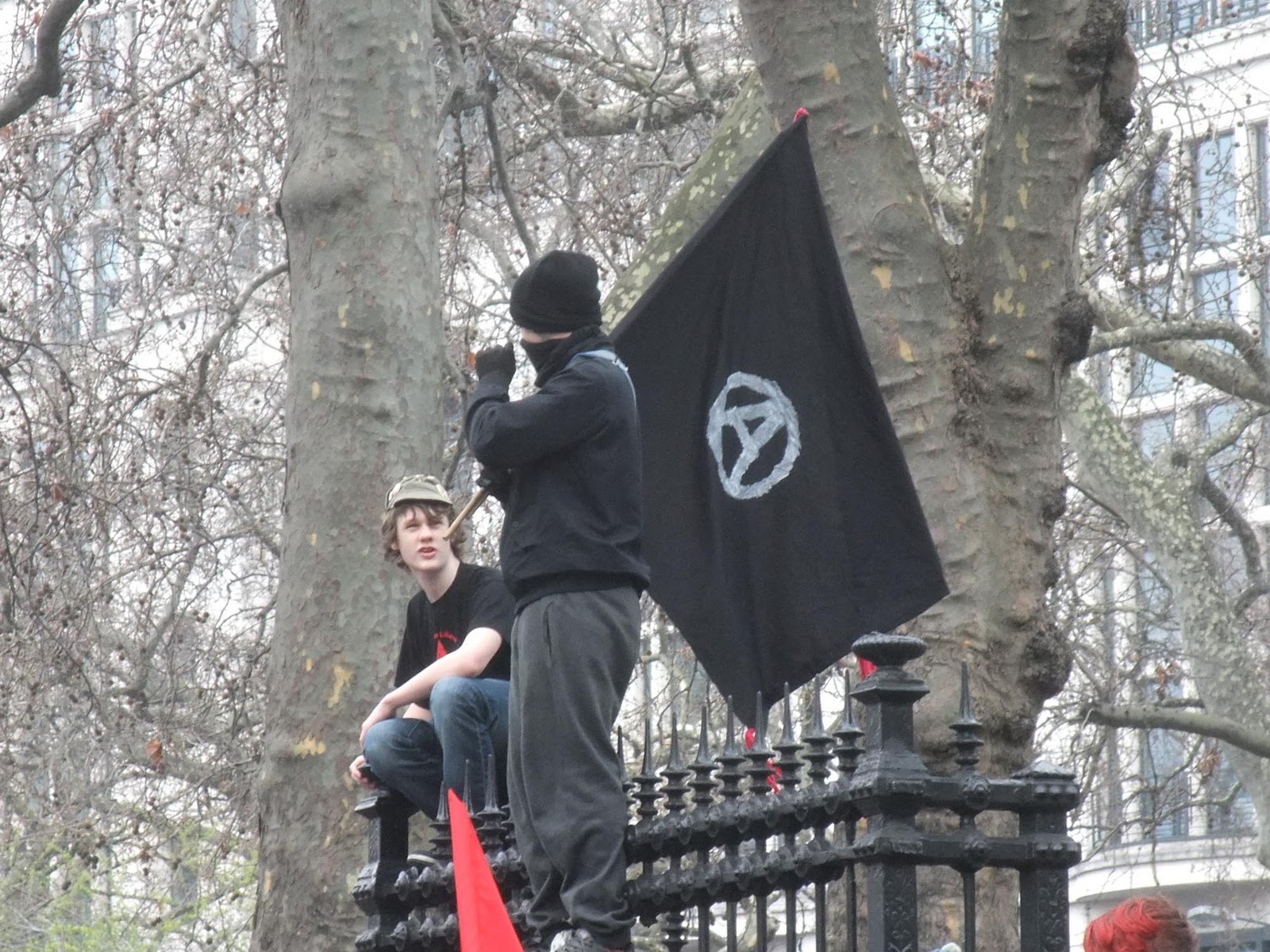
The day pretty much lived up to expectations. There was a good turnout, with people coming from an amazing variety of organisations, and from places far and wide. From what I could see the demo was a completely peaceful and yet powerful statement about the opposition to the cuts. There was a tremendous variety of banners and placards, both mass-produced and individually hand-crafted.


It was only afterwards that we discovered there had been a few incidents of so-called anarchists smashing windows and defacing property with spray paint. Also, UK-Uncut disrupted a few business premises with occupations and sit-ins.


So does anything now change? As ever, politics is about power and who has access to it. It's not about having a reasoned debate and arriving at "the truth", which must then be noted and acted upon. We all have our own versions of the truth. The coalition certainly has theirs, which they're able to broadcast incessantly through their easy access to the mass media. Working people can only shout loudly, or march on the streets.


As for the Labour Party's version of the truth about our economic and political situation - it hasn't shifted much from the New Labour orthodoxy. There's a sort-of acknowledgement that the financial meltdown happened on their watch, and that they were somehow complicit in the crash - owing to their continuation of broadly Thatcherite and Friedmanite economics, with light-touch (ie hardly any) regulation of the City and the banks, and hardly any radical attempt to deal with growing inequality and poverty.


As to what needs to happen now - what credibility do any of our current politicians really have? On the one hand we have the Bullingdon Club, the Etonites and the millionnaires, aided and abetted by Clegg & chums (who admit that there are no substantial political differences between them and the Tories). On the other hand we have the young, Oxbridge-educated, professional politicians who now run the Labour Party and were part of the New Labour gang, even if they don't call themselves that any more.


Ed Milibean - nice, clever, posh boy with zero charisma and zero leadership ability. Ed takes the rap for being so stupid as to appoint Alan Wotsit as Shadow Chancellor - a man with no grasp of economics whatsoever, and who thankfully did a bunk as soon as he could. So Ed then rightly replaces him with the appalling (but economically savvy) Ed Balls, but stupidly replaces Balls with the even more appalling Douglas Alexander - a tosspot of the very first order. Meanwhile we hear nothing whatsoever from Mrs Balls - I can't remember her real name (Yvonne something? Cooper?) - about the great world issues, including Libya and the rest of the Arab world.


These people are basically clever prats, who have failed to differentiate themselves sufficiently from the Tories and Libdems, and failed to associate themselves with the very people the Labour Party was created to support. Power-seeking missiles, born to manuever their way to positions of influence and power in the People's Party, but not to rock the boat, or to promote or create any radical change. They're not even proper social democrats, let alone socialists. They have neither the gifts nor the intention to change the terms of the political debate and cause people to think differently about politics, social justice and social policy. They're political pygmies, and are hard, if not impossible, to support and vote for, even if you're a lifelong Labour supporter.


So who should we vote for? Ideally a new political party, a new political movement, which comes into being as a true party of the Left in Britain. A party that is led by people of conviction who can make the case for social justice, greater equality and decent public services; a party that will argue for a fair tax system and the eradication of poverty; a party that will rebalance the economy and properly regulate the banks and the City; a party that will do all the things that the Labour party was initially set up to do, and can no longer claim with any credibility that it will do, if it ever returns to power.


I don't even care if that party turns out to be non-electable - it's the party I want to vote for. As things stand, the present Labour party is the lesser of the evils on offer, but it's not a party I want to vote for. It's time for politics in this country to move on, and we need a party that's led by people who are untainted by New Labour and is led by people with experience, maturity, gravitas, imagination, wisdom, idealism, conviction and credibility.


If UKIP can appear out of nowhere on the right of the political spectrum, then it must be possible for a new party to do so on the left - providing they have good leadership and a programme that matches reality and matches the expectations of large sections of the population who are sick of what the Labour Party continues to be and to do, or not do.


The only possible alternative (for we anti-Tories) is for masses of people to stop work and peacefully occupy public spaces, withdrawing our consent to be governed by people who have no legitimate mandate for what they're doing to the country - to follow the example of the courageous Egyptians and Tunisians.


We should be clear that there is absolutely no mandate for what this government is doing since Cameron, Clegg and co totally misled the country as to their intentions to introduce and support massive changes to public services that weren't even proposed at the time of the election. Who the hell agreed that the health service should be turned upside down and largely privatised or outsourced? Who agreed that "free schools" could be set up and run by oddballs like Toby Young with handouts of large wads of public money? Who agreed to the closure of libraries and children's centres? Who agreed that bankers could carry on paying themselves massive bonuses, and banks could remain unregulated?

Sadly there will be NO mass demonstrations, NO occupations, NO irresistable demands for fresh elections, NO new government with a real mandate, and almost certainly NO new political parties. This is the pathetic reality of Britain today, in spite of the dire state of the country and the massive political coup that has taken place. The shock doctrine lives on, and most people are too confused and scared, or too damn comfortable and complacent, or  too selfish and arrogant, to do anything about it.

Here's my solution for action to raise awareness.

It has to be action taken by "the people" and must not be led by the political parties or the unions. It has to be taken by people from across the awareness spectrum and the political spectrum.

We pick a Saturday in May - or possibly May Day - and call it DO NOTHING day. On that day as many people as possible should do nothing. No work. No rallies. No marches. Stay at home if you wish - but preferably gather in public spaces, hang about, chat to one another, read newspapers or books, and DO NOTHING. People who do nothing on this day will be deemed to be supporting the call for new elections on the grounds that this government has NO MANDATE for their spending cuts and changes to public services.

If the day is successful in getting people to stop work and do nothing, then the following weekend should be designated the DO NOTHING weekend. If it's successful in getting mass support then the following weekend should be designated the NO MANDATE weekend. From that weekend onward as many people as possible should continue to DO NOTHING (apart from hang around peacefully and have fun in public spaces) until the government agrees to call a new election.

The only people who should continue to DO SOMETHING should be people who work in schools, people who run hospitals and services for the elderly, etc. In other words, essential public services. Suitably qualified and experienced people who would otherwise join in with the call to DO NOTHING could volunteer to help those who are keeping the essential services going, thereby making those services even more effective. They could even volunteer to run creches and discussion groups at the DO NOTHING gatherings. Other sorts of creative and worthwhile activities could also be set up at the DO NOTHING gatherings.

It's worth a try.


All photos (c) Oxzen Pics

.

Sunday, January 23, 2011

Layer 428 . . . Forbidden Love, Sex on the Job, Rough Trade, Politics, Wee Dougie Alexander, and Adele

.
Douglas Alexander has been chosen by Ed Miliband to become his shadow foreign secretary. This raises very serious questions about Brother Ed's ability to build a winning team. He's never actually managed an organisation in real life, and he's making a complete nonsense of the most important aspect of management - recruiting the right people to fill the key roles.

He totally messed up with his appointment of Alan Johnson to be his shadow chancellor - which also makes you wonder how much Ed himself knows about economics. Now that Johnson's resigned he's brought into his senior management team one of the dullest, most right-wing, most conservative, most careerist, most New Labourist little shits he could possibly have found.

The boy Alexander is an appalling choice. He's the ultimate machine politician. He's a revolting little toad of an arselicking, conniving, over-ambitious, political pillock. What's more, his speaking voice, his delivery and his language are so boring he's impossible to even listen to, let alone understand and appreciate.

He has no ideology, no principles, no regard for Labour traditions. He's the classic managerialist. He has no passion for equality and social justice whatsoever. He'll go along with whatever Ed Mili says is current policy, and he'll do whatever he's asked to do in order to keep his nose clean(ish) and further his career in politics.

This whining prat was in charge of DAVID Miliband's leadership campaign. What's that tell us about his effectiveness - he couldn't even get the hot favourite for the leadership to be first past the winning post. Brother David must be cringing in disbelief.

Voting record (from PublicWhip)

How Douglas Alexander voted on key issues since 2001:
   
    * Voted very strongly for the Iraq war.
    * Voted very strongly against an investigation into the Iraq war.
    * Voted strongly for Labour's anti-terrorism laws.
    * Voted moderately for replacing Trident.
    * Voted very strongly for introducing foundation hospitals.
    * Voted strongly for introducing ID cards.
    * Voted moderately against greater autonomy for schools.

This man was a bugler in the Boys Brigade, he's the son of a Church of Scotland minister, he was a speechwriter and a researcher for Gordon Brown, he was a solicitor for precisely six months, he supported Blair on the abolition of Clause 4, and he's done fuck all of any real use - ever.  He's typical lobby fodder.

Make your own mind up.

http://en.wikipedia.org/wiki/Douglas_Alexander

PS There's no point anyone saying that Alexander was/is a decent constituency MP. Even if that were the case - so what? There are lots of us who could be hard-working MPs, given half a chance. Those Labour politicians who hold the senior posts in politics ought to be those who have a track record of fighting for the principles of equality, social justice and solidarity which the Labour party was created to fight for. Alexander is a third-rate apparachik and a lickspittle who supports illegal wars, supports a police state, supports nuclear weapons, supported the most right-wing leadership the Labour party has ever had, and hasn't a single radical thought in his head.

.................................

People on the political programmes this morning were all talking about politics being a 'rough trade' - as they were discussing the resignations of Coulson and Johnson, the promotion of Balls, the competence of the police, the further questions about Blair being a war criminal, etc.

Presumably the word 'trade' is supposed to differentiate politics from proper professions, for which you need academic qualifications - as distinct from trades such as building, carpentry, plumbing, electrical contracting, etc . . . for which you also need proper qualifications. Plus practical skills, rather than academic theory.

The professions are for the middle classes. Trades are for the working classes.

Working class men and women used to be in Parliament, but not any more. These days you need to be something like the son or daughter of a church minister, preferably with a first class degree in politics, philosophy and economics, or law; preferably from Oxbridge. There are lots of lawyers in Westminster and Washington.

By 'rough', they mean that if you're a politician you become an object for abuse, condemnation, ridicule and hatred. Which is true. I'm happy to give my fair share of abuse, whilst also trying to reasonable, accurate and honest.

If you put yourself up to be a representative for people's needs and aspirations, and you then fail to say or do anything of significance to challenge or change the status quo, and you fail utterly to improve the lives of the poorest sections of society (if you happen to be a Labour politician), then you thoroughly deserve to be despised and verbally roughed up.

People are going crazy with frustration, living in poverty, living with no hope of a decent job, let alone a career or a decent pension, whilst fat cats get ever fatter, thanks to the complacency, indolence and self-serving smugness of unprincipled, visionless bastards like Douglas Alexander. What the hell do they expect?

...................................................................

Ello, Ello, Ello, Goodbye.

Undercover police officers are apparently allowed to have sex with those they're spying on, but they're not allowed to fall in love with anyone they're trying to bang up, so to speak. Sounds about right.

It would look very strange if some needy activist says to her environmentalist-activist 'colleague' - "I'm gagging for a damn good bonk, old mate - let's go back to my place and get jiggy," and he - who's apparently a healthy heterosexual male then turns round and says, "No thanks".

What kind of collegiality and solidarity would that show? That would blow his cover instantly. The 'activist' would immediately realise that she was in the company of of an undercover plod who's under orders not to do normal human things - like having sex.

On the issue of falling in love - well, what can one say? Falling in love is NEVER a good idea. Admittedly it can sometimes take half a lifetime for people to learn NOT to "fall in love" (and just as quickly fall out again) and to realise that the love drug is just as dangerous and  as addictive as crack and heroin. This can be a very hard lesson to learn, especially when someone's bloodstream is full of the endorphins produced by great sex with an attractive partner and they feel BRILLIANT!

There's a world of difference between wanting to be with someone whose company and whose sexuality makes you feel fully alive, and mistaking your desire for that person for enduring love.

Loving someone involves a hell of a lot more than desiring someone, wanting to be with someone, feeling good when you're with someone. There are thousands of books and films about people who fall in and out of love. Mills and Boon created an industry out of people's desire for romantic love. People might want it, but that doesn't make it desirable. It can seriously mess up your life. Especially if you're an undercover cop.

.............................................

There's a brilliant song about crazy love released this week by a young English singer called Adele. She and her band performed it last night on the Alan Carr show. It's a rocking and rolling soulful groove called Rolling in the Deep. Catch it here:

http://www.adele.tv/videos/179/rolling-in-the-deep-official-video

http://www.metrolyrics.com/rolling-in-the-deep-lyrics-adele.html

http://www.youtube.com/watch?v=a3gkoU7KtG4&feature=fvsr

http://www.youtube.com/watch?v=lazyDlfaptM&feature=related

http://www.youtube.com/watch?v=8slyQBbZFgc&feature=related

Great pounding rhythms, great voice, great backing vocals.

Very interesting how different her second album (21) sounds compared to her first album (19). Apparently the experience of touring in the USA and listening to soul and blues music had a huge impact on Adele, as she'd not really paid attention to these types of music previously.

The first single (from ("21")is a revenge tune "Rolling in the Deep". Adele described it as a "dark bluesy gospel disco tune."  -  Wiki

http://en.wikipedia.org/wiki/Adele_%28singer%29

The fact that Adele had a huge hit with Bob Dylan's "Make You Feel My Love" (which was on her first album) also speaks volumes about her excellent taste and musical sensibilities.

http://www.youtube.com/watch?v=0put0_a--Ng&feature=related

http://www.bobdylan.com/songs/make-you-feel-my-love

http://www.lyricsmode.com/lyrics/a/adele/make_you_feel_my_love.html

http://www.youtube.com/watch?v=Fnn9JlqqTE4

....................................

Sex Was A Tool

Undercover police cleared 'to have sex with activists'

Promiscuity 'regularly used as tactic', says former officer, contradicting claims from Acpo

 http://www.guardian.co.uk/uk/2011/jan/22/undercover-police-cleared-sex-activists
Undercover police officers routinely adopted a tactic of "promiscuity" with the blessing of senior commanders, according to a former agent who worked in a secretive unit of the Metropolitan police for four years.

The former undercover policeman claims that sexual relationships with activists were sanctioned for both men and women officers infiltrating anarchist, leftwing and environmental groups.

Sex was a tool to help officers blend in, the officer claimed, and was widely used as a technique to glean intelligence. His comments contradict claims last week from the Association of Chief Police Officers that operatives were absolutely forbidden to sleep with activists.

The one stipulation, according to the officer from the Special Demonstration Squad (SDS), a secret unit formed to prevent violent disorder on the streets of London, was that falling in love was considered highly unprofessional because it might compromise an investigation. He said undercover officers, particularly those infiltrating environmental and leftwing groups, viewed having sex with a large number of partners "as part of the job".

"Everybody knew it was a very promiscuous lifestyle," said the former officer, who first revealed his life as an undercover agent to the Observer last year. "You cannot not be promiscuous in those groups. Otherwise you'll stand out straightaway."

Well, of course - we all know these promiscuous activist anarchists are all bonking like bunnies. Especially the women. Mad, bad and dangerous to know. OK to shag though, if you really need to.

.

Thursday, January 13, 2011

Layer 420 . . . Libraries, Social Hubs, Closures, Philistines, Pedlars of Fear, Securocrats and New Labour Nasties

.
It's now beginning to feel like the bad old days of Thatcher and the Nasty Party. Every day the blood starts to boil at the sheer awfulness, meanness and stupidity of government.

This week it's the continuing effects of unnecessary cuts in spending, the rise in prices caused by increasing VAT, the money wasted on goverment spies, the closing of libraries, and so on.

The closure of libraries is appalling. You can just sense the glee of the local bureaucrats and politicians, all of them presumably card-carrying members of the Provisional wing of the Daily Mail, who are rubbing their hands with glee at the prospect of shutting libraries - which from their point of view is a triple whammy.

1) Sod the working classes and their inability/unwillingness to buy their own books and computers, and to rent their own broadband.

2) Stop paying the salaries of librarians, and spending a fortune on new books.

3) Sell off valuable premises in some prime locations, thereby bringing even more money into their coffers.

Of course this works wonderfully for central government as well - being able to pass on the blame for library closures to local government, on the grounds that they didn't directly order the closures, and in any case they suggested that libraries could be run by 'volunteers'.

Have a look at this excellent article by John Harris, and learn more about the essential role of local libraries as community 'hubs', and the key role of librarians:


Librarians: 'We do so much more than shelve books and say shhh'

The Tories clearly don't know how much libraries do. Cuts will threaten the very social bonds they claim to want to promote

http://www.guardian.co.uk/commentisfree/2011/jan/11/north-yorkshire-libraries-cuts-closures-big-society

Fifteen minutes south of Scarborough is Eastfield Community Resource Centre – opened four years ago, to serve one of the area's most disadvantaged communities. In addition to lending out books, what would once have been a mere library has obeyed the modern demand to transform itself into a "hub", and provides what might look to a lot of people like the raw materials of social mobility: internet access, parent and toddler groups, space and resources to help with school homework, meeting rooms and more.

On the day I visit, four staff members are seeing to the needs of a steady stream of people. The shelves bulge with titles that point to horizons well beyond these parts: David Remnick's Obama biography, The Bridge; a rich work of pop-cultural scholarship entitled Dylan's Visions Of Sin; and a coffee-table study of Matisse. "You can't learn everything at school," one local tells me; this place surely offers instant proof.

In Somerset, 24 out of 40 libraries may soon close. In Doncaster, 13 of the 26 are under threat. The same applies to 20 out of 43 libraries in Oxfordshire, 7 of the 12 in Conwy, 23 of the 32 in Cornwall, and 9 of the 11 on the Isle of Wight. The noise of protest grows greater by the day: do not be surprised if pockets of local dissent soon fuse together, and cause no end of problems for both national and local government.
Why can't Cameron, Clegg, Pickles and co understand that this kind of thing makes this country look utterly pathetic in the eyes of the rest of the world - or at least the parts of it that aren't run by similar Philistine arseholes whose greed and selfishness are the key components of their DNA? Admittedly those sorts of people are the ones who tend to rise to the top in politics - in all countries - but anyone with a shred of decency and intelligence surely understands that for a country as wealthy as Britain to be CUTTING BACK on library provision instead of expanding it is a vile act of cultural and social vandalism. Obviously this sort of thing increases social divisions, instead of reducing inequality. It reduces people's prospects of lifelong learning instead of increasing them. It reduces social cohesion instead of increasing it. It destroys social capital instead of multiplying it.

http://www.guardian.co.uk/culture/culture-cuts-blog

..............................................

It might be worth also taking another look at this article from a while back:


Our libraries are at risk - just when we need them most

Lean times are already bringing cuts in services, with little heed to the vital role they play and how they shape futures

http://www.guardian.co.uk/commentisfree/2009/apr/02/libraries-closures-recession

Also refer back to the article by Catherine Bennett commented on in Layer 389 back in November:

http://oxzen.blogspot.com/2010/11/layer-389-closing-libraries.html


.............................................

You should also take a look at this piece by Simon Jenkins this week:


The state's pedlars of fear must be brought to account

Why have a private firm run police to spy on a few greens? The Ratcliffe Six case is a warning story of securocrats out of control

http://www.guardian.co.uk/commentisfree/2011/jan/11/police-reform-mark-stone-terrorism

The picture of the Ratcliffe Six, who appeared to be "greens" from central casting . . .  recalled Chesterton's satire on the early Met police special branch, The Man Who Was Thursday, in which all the members of the "supreme anarchist council" turned out to be policemen. So, are the greens all policemen, and if so what is their game?

Mark Stone, aka Kennedy, clearly had a good job. He could climb trees, buy drinks, sleep with girls, shout at the fuzz and chain himself to nuclear power stations, all on the taxpayer. The only thing that went wrong was a bad attack of Stockholm syndrome. Kennedy fell in love with the enemy. He started worrying about global warming, which was not in the script.

Running Kennedy – let alone his colleagues – cost the taxpayer £250,000 a year, or £1.75m over seven years. Whether tree-hugging and the occasional trespass constituted threats to national security is moot. A gilded sledgehammer was clearly being deployed to crack a few nuts. They were not a serious terrorist threat. The denouement was a costly fiasco. This is what happens when authority has too much money and no one in charge to impose a sense of proportion.

It is significant that Kennedy did not work for any police force. He worked for a murky organisation called the National Public Order Intelligence Unit (NPOIU). With a budget of £5m this operates as a branch of the National Domestic Extremism Unit (NDEU) which, in turn, works alongside the National Extremism Tactical Co-ordination Unit (NETCU). Ask where this stands, and you will be told it reports to the Association of Chief Police Officers' Terrorism and Allied Matters Committee, codenamed Acpo(TAM).

Only those who have tarried in the foggy corridors of the Home Office, the Ministry of Justice and the Metropolitan police can have any notion of the Orwellian extravagance of these places. Agencies, units and groups cruise shark-like round the feet of terrified Home Office ministers. Their staffs, expenses, overtime and accommodation are crammed into London's Scotland Yard and Tintagel House. If challenged, they incant their motto: "We keep you safe."

Kennedy's bosses in the NPOIU work for Acpo, but this is not what it seems. It is not, as its name suggests, the police officers' staff club, nor is it a public body of any sort. It is a private company, incorporated in 1997. It is sub-contracted by Whitehall to operate the police end of the government's counterterrorism and "anti-extremism" strategies. It is thus alongside MI5, but even less accountable.

As a private company, Acpo need not accede to Freedom of Information requests and presumably could distribute its profit to its own board. The whole operation is reminiscent of the deals set up by the Pentagon with private firms to run the Iraq and Afghan wars, free of publicity or accountability. There is no more vivid testament to the illiberalism of the Blair regime than these eccentric arrangements. They were all approved by the likes of David Blunkett, Charles Clarke, John Reid and Jacqui Smith.
These people are the real baddies in this story - Blair, Blunkett, Clarke, Reid and Smith. Every one of them a nasty piece of work - plotters, careerists, authoritarians, eliteists, bullies, egomaniacs and all-round arseholes. No more interested in civil liberties and justice than they are in socialism and greater equality in our society. New Labour through and through. It's mainly thanks to them - their negligence, acquiescence and positive intent - that the system became what it clearly is now, and which somebody needs to do something about as a matter of urgency. So step forward Teresa May . . .

.

Wednesday, November 24, 2010

Layer 385 . . . Ireland, Tax Piracy, IMF, Shock Doctrine, Terrible Neighbours, the PFI Racket, Nick Clegg, Social Mobility and New Fangled Progressives

.
Royal wedding date set for 29 April

Prince William and Kate Middleton's wedding will take place on Friday 29 April at Westminster Abbey

Exciting. Not.

....................................

Things are hotting up again on the economics and financial front. Shit hitting the fan big time in Ireland. Polly Toynbee's column gives an excellent overview:


 Ireland shouldn't get a penny until it gives up its tax piracy

Cameron says he is being 'good neighbours' with the Irish. Why, when they have been such terrible neighbours to us?

http://www.guardian.co.uk/commentisfree/2010/nov/22/no-bailout-for-ireland

Yet again the western world teeters on the edge of calamity caused by the bank-lending extravaganza that fuelled the great property bubble. Europe holds its breath. Will the market predators be halted at Ireland, or might the rating agencies knock down all the dominoes one by one, first the weak countries, then the strong? Meanwhile a Europe-wide fiscal tightening panic may yet bring about the very thing it seeks to prevent, as democracy once again falls under the wheels of finance.

What lesson has George Osborne learned since he penned a paean of praise in the Times in 2006, "Look and Learn Across the Irish Sea"? He wrote: "Ireland stands as a shining example of the art of the possible in long-term economic policymaking ... Capital will go wherever investment is most attractive. Ireland's business tax rates are only 12.5%, while Britain's are becoming among the highest in the world." Low taxes are the answer, he said.

He claims he is being "good neighbours" with our cousins across the Irish sea. What he does not say – perhaps embarrassed by all that previous praise – is that the Irish have been exceptionally bad neighbours to everyone else.

Ireland's corporation tax is 12.5%, the UK's is 28%, dropping to 24% in 2013, and the US rate is 35%. Ireland has played the beggar my neighbour, race-to-the-bottom tax game for many years. Quite why the EU tolerated this is a mystery when a fortune was poured from Brussels to Dublin to pay for a spectacular modernising infrastructure over the years. A few other large companies recently decamped to Dublin from London, advertising giant WPP for one: these are mainly virtual moves for tax purposes only, since virtually no staff go over – and certainly not the board.

But, in the view of Richard Murphy of Tax Research UK, the corporation tax rate is only a fraction of the true story, a flag to signal to global companies that they will get a phenomenal deal with an Irish relocation. Ireland's real shame is not that, like the UK, it mistook its property boom for a never-ending cash machine. What is unforgivable is its shameless status as Europe's greatest tax haven, helping to cheat tax from the world's treasuries for decades.

Ireland allows Google, Facebook, Microsoft Corp and many others to shunt profits around subsidiaries so that they escape even Ireland's own low tax rate.

Ireland allows them, quite legally, to pass the profits on to other tax havens that levy no corporation tax at all, paying only tiny sums in passing: Google put 92% of its billions of worldwide non-US profits through Dublin, and it paid Ireland just £18m.

This is a pure tax haven, with the laxest tax regime in the EU, with no controlled foreign companies rules (to limit deferral of tax).

So why is Ireland not required to put its tax affairs in order and stop cheating all those neighbours now coming to its rescue? IMF doctrine demands countries squeeze the breath out of their people with punitive cuts – and they like low or, even better, no taxes.

The IMF's purgative is an ideological brew; it learns no lessons. When its patients get worse and near death, as Ireland has done after its first terrible dose of cuts, the fund calls for more leeches, mercury and arsenic. That is, of course, the same pre-Keynesian medicine Cameron and Osborne prescribe for us. There is a week before a final settlement: will the rest of Europe really hand over their money without demanding Ireland abandons tax piracy and joins the civilised world?

...........................................

Yes - classic IMF 'Shock Doctrine' prescriptions and demands. For more on the IMF and the shock doctrine outrage, just type 'shock doctrine', IMF, Naomi Klein, disaster capitalism, etc into the Oxzen search box at the top of this page.

.........................................

The bill for PFI contracts is an outrage. Let us refuse to pay this odious debt

The great racket that was private finance now robs the taxpayer of billions that should be spent on nurses and teachers

by George Monbiot

http://www.guardian.co.uk/commentisfree/2010/nov/22/pfi-private-finance-refuse-debt

You've been told that nothing is sacred; that no state spending is safe from being cut or eroded through inflation. You've been misled. As the new public spending data released by the government shows, a £267bn bill has been both ringfenced and index-linked. This sum, spread over the next 50 years or so, guarantees the welfare not of state pensioners or children or the unemployed, but of a different class of customer. To make way, everything else must be cut, further and faster than it would otherwise have been.

This is the money the state owes to private corporations: the banks, construction and service companies that built infrastructure under the private finance initiative. In September 1997 the Labour government gave companies a legal guarantee that their payments would never be cut. Whenever there was a conflict between the needs of patients or pupils and private finance initiative (PFI) payments, it would thenceforth be resolved in favour of the consortia. The NHS owes private companies £50bn for infrastructure that cost only £11bn to build, plus £15bn for maintenance charges.

In 1997 the British Medical Association warned: "The NHS could find itself with a facility which is obsolete in 10 or 20 years' time, but for which it will still have to pay for 30 years or more." No one's celebrating being proved right.

If a hospital no longer requires the services it contracted to buy, tough.

The cost and inflexibility of PFI is an outrage, a racket, the legacy of 13 years of New Labour appeasement, triangulation and false accounting. At first sight, it looks as if nothing can be done: contracts are contracts. What I'm about to propose is a wild shot, but I hope it deserves, at least, to be discussed. I contend the money we owe to the PFI consortia should be considered odious debt.

Odious debt is a legal term usually applied to the endowments of dictators in the developing world. It means debt incurred without the consent of the people and against the national interest.

PFI was a Tory invention but became a Labour doctrine.

There was no democratic mandate for this policy, which appears to have arisen from secret talks with companies.

Secrecy surrounded the whole scheme. To this day, PFI contracts remain commercially confidential. You can't read them; MPs can't read them. We don't know what we are being stung for or whether the costs are justified. But there are some powerful clues.

In Coventry, for example, NHS bosses originally sought £30m of public money to refurbish the city's two hospitals. When the government told them it was "PFI or bust", the refurbishment plan was dropped in favour of a scheme to knock down both hospitals and build a new one – with fewer beds and doctors and nurses – at an eventual, corporate-friendly cost of £410m. A report commissioned by the local health authority found that the scheme had been "progressively tailored to fit the needs of private investors".

To get their new buildings or services, public bodies had to show that PFI was cheaper than public procurement. The system was rigged to make this easy.

Desperate public bodies were gulled and outmanoeuvred with the blessing of central government, which sought only to keep the corporations off its back and the liabilities off its balance sheets. Was this a legitimate means of loading our schools and hospitals with debt? I don't think so.

But where else do we go with this? I've been warning about inflexible PFI contracts since 1998. I've wasted months on this mission, trying to understand and explain the most complex issue in public life. For all the good it's done, I might as well have gone fishing.

Now I see corporations squatting like great cuckoos on our public services, while officials pour the money that should have been spent on nurses and teachers into their widening bills. Yes, I'm bitter. Yes, I'm clutching at straws. Have you got a better idea?

.......................................................

If anyone's interested in reading more evidence that Nick Clegg's just a Tony Blair clone, then just read this column he wrote for the Guardian yesterday:

For old-fashioned progressives, achieving income equality was the ultimate goal. For us, it is increasing social mobility

http://www.guardian.co.uk/commentisfree/2010/nov/22/inequality-injustice-nick-clegg

Nick thinks he's a new-fangled 'progressive', when in reality all this guff about social mobility and equality of opportunity is the same old New Labour bollocks.
.

Tuesday, November 23, 2010

Layer 384 . . . Finding A Voice, Teaching Writing, Education, Traditions, Enlightenment, Zen Socialism, Ed Miliband and the Labour Party

.
Personal Voice

So why are some of us keen to write, whilst others run a mile from the idea? The esteem we have for 'proper' writers is both a magnet and a deterrent. We grow up thinking and believing that novelists, playwrights, biographers, journalists, columnists and writers of learned tomes are all special people. Some people have large enough egos to see themselves  as potential and future members of the writers club. Others just think they have no voice worth listening to.

Teachers and educators like Harold Rosen pioneered the idea that every single one of us has stories to tell, thoughts worth sharing and a voice worth listening to. What's more, children should discover their personal voice as soon as they are able to talk, and write.

Such radical ideas were starting to gain some traction in schools in England in the 1970s, 80s and early 90s, and then along came the New Labour national literacy strategy with its glib prescriptions, and which, in its stupidity, turned the clock back decades - thereby pretty much eliminating all ideas about young people finding a personal voice, writing for their own purposes, writing for audiences and writing for 'publication' - and enjoying writing as a thing that had personal meaning and utility.

We now have a generation of young people who have rarely completed an entire piece of writing which they chose to write as an expression of their own thoughts, memories, feelings and ideas. Or indeed any piece of writing. We have thousands of young people who know how to construct long sentences full of 'connectives', adverbial phrases and "wow words", but they can't actually write well, and on the whole they choose not to. Lacking motivation to write, they don't do it unless they have to.

Wow words? Don't even ask.

I probably feel more angry about the way the  teaching of writing has been perverted by the NLS (New Labour Shitheads) than about anything else in the crazy world of schools and education. The harm that's been caused is immeasurable.

And why did this happen? Because schools were pressurised into doing it - in order to improve test scores and achieve government targets. Because school managers were desperate to improve test results - tests that awarded marks to pupils  for . . . guess what? Scatterings of connectives. Fistfuls of adjectival and adverbial phrases. Shitloads of wow words.

Oops - non-standard English. Short sentences. Must try harder.

After all, this is what proper writers do - innit? Write in long sentences, fill them with subordinate clauses, and use lots of flowery language. Brilliant.

What a stupid culture. What a mean, ridiculous, hopeless society. What a pathetic, ignorant, uncaring system.

Pity the poor kids who now have to unlearn all that bullshit about what good writing consists of. Poor bloody kids who've been bored to tears by meaningless coaching for pointless tests. Poor kids who've never enjoyed writing a single word in their entire lives, let alone enjoyed sharing their thoughts, their ideas and their imagination, in written form.

......................................................

How do we expect kids to articulate their thoughts competently when they rarely, if ever, have either opportunity or encouragement to do so? Let alone individual coaching and mentoring in how to express themselves in their personal voice.  All of which takes time, and empathy, with proper attention being paid to what the child is trying to say - not 'all eyes on the teacher and on the whiteboard' methodology, and exhortations to write in longer sentences and use more flowery language. Because that's what adults do, n'est-ce pas?

In order to say something, there ought to be something worth saying. Most of the writing assignments handed out in schools have no meaning whatsoever for the kids who are forced to carry them out. And the pupils aren't fools either - they know that the writing tasks are not genuine or useful, except in terms of preparation for tests. They're well aware they're just pawns in adults' political and professional games. And they're right to feel bloody resentful about that, even as they beaver away at their exercises and worksheets.

.....................................................

Keeping Up Traditions

"You need to conserve your traditions in this country", said David Ginola, a decent and thoughtful man, and a sometimes brilliant former footballer, speaking on TV this week.

Is that really so? I can think of quite a few traditions we could happily lose. Too many to mention, really.

But what David was talking about was 'foreign' ownership of football clubs, and 'foreign' managers.

Since football's now just a business, and a branch of the entertainment industry, I guess we could say the same about any other business. Maybe we should be hankering after the distinctively British type of management that brought our major industries to their knees, and for that matter collapsed the banking and finance system. What a triumph for Anglo-Saxon ownership, leadership and management that turned out to be.

If you're a European by birth, is someone from another part of Europe a 'foreigner'? When will people learn that it's not the nationality of people and businesses that matter - it's the degree of enlightenment, creativity and imagination that's important. Worldwide we can all learn from one another in order to make a better planet.

The amusing thing at the end of the Ginola discussion was seeing the people who were taking part in it realise that Ginola is, well, foreign. And the gimp who presents the programme is Irish.

.........................................................

Right now, the Labour party needs Ed Miliband's Zen socialism

Labour's leader should not listen to the goading of the coalition and media. He needs thinking time to plan the fightback

http://www.guardian.co.uk/commentisfree/2010/nov/22/labour-ed-miliband-zen-socialism

by Jackie Ashley

What is the Labour party for?

That's the question being flung at Ed Miliband by almost every newspaper and by many of his own MPs.

Look around at the political reporting of Labour just now. It's as if a spew of lava has buried the landscape – a molten river of anger, burning lakes of score-settling and an ash-cloud of bitterness under which everything else has vanished.

Miliband's first job is to make sure that the angry, self-destructive mood of the moment does not wreck his leadership too. He attempted to put a line under the past, to give New Labour a decent burial and proclaim a new generation.

Miliband, I can report, is almost surreally relaxed, displaying the sang-froid that has so struck people in the Commons. He simply won't engage. He won't take sides, align himself with old quarrels or even listen to passionate explanations of what when wrong before.

They need to return to the party in the country, and the many who deserted Labour – and really listen to them.

They need to get inside the banking system and try to understand it from within.

They need to discover how to get more good people into local government, and how to strike a better balance between targets and bureaucracy.

They need to go back, rather humbly, to Labour councillors and party workers who felt snubbed and ignored during the years of New Labour, and discover how hard it became to mobilise and enthuse people. And then they need to rebuild policies from the bottom up, not simply watch what the coalition does, and say the opposite.

I hope Miliband holds his nerve. I suspect he will – some kind of Zen socialism we haven't come across before.

...............................................................

Ed Miliband sets out 'profound' changes to Labour party

Exclusive: Labour leader reveals plans to review organisation and policies in first full interview since winning leadership contest

http://www.guardian.co.uk/politics/2010/nov/21/ed-miliband-profound-changes-labour

Ed Miliband today launches his party on "the hard road back to power", saying it has to move beyond New Labour and commit to changes in policy and organisation as profound as those introduced by Tony Blair in 1994.

He also appears to clash with the shadow chancellor, Alan Johnson, by saying a 50p tax rate for those earning more than £150,000 should be permanent, as a way of creating greater equality in Britain. Making the country more equal, he says, is one of the issues that gets him out of bed in the morning.

He warns his party not to expect a quiet life, saying: "I am talking about change as profound as the change New Labour brought because the world itself has changed massively, and we did not really change fundamentally as a party, or come to terms with the changes, and have not done so since 1994."

Miliband dismisses suggestions he has been too low-profile since becoming party leader, saying: "It's about digging in, and it's not about short-term fixes, nor shortcuts to success. There is a long, hard road for us to travel." He does not accept that the deficit is the product of over-spending by Labour, but says British politics has not come to terms with the 2008 banking crisis and the economy's over- exposure to financial services.

He appears to disagree with Johnson, who has described the 50p top rate as only "right for now". Asked if the 50p rate was simply necessary to cut the deficit, Miliband says: "No, it's about statement about values and fairness and about the kind of society you believe in and it's important to me."

He sticks with Labour's plan to halve, as oppose to eradicate, the deficit by the end of the parliament, insisting he will not concede that the Labour government overspent before the 2010 election.

"I don't agree with what the Tories say about us overspending. They are on a mission and we know what their mission is and we have got to take them on. Their mission is to say 'This deficit is not the result of an international banking crisis, it is the result of a crisis in government'."

He also rejects suggestions he has been shifting to the centre since becoming leader in September, arguing: "I said during the election I was the person who would take us beyond New Labour. That's the way I ran as a candidate and that is the way I am going to run the party. We've got to recognise that in terms of who we stand up for – we as New Labour lost touch of people's hopes and aspirations."

The overarching task, he says, is to examine "how you can create greater social justice in the economy without having to rely only on redistribution and the welfare state.

..........................................................

The Labour party can count itself itself extremely fortunate to have elected a leader who has some of his father's socialism in his soul, and is prepared to speak out for the founding principles of the Labour party. This is in contrast to brother David who sold his soul to New Labour and its scheming, triangulating, mealy-mouthed creatures of the night, most of whom were 'intensely relaxed' about the filthy rich getting even richer. Talking of which, there's a documentary on Mandelson being screened on TV this week - The Real PM. I do hope it focuses on his desire to become as filthy rich as his already filthy rich friends.

All power to Brother Ed, therefore, and his principled efforts to create a credible progressive party whose main aim is to transform society into a proper social democracy - a party that cares about social justice and creating greater equality, and isn't merely hungry for power for power's sake. For Britain to become more like Denmark, for example, would be extremely beneficial.

I'm beginning to think that Ed decided to try for the leadership of the party when he realised that it would otherwise fall into the hands of his NuLab brother, and hated to think what keeping on the New Labour path would do to Britain and to British politics.

He can take a lot of comfort from the fact that under his leadership Labour is already ahead in the polls . . . and things can only get better.
.

Tuesday, October 5, 2010

Layer 359 . . . Enlightenment, Freedom, Philosophy, Neuroscience, Modern Conservativism, Progressive Politics, Fairness, Leadership and the Tao

.
Start The Week - Radio 4 - Andrew Marr

http://www.bbc.co.uk/programmes/b006r9xr

Sheila Stephenson - "Enlightenment"

"Playwright Shelagh Stephenson also explores family tensions in her new play, about what happens when a missing child returns home."

We think we have freedom and control of our lives - but the world is a connected place and our lives are shaped, if not determined, by "events", and by other people.

Is it possible to reach "an enlightenment of acceptance"?

Jonathan Franzen - "hailed as a 'Great American Novelist' for his latest book, Freedom. Amidst the backdrop of the war on terror, environmental disaster and class war, Franzen chronicles the lives, choices and compromises of one family."

These are certainly big themes - class war, the war on terror and the environment. As is 'freedom'. Thank goodness there's at least one major novelist who's willing and able to deal with the major issues of our day. Economic crisis, gun ownership, overpopulation, overcrowded streets and roads . . . Huge moral challenges . . . confronting the basic weakness - the punyness - of individuals.

We need a 'sustaining narrative' of our times? [People need to know what point is there in being alive!]

"Philosophy is under attack as advances in neuroscience question many of its assumptions, and yet Barry Smith argues that the science of the mind needs philosophers now more than ever, to make sense of its new discoveries."

Our starting point is our own experience - it's assumed to be the one thing we can rely on. Apparently. Neuroscience is now able to show that the world is a construct brought into being by a combination of different parts of the brain. Lose one part, and the world appears very different. Taste is not a simple thing, for example - it depends to a large extent on sight and touch and even memories of past tastes.

As for our sense of self . . .

We have suites of opinion-making systems. [Logic, empathy, intuition, sensory perception and instinct all interconnect and interact and shape our feelings and emotions, our opinions and perceptions.]

[Which is why we need to educate ALL of our intelligences, and train them to work together.]

"Robert Douglas-Fairhurst celebrates the great Victorian journalist Henry Mayhew and his captivating portraits of life on the streets of London."

Mayhew was an Establishment man, but also an outsider. (A Boris?) Very good at describing the sights, sounds and smells of the streets, which in the 19th C were full of many more different types of people - different trades, ways of speaking, ways of dressing. Did he become a pompous moraliser? (Like Boris?) A cartoonist and caricaturist? "The undiscovered country of the poor." This is what Polly Toynbee wrote about when she went 'underground', lived in a council flat and took jobs on the minimum wage. The poor are always with us?

.................................................

Progressive Politics?

And so to the Tory Party conference. Not literally - obviously. But I'm drawn to it like a political moth to a flame; or like a cyberfly to a pile of poo.

Only this year it doesn't smell quite so crappy - so far. Then again, it's still only Tuesday morning.

Take David Cameron. On the Andrew Marr TV programme on Sunday he again managed to look and sound like a human being - a feat too difficult for the likes of Michael Howard, Iain Duncan Smith, William Hague and John Major -  quite a range: from prince of darkness to chartered accountant.

He appeared reasonable and rational, and spoke about taking decisions in the national interest. Maybe his predecessors said similar things, but with Cameron there appears to be a real human being talking and not just a scheming, shifty, lying, cheating politician. I still say that his painful experiences of parenthood, sickness and bereavement have given him a proper grounding in what disability, emotional intelligence and compassion really mean.

His two main themes at the moment appear to be the provision of a "good State pension system" and the creation of a "refreshingly radical" benefits system [put forward by IDS] that actually encourages work by not penalising people when they take jobs and come off benefits.

"This is NOT the Conservative party of old!"

Well – even Cameron is now using the F word - fairness!

He's also saying the NHS budget will continue to grow IN REAL TERMS.

On yesterday's Today programme George Osborne, also sounding sane and reasonable,  was also talking about the intention to adopt Iain Duncan Smith's proposals and create a single benefits system that's fit for purpose, that doesn't penalise people who take on jobs (though they WILL HAVE TO take jobs that are offered) and will actually cost the State MORE in the short run.

Osborne also says they have decided to stop paying family allowances to people who are on higher rate taxes.

Bloody hell. Why didn't New Labour take on these issues?

It's not really possible to like Osborne and Cameron, because they are, after all, Tory toffs. But credit where it's due - they speak calmly, courteously, clearly and reasonably. They may be misguided, but they seem sincere in what they believe, and whilst their economic policies may well plunge the country into an even deeper industrial and financial crisis, they are, after all, doing what Tories traditionally do, but with a touch of liberalism and speaking the language of 'fairness'.

Would a re-elected New Labour be doing any better? Probably not. And we'd still have to listen to the same old tedious, pompous and ridiculous voices of the same old Brownites and Blairites  . . . spinning, blathering, patronising, droning . . . on and on. I never, ever, want to hear the voices of Mandelson, Brown, Straw, Adonis, let alone Blears, Prescott, Hewitt, Burnham, Jowell and co EVER again.

.........................................

Fair's Fair and Instinctual Intelligence

Anyone who's spent time around kids knows that they're experts on fairness. They're born with a precise understanding of what's fair and what isn't. They will tell YOU whether something is fair or not, and will get very upset if you're too stupid to recognise unfairness.

Kids have much to learn about fairness as they grow up, but haven't we all? We clearly have unfairness meters built into our brains. Unfortunately they're not all calibrated precisely the same, which means that fairness is something we constantly argue about. We develop a better awareness of real fairness as we learn about the different aspects of privilege, disadvantage, inequality, level playing fields, and so on.

Is it fair that the banks are still handing out several billions in 'bonuses' to those within their ranks? Is it fair that so many families still live in what are virtually slums? Is it fair that house prices and rents are so high? Is it fair that public sector workers will now be deliberately made redundant by the coalition, instead of becoming 'redeployed', as it were, if and when jobs become available in the private sector?

.................................................

Leadership
Guardian columnist Jackie Ashley, PPE Oxford, no doubt means well and probably has a heart of gold. She's Labour through and through. She's married to the very likeable Andrew Marr. And she writes hopeless, out of touch, middle of the road rubbish.

http://en.wikipedia.org/wiki/Jackie_Ashley

Her latest piece - "A sharply defined Miliband can pierce a fuzzy coalition" - is itself a piece of hopeless, fuzzy tosh.

http://www.guardian.co.uk/commentisfree/2010/oct/03/cameron-miliband-leader-labour-coalition?

The strapline says - "Cameron's laid-back regime lacks the clarity of real leadership. The new man in opposition has to fashion a different path"

Bearing in mind that Jackie was a supporter of both Blair and Brown it's not at all clear she has a clue about effective leadership, or that she's in any position to advise Cameron on his leadership shortcomings, or that she's ever had any leadership experience of anything ever in her life.

She says -

Cameron's style of leadership is a response to Gordon Brown's iron fist. The new prime minister has been laid back almost to the horizontal. True, he has had some huge upheavals in his personal life over the summer, but even before that colleagues were complaining that he took so much time off, and delegated too airily. His admission that he has seven hours of sleep a night will amaze former colleagues of Brown, who got used to being woken at all hours of the day and night by him. If Brown's failing was to imprint a single "true path" and punish all deviationists, perhaps Cameron's will turn out to be the absence of central control.

Central control, see? Dopey Jackie is of the old school that still thinks political parties should be Stalinist and managerial, rather than democratic and collegiate. Here's Cameron making the point that the coalition is a true collective, and has restored government by cabinet, through democratic discussion and proper collective responsibility, and there's Jackie advising him to become the great clunking fist of central control.

What else does she say? What pearls of wisdom does she have to offer young Ed?

"He needs to reach out to bruised and resentful colleagues. He must show he understands business and "gets" middle England. But above all, he needs self-confident personal definition – the clarity of real leadership. For that's just what this cosy, self-congratulatory, fuzzy coalition seems to lack."

"Understands business"? "Gets middle England"? What is this patronising shit?

"Needs to reach out to bruised and resentful colleagues"? No he doesn't. He needs to tell them to fuck off with their bruises and their resentment, and count themselves lucky not to have the shit kicked out of them after all the New Labour bollocks they've been dealing in and making a career from.

"Self confident personal definition"? Like a high-tech 1080p TV maybe?

Oh yes - "REAL leadership". As opposed to imaginary leadership, or unreal leadership or leadership that's just a mirage.

I'd like to send Jackie copies of some books that might help her to understand that what Cameron is doing is perhaps extremely wise, thoughtful and progressive. Here's three for starters:

1. The New Leaders    by Daniel Goleman

2. The Tao of Leadership    by John Heider

3. The Tao of Management    by Bob Messing

For Jackie's benefit, and for Ed Miliband's benefit, I'm going to quote from these books in the next couple of blogs. I'll just leave her with this one thought for today:

Seventeen

The very highest is barely known by men.
Then comes that which they know and love.
Then that which is feared.
Then that which is despised.

He who does not trust enough will not be trusted.

When actions are performed
Without unnecessary speech,
People say, "We did it!"

Tao Te Ching


It's worth checking out the CiF comments on Jackie's piece. There are plenty of people who do, in fact, "get it".
.