Showing posts with label coalition. Show all posts

Monday, May 7, 2012

Layer 536 . . . Hollande's Victory, Clegg's Nonsense, and a Web of Privilege


Brilliant news yesterday from France - every bit as uplifting as the day Berlusconi was booted out of power in Italy -
French president François Hollande promises 'a new start' for Europe
After victory over Nicolas Sarkozy, Socialist says he will fight back against German-led austerity measures
http://www.guardian.co.uk/world/2012/may/06/francois-hollande-becomes-french-president

François Hollande has won the presidency of France, turning the tide on a rightward and xenophobic lurch in European politics and vowing to transform Europe's handling of the economic crisis by fighting back against German-led austerity measures.
The 57-year-old rural MP and self-styled Mr Normal, a moderate social democrat from the centre of the Socialist party, is France's first leftwing president for 17 years. Projections from early counts, released by French television, put him on 51.9% and Nicolas Sarkozy on 48.1%.
His victory is a boost to the left in a continent that has gradually swung right since the economic crisis broke four years ago.
From the town of Tulle in his rural heartland of Corrèze in southwest France, Hollande declared victory. "May 6 should be a great date for our country, a new start for Europe, a new hope for the world," he said. "I'm sure in a lot of European countries there is relief, hope that at last austerity is no longer inevitable."
..............................................


Meanwhile, here in Poundland, we have the Guardian giving column space for Nick Clegg to make himself look as big a dickhead as he undoubtedly is:
Local elections: this coalition is stable and the centre will hold
The Conservative-Lib Dem coalition isn't about to lurch to the left or the right. We spent two years on rescue. Now it's reform
http://www.guardian.co.uk/commentisfree/2012/may/06/nick-clegg-coalition-local-elections

This is a classic, as are the dozen or more pages of comments beneath it. Enjoy.

...................................................

The wonderful Gary Younge wrote this superb column today:

A web of privilege supports this so-called meritocracy
On both sides of the Atlantic, the social ties that bind our political, legal and corporate forces lie exposed
http://www.guardian.co.uk/commentisfree/2012/may/06/leveson-murdoch-cameron-brooks-privilege
Class privilege, and the power it confers, is often conveniently misunderstood by its beneficiaries as the product of their own genius rather than generations of advantage, stoutly defended and faithfully bequeathed. Evidence of such advantages is not freely available. It is not in the powerful's interest for the rest of us to know how their influence is attained or exercised. But every now and then a dam bursts and the facts come flooding forth.
The Leveson inquiry has provided one such moment. It was set up last year to look into the specific claims about phone hacking at the News of the World, alleged police corruption and the general culture and ethics of the British media. But every time it probes harder into the Murdoch empire it draws blood from the heart of our body politic, telling us a great deal about how Britain's political class in particular and ruling class in general collude, connive and corrupt both systemically and systematically.
Issues of alleged criminality will eventually be determined in the courts. But while illegality would be more damning, much of what we now know that is legal is no less corrosive. The evidence has laid bare the intimate, extensive and insidious web of social, familial and personal ties between the political, corporate and legal forces that govern a country: a patchwork of individual and institutional associations so tightly interwoven that to pick at one part is to watch the whole thing unravel. The "sit downs", pay-offs and class camaraderie on display owe more to a cross between Downton Abbey and the Sopranos than the functioning of a 21st-century democracy.
Now that Brooks has agreed to hand over her text messages to Cameron, we are about to learn whether rumours that they exchanged as many as 12 texts a day are true.
Brooks was arrested both on suspicion of phone hacking and corruption last year. She was arrested again this year with her husband, Charlie Brooks, on suspicion of perverting the course of justice. Charlie went to Eton with Cameron – as did the Tory mayor of London, Boris Johnson.
Such is the incestuous nature of the British ruling class and the gene puddle from which it draws its stock. Such is their brazen venality, complicity, contempt and mendacity. Eton, Oxford, Bullingdon, Westminster – if you're looking for a tiny minority who are struggling to integrate, look no further than the cabinet.
The issue here is not class envy but class entrenchment. The fact that they were born rich is irrelevant. They had no choice in the matter. But the fact that they appear to want to give even more to those who already have a great deal while denying much to those who have little is unforgiveable.
Rocked in the cradle of power from birth so that its rhythms become second nature, these people imbibe their sense of entitlement with their mother's milk. But the personal tutors, private schools, the most expensive universities do not, somehow, suffice. As though the benefits of wealth were not enough, they apparently feel the need to game the very system they already control.
Which brings us to the manner in which these interactions mock the very notion of democracy on which the nation's illusions are based. For the meetings, lunches and visits showcase a parallel, unaccountable universe where actual decisions are made and deals are done. 

Friday, February 10, 2012

Layer 516 . . . Killing the NHS Bill, Marketising the Health Service, and Sensible Conservatism

.
In the previous blog there was a piece about the future of Conservatism. The Conservative party is very much in the news again today.

Tim Montgomerie's an interesting chap. He runs a blog called ConservativeHome. Some time ago he wrote a column for the Guardian in which he said, among many other things,
I’m not defending the financial sector. Greedy banks hid toxic debts in increasingly ingenious financial vehicles that fooled every auditor, every regulator and every ratings agency until it was too late. But who was really fooling who?
Capitalism is not immoral but amoral. It does what its users demand of it . . . It will invent whatever instruments governments and consumers want, and if not given limits, its inventiveness knows few bounds.
These limits come from two sources: politicians and culture. And ultimately, it’s the culture that counts.
We have entered a vicious cycle where both government and capitalism have eaten into the culture’s ability to be a countervailing and moderating force.
Liberal capitalism requires social conservatism. It needs the virtue-generating institutions or there’ll be no thrift, no duty, no honesty, no Protestant work ethic.
Civilisation is a project that starts anew with every generation, else we’re all on the road to the Lord of the Flies. It has traditionally been the work of the family, church, synagogue or mosque, but in an era when families are weaker and places of worship are in decline, there are big questions as to who will discourage people from getting into impossible debt in order to buy things that can’t give them happiness. 
We need to tax unearned wealth more and wealth creation less. Big companies should feel greater obligation to employ local labour.
But arguments about the integrity of capitalism are, in the end, just diversions from the underlying weakness of our time. How do we put moral limits on big business, big government and the people who operate them? More pertinently, how do we put limits on ourselves?
http://www.guardian.co.uk/commentisfree/2011/nov/11/capitalism-amoral-worst-enemy-people

The country needs thoughtful Conservatives like Mr Montgomerie - if only to keep in check the Nasty Party and the right-wing nutters.

Today's Guardian website contains the following article:

Cameron should scrap NHS bill and drop Lansley, says influential Tory blog


ConservativeHome editor says health secretary has failed to win public support for health and social care bill


http://www.guardian.co.uk/society/2012/feb/10/cameron-scrap-nhs-bill-lansley


David Cameron has been urged to replace Andrew Lansley and drop large chunks of the health bill by the Conservative party's most widely read and influential website.


Tim Montgomerie, the editor of ConservativeHome, said in a post published on Friday that Lansley, the health secretary, had failed to win public support for the legislation and that, if the Tories did not back down, every problem with the NHS over the next three years would be blamed on the bill.


The ConservativeHome intervention is particularly damaging to Cameron because Montgomerie says he was encouraged to speak out by three Conservative cabinet minsters who believe that pressing ahead with the bill would be folly.


"One was insistent the bill must be dropped. Another said Andrew Lansley must be replaced. Another likened the NHS reforms to the poll tax," says Montgomerie in his article.


"The consensus is that the prime minister needs an external shock to wake him to the scale of the problem."


ConservativeHome is not officially linked to the Conservative party. But it is read by thousands of activists, whose views it broadly represents, and, although it does criticise government policy, it is generally supportive and not given to gratuitous attacks on the party leadership.


On Friday Montgomerie told the Today programme why he had decided to publish his article. "I wrote this blog this morning because I think the feeling is David Cameron isn't listening enough to internal party feeling and this is why I have gone public," he said.


Montgomerie says Cameron faces a choice. "Path one involves removing all contentious components of the bill," he writes. A gutted bill could then be passed with cross-party agreement. "It would be humiliating to forge such a cross-party deal but the humiliation would subside over a few weeks.


"Path two involves pressing on. It's the path that, despite his rhetoric, Ed Miliband prays the coalition will tread. Pressing on avoids the immediate political pain but leaves the chronic electoral problem in place. By 'succeeding' in enacting a contentious bill every inevitable problem that arises in the NHS in the years ahead will be blamed on it. That's a heavy price to pay for a bill that is neither transformational nor necessary."


Montgomerie, who says that Cameron's "greatest political achievement" as leader of the opposition was to stop the Conservatives being seen as an anti-NHS party, says Lansley should go. "He hasn't been able to communicate these reforms in a streetwise way," Montgomerie says.


The ConservativeHome broadside was published after it was revealed that Lib Dem activists want to call a vote on scrapping the bill at the Lib Dem spring conference next month.


Lansley faced fresh embarrassment on Friday when a report by the right-of-centre thinktank Reform said the government's entire reform of public services was being undermined by the Department of Health's management of NHS changes.

.........................................

Denis Campbell, the Guardian's health correspondent, had this column in the paper:

ConservativeHome attack on NHS reform may prove game-changing


A consensus is emerging over which parts of the bill should survive if Andrew Lansley's 'big bang' reforms are dropped

http://www.guardian.co.uk/society/2012/feb/10/conservativehome-attack-nhs-bill

Among Conservative Home editor Tim Montgomerie's telling points in his potentially game-changing piece about the government's NHS plans is his description of the health and social care bill as "not only mangled and bureaucratic but also unnecessary".


The health secretary, Andrew Lansley, a minister for whom the word embattled could have been invented, has previously admitted that many of the radical changes he wants to see in the NHS in England do not actually require the gargantuan, hugely unpopular legislation that is now dividing the cabinet and may yet end his career rather than prove the defining high point he hopes. Many of the best-informed health policy experts, such as those at the King's Fund thinktank, have said the same thing.


All the way through this bill's tortuous, increasingly divisive passage significant voices have argued consistently that the NHS should be concentrating on meeting Nicholson's £20bn savings challenge by 2014-15, not being blown up and put back together in the sort of top-down reorganisation that David Cameron pledged not to implement. Stephen Dorrell, the last health secretary in the last Tory administration and now chair of the Commons health select committee, has cogently argued that position for months, his committee's reports increasingly sceptical about the bill's many likely negative impacts, but without ever explicitly criticising Lansley's plan. At least three of his colleagues in Cameron's cabinet are clearly less reserved.

...............................................

Tim Mongomerie's own blog, reproduced in a column in the Guardian today, says:

NHS bill may be the death of Tories' election prospects


Unless David Cameron kills off the bill, it, and the Conservatives, will be blamed for every NHS problem for years to come


http://www.guardian.co.uk/commentisfree/2012/feb/10/nhs-bill-tories-election-prospects


The NHS was long the Conservative party's achilles heel. David Cameron's greatest political achievement as leader of the opposition was to neutralise health as an issue. The greatest mistake of his time as prime minister has been to put it back at the centre of political debate.


Many Conservatives think that the NHS needs fundamental reform, but for far-reaching reform to succeed certain preonditions must be met. The public needs to have been persuaded that substantial change is necessary. The government cannot be distracted by other consuming projects; its best brains must be focused and single-minded in ensuring the policy's success. The Whitehall machine needs to be prepared and co-operative. The health secretary needs to enjoy significant goodwill amongst NHS staff and possess exceptional communication skills.


Few – perhaps none – of those preconditions exist.


Earlier this week David Cameron and Nick Clegg decided again that they would plough on with the health and social care bill. Clegg was particularly reluctant. Cameron was resigned to doing so. Neither were enthusiastic.


ConservativeHome supports the government's radicalism on schools, welfare and the deficit. We'd like to see much more ambition on competitiveness and changing Britain's relationship with Europe. The NHS bill is not just a distraction from all of this, but potentially fatal to the Conservative party's electoral prospects. It must be stopped before it's too late.

........................................................

Polly Toynbee's recent column on the NHS bill:

The NHS bill could finish the health service – and David Cameron


The market ideology of the health and social care bill shows that the pragmatic prime minister is on another planet


http://www.guardian.co.uk/commentisfree/2012/feb/06/nhs-bill-finish-cameron-ideology


Andrew Lansley's last refuge is his most disreputable argument so far: his health and social care bill must pass as so much has already been implemented without waiting for royal assent. None can recall such flagrant flouting of parliament.


All but abolished are 151 primary care trusts – replaced by 279 clinical commissioning groups – while strategic health authorities are to become four hubs. The new national commissioning board already has a chief executive and finance director with seven board members recruited on salaries of up to £170,000 before the bill is passed. Brass plate shifting has squandered £2bn, while the NHS suffers cuts of £20bn. McKinsey and KPMG already have fat contracts to take over much commissioning supposed to be done by GPs. Which sector will they instinctively favour for contracts? Yet none of it has yet passed into law.


"Too late," the health secretary says with grim glee, and Lansley's alarmed party believes it's so. Of course it's not and the bill could be withdrawn. A U-turn would be greeted with guffaws by the opposition, but that would be less politically dangerous than the cataclysm likely to engulf the NHS shortly. Andrew George, the Lib Dem MP and member of the health select committee, puts it like this: "It will now cause havoc either way, but going ahead is even more catastrophic".


Opposition is unprecedented as the government scrapes around for support from insignificant medical groups, most with commercial links. The BMA tends to oppose change, from Nye Bevan to Ken Clarke and Blair. But it's remarkable that so many royal colleges are opposed, even the Royal College of GPs, supposed to be a beneficiary. Editors of the three medical journals object. The health select committee, dominated by coalition MPs, issues dire warnings.


Will the voters understand? They know one big thing: Cameron promised to protect the NHS, yet hundreds of units will go bust as waiting times soar. Ed Miliband put it crisply: the money wasted could pay for the 6,000 nurses the NHS is cutting. On the NHS Labour did well, eliminating long waits, with its highest ever public approval; the OECD named it the one of the best performers in the world. This is Labour turf. Cameron will regret digging it up.
.

Friday, June 10, 2011

Layer 472 . . . Alfie Bowe, Songs and Singers, AC Grayling, Rowan Williams, Blair, Bunnies, Private Equity and Phone Hacking

.
Opera singer Alfie Bowe, brought up in Fleetwood, Lancashire, said this on Desert Island Discs -

"I never actually go to the opera. It's not my world. I don't feel comfortable in it. I love singing and performing, but sitting in the audience I'm bored stiff."

So there we have it. I love the honesty of this man.

And his choice of music! First disc - Bob Dylan: Knocking On Heaven's Door.

He's from a family of nine, whose father used to deliver groceries on his bike.

"I don't just like one genre of music. I like good music and good singers."

He also chose The Beatles' "A Day In The Life", Led Zeppelin's "Rain Song", and the Floyd's "Comfortably Numb". Brilliant. This is a guy who REALLY knows about good singers. "Robert Plant is the Rock God."

He also said, "It's an incredible thing - being present at the birth of your child, and the death of your father."

..................................................

SJ hits the nail right on the head in today's paper - as ever:

AC Grayling has caricatured British universities. No wonder they're fuming


The New College of Humanities founder has exposed higher education as a luxury consumable for the middle classes


By Simon Jenkins


http://www.guardian.co.uk/commentisfree/2011/jun/09/ac-grayling-caricatured-british-university-fuming


This has been a purple week for red rage. The hirsute philosopher, AC Grayling, may call himself a "pinko" but his embryo London humanities university in Bedford Square has induced apoplexy in the old left . . . The Kropotkin of our age, Terry Eagleton, claims to be fit to vomit.


What Grayling has done is caricature the British university. He has cartooned it as no longer an academic community but a high-end luxury consumable for the middle classes, operating roughly half a year, with dons coming and going at will, handing down wisdom in between television and book tours. Just when state universities have been freed by the coalition to triple their income per student (initially at public expense) to £9,000, Grayling has mischievously doubled that to £18,000


Grayling thus reveals today's "anti-fees" demonstrators for what they are: middle-class militants protecting their parents' incomes from fees today and their own incomes from a graduate tax tomorrow. He wants to make the rich pips squeak.


The academic left needs the comfort blanket of state finance for a reason. It covers the unpleasant truth that universities are a benefit chiefly to the present and future middle classes. Universities in general redistribute money from average tax payers to rich ones and are anti-egalitarian. Their staff do not teach in sink schools or give literacy classes in prison or wrestle with Haringey social services.


I blame the Liberal Democrats. Their impact on every coalition policy has been dire, but nowhere more than in abolishing university fees while still pretending they exist. By converting the student cost of a university education into a postponed surtax, and loading the immediate cost on to the Treasury, the coalition relieves thousands of families who could well afford fees from doing so. Why should any parent meet their offspring's future tax liability at age 18?


Yet by implying that fees still exist, the Lib Dems must have deterred thousands of poorer students from applying to university. The policy is as cruel as it is mendacious. 


This is the desperate state of affairs that Grayling and co have ridiculed. Their college is exploiting the global intellectual melting pot that is London, to make a point and make a profit. In this they are no different from any publisher, broadcaster, magazine or private clinic.


They have lobbed a few well-aimed grenades at the preference of state universities for incomprehensible research at the expense of teaching, for science at the expense of humanities and for scholarly pursuit at the expense of career opportunities. The proposed emphasis on developing a student's critical, logical and life skills is admirable, as is the determination to draw on London's cultural vitality. That said, I would still be amazed if the venture succeeds.

...................................................................

Archbishop of the opposition


While Labour's leader Ed Miliband is muted, it is right for Rowan Williams to speak out on social justice


by Giles Fraser


http://www.guardian.co.uk/commentisfree/2011/jun/10/rowan-williams-leader-opposition


Should the church get stuck into the mucky world of politics? How ridiculous – of course it should. Dom Hélder Câmara, former Roman Catholic archbishop in Brazil, put it perfectly: "When I give to the poor, they call me a saint. When I ask why they are poor, they call me a communist."


The coalition government is letting down the most vulnerable in our society.


Where is Ed Miliband? Has he gone to sleep on the job?


The archbishop's electoral deficit does not disqualify him from speaking out on issues of social justice where he has the overwhelming majority of the church behind him. The very fact that his opinions do not need to be muffled by the deadening constraints of the focus group helps to generate a public debate in areas where career politicians are often too bland and cautious. What the archbishop said is only controversial because the elected politicians are not saying it themselves. Even-handed in his criticism, the archbishop rightly bemoans the lack of a coherent vision for society emerging from the Labour party itself: "We are still waiting for a full and robust account of what the left would do differently and what a left-inspired version of localism might look like."


Like it or not, the voice of the theologian is back in the public square.

.......................................................................

This is also excellent -

The journey's over, Tony Blair


Tony Blair supports the Arab spring and wants to heal Africa. Laudable aims but breathtaking hypocrisy


http://www.guardian.co.uk/commentisfree/2011/jun/10/journeys-over-tony-blair


by Ian Birrell


Switching on the Today programme yesterday, it was like an unwelcome blast from the past. There was Tony Blair, that familiar mixture of evangelical fervour and earnest sincerity, putting the world to rights with his views on the coalition, Europe and events in the Middle East.


Money, of course, lay behind his appearance on the show, since he was promoting the paperback edition of his biography. Just as money lay behind his decision to take free holidays at the expense of the Egyptian people while in power, ignoring complaints from families of those being tortured in the country's notorious jails.


As blood began to run in the streets during the tense standoff in Tahrir Square, Blair hailed Mubarak as "immensely courageous and a force for good".


But what breathtaking hypocrisy to place himself in the vanguard of the movement for change in the region, diminishing the Arab spring to a struggle between modernisers and reactionaries and saying the Gulf states must change or lose our support. This is the man, after all, who earned a seven-figure sum advising the Kuwaiti royal family, and rakes in a fortune giving speeches in the region.


Just recall, if you can bear to, how he cosied up to the Libyan leader he now wants to see overthrown . . .


Little wonder the dictator's son saw him as "a personal family friend".


Even worse was Blair's appeasement of the Saudi royal family in perhaps the most disgraceful episode of his time in office, when his pressure led to the halting of the landmark BAE bribery case. This was an incident that demeaned our country, usurping Britain's legal process to avoid upsetting a repressive and – to use his own words – reactionary regime.


The BAE move sent a signal round the world that Britain turned a blind eye to allegations of corruption, ensuring autocrats could feel safe laundering their stolen money here with the help of pin-striped pimps in our finance houses, law firms and estate agencies. Large-scale larceny by the likes of Mubarak, Gaddafi and the Assad family in Syria was one of the primary sparks for the explosion of protest – and all had substantial holdings in Britain.


Shameless corruption is one of the primary causes of poor governance across Africa. Now Blair proclaims it as part of his mission to heal the continent he once called "a scar on the conscience of the world". 


Now he has the effrontery to speak about the importance of freedom of expression in north Africa.


You can almost admire the brazen way Blair ploughs on, ignoring his past and brushing aside uncomfortable facts as he seeks to play a part in shaping the future. But then you remember how he backed an ethical foreign policy before ending up an apologist for torture.


As well as promoting his book, it is part of a desperate bid to promote himself as a future elected president of Europe. Someone should tell him the journey's over.

.....................................................................

This is the best article I've read so far on the debate about "childhood sexualisation" - because it focuses on children themselves, and their points of view, and it also highlights the whole agenda to suppress sexuality in general and sex/relationships education.

Playboy bunnies? We should be more upset by Poor Kids


The moral crusade against childhood sexualisation isn't top of most parents' agenda – or that of the children allegedly at risk


http://www.guardian.co.uk/global/2011/jun/09/playboy-bunnies-poor-kids


by Libby Brooks


What goes through the mind of an 11-year-old girl as she picks a Playboy bunny-emblazoned pencil case from the shop display? . . .


I wouldn't want to speculate further because I'm an adult, and thus can't speak for children.


Still, since the publication of the Bailey review on Monday, grownups have been speaking a lot about children . . . 


It may be too late to backpedal to a point where we can usefully define what is actually meant by "sexualisation". And it is problematic to ask children about a term that is so freighted with adult anxieties. Very little work has been done that takes into account young people's views – and when they are included it's usually in a limited fashion, responding to an adult-set agenda.


But when researchers have looked beyond the generalised public account of innocence corrupted, young people present themselves as active, knowledgeable and nuanced consumers.


Anyone who watched Poor Kids, Jezza Neumann's powerful documentary about some of the 3.5 million British children living below the poverty line would have been prompted to ask whether sexualisation is indeed the most pressing harm facing our young people. Of course, a social concern is not rendered benign because it is the least of the evils on offer. But this is a preoccupation favoured by the white middle classes who have the means to buy their way out and, on occasion, the inclination to use it as a method of policing other people's parenting choices, and their taste.


There is deep disquiet among professionals that this crusade will end up cutting off young people from the sexual advice and support services they need. As much as we require more effective research into the links between, say, thongs and teenage pregnancy – with more input from young people themselves – we owe it to ourselves and our children to interrogate whose agenda this serves and what that agenda is. It's all too easy for legitimate, loving adult anxieties to be used as window-dressing for a far harsher and more insidious governmental moralism.

............................................................

This is a brilliant column by Peter Wilby, on a subject a lot of people don't even know exists, let alone know anything about -

Rampant private equity will mean more Southern Crosses


Without tight regulation, this institutionalised corporate irresponsibility – capitalism at its most barbaric – will triumph


http://www.guardian.co.uk/commentisfree/2011/jun/09/private-equity-southern-cross


Private equity takes over firms and often does bad things – otherwise known as "efficiencies" – such as sacking workers, cutting wages, selling off assets, walking away from pension liabilities and screwing suppliers. But exactly what private equity is, why it does bad things and why it is so important are not widely understood. Business journalists rarely explain it, presumably on the same principle that sports journalists don't explain leg-before-wicket or offside.


Private equity plays a central role in what modish academics call "late capitalism"


Politicians endlessly debate the merits of public ownership versus privatisation. When business people use those terms, however, they mean something different. To them public ownership means not a nationalised industry directly accountable to taxpayers but a public limited company (plc) in which shares are traded on the stock market under strict rules. Such firms are required, for instance, to announce biannual financial results, issue warnings if profits are about to plunge, abide by rules of corporate governance, and publish annually details such as employee numbers, wage costs and remuneration of senior executives. In short, they have to meet standards of accountability and transparency.


A private firm has no such obligations. It is largely beyond the reach of public regulation – or "red tape" – and it can keep many of its financial arrangements, and even the identity of its owners, out of the public eye. After the US introduced new rules for publicly owned companies in the wake of Enron and other scandals, many went private, so they could, as it were, do their dirty capitalist business in the dark . . . 


[Publicly owned companies have] been the dominant form of corporate capitalism for the past 150 years. If it is lost, capitalism in its rawest, most fundamentalist and arguably barbaric form will have triumphed. Public companies are under growing pressure to accept "corporate social responsibility". Private equity institutionalises corporate irresponsibility.


The left needs to focus far more on challenging the argument that regulation equals burdensome "red tape" and on pressing for effective control of private sector firms, particularly where public services are involved. In the future, as health and education as well as social care are increasingly traded as commodities, private equity will pose a much bigger threat to vital public services than the industrial action against which the Tories threaten to legislate.


Four years ago, when private equity was flourishing, there was an intense political debate about more regulation. The result was a voluntary code of conduct, mainly concerning greater transparency. Most private equity firms don't subscribe to it and, of those that do, about half don't observe it. EU regulations take effect in 2013 but, after intense lobbying, are so enfeebled that unions describe the glass as not so much half full as barely above empty. Don't hold your breath for more from a Tory-led government. But Labour and – dare we hope? – the Lib Dems should at least be pressing for tight restrictions on the role of private equity and high debt in companies that supply public services. Otherwise, there will be many more Southern Crosses, with children and hospital patients as well as old people thrown on the taxpayer's mercy.

..................................................

Editorials

Welfare reform: Canterbury tales


At the heart of the archbishop of Canterbury's comments is a shrewd and important observation


http://www.guardian.co.uk/commentisfree/2011/jun/10/archbishop-of-canterbury-welfare-reform


At the heart of his comments is a shrewd and important observation. His central contention is that the sense of a society underpinned by mutual responsibility – the essence of Beveridge – has been in decline for decades (certainly since his predecessor Robert Runcie tackled Mrs Thatcher about it 30 years ago) and is now on the point of collapse.


This is why language matters. Mr Duncan Smith's welfare reform programme is far from perfect but, in an article commissioned by the archbishop, he describes it in the language of empowerment, of supporting marginalised communities. It is a different animal to reforms motivated by assigning merit and penalising those found undeserving, a view that seemed to underlie – say – the way George Osborne originally proposed a cap on housing benefit. At least in theory, the Duncan Smith approach is meant to work with the grain of community, and the Osborne version against it. It is the difference between a society of rights and responsibilities and an atomised world of individuals. A fundamental question – three cheers to Rowan Williams for raising it.

.......................................................

Phone-hacking scandal: Time for a public inquiry


News Corp has conducted the most feeble non-inquiries of its own. It has denied the allegations, throwing mud at its accusers


http://www.guardian.co.uk/commentisfree/2011/jun/10/phone-hacking-scandal-time-for-public-inquiry


The culture secretary, Jeremy Hunt, has a problem. His instincts – and possibly his advisers and lawyers – are in favour of remaking the British media landscape by allowing News Corp to have full control of BSkyB. But with every passing day the politics of the decision become harder as more and more evidence comes to light that questions whether News Corp is really a fit and proper business to be allowed to become easily the most dominant media company in Britain – owning nearly 40% of the national press as well as 100% of a TV company generating £6bn a year in revenues.

................................................

Phone hacking: End this toxic culture now


The police, the government – and spineless MPs who've settled with News International – have failed in their democratic duty

http://www.guardian.co.uk/commentisfree/2011/jun/09/phone-hacking-end-toxic-culture-now

.

Thursday, June 9, 2011

Layer 471 . . . Essays, Rowan Williams, The New Statesman, Proper Public Argument, and the Bastard Blair

.

Thought For The Day

The things that bring meaning to life are fellowship, solidarity and community.

.......................................................

Bastard Blair on the Today programme again . . . Every single word that comes out of his mouth is pure shit. Here's an appalling psychopath with an abysmal track record  - whose great success was in winning the Labour leadership and then surfing an enormous wave of anti-Tory feeling in the country - who's STILL being given platforms to spout his neo-conservative bullshit opinions - on Syria, Egypt, Middle East policy, the state of British politics - you name it. Tone still has lots of opinions.

In a week when the current Archbishop of Canterbury is strongly criticising our Tory-led government's policies (as guest editor of the New Statesman!) and pointing out that they have NO MANDATE for their policies, all that Blair had to say is he doesn't read the New Statesman (ignorant bastard) and he supports the 'reform agenda' of the coalition - as long as they're continuing with the 'reforms' that the New Labour mob started during Blair's time as Leader. Which indeed they are.

This man is a fucking disgrace - and a shameful reminder of what the Labour party allowed itself to become. Any Labour party member who DIDN'T resign their membership to protest about Blair's policies really needs to take a good look at themselves and ask to what extent their continuing support for Blairism got us to where we are now. Or do they really think that they did something valid and useful by continuing with their membership?

http://news.bbc.co.uk/today/hi/default.stm

.....................................................

Archbishop of Canterbury criticises coalition policies


http://www.bbc.co.uk/news/uk-13706710


The Archbishop of Canterbury has warned that the government is committing Britain to "radical, long-term policies for which no-one voted".


Writing in the New Statesman magazine, Dr Rowan Williams raises concerns about the coalition's health, education and welfare reforms.


He said there was "indignation" due to a lack of "proper public argument".


Talking specifically about the government's key health and education policies, Dr Williams said they were being introduced at a "remarkable speed".


"At the very least, there is an understandable anxiety about what democracy means in such a context," he said.


"Government badly needs to hear just how much plain fear there is around such questions at present."


In a wide-ranging attack, he accuses the Conservative-Liberal Democrat coalition of creating "anxiety and anger" in the country by introducing reforms without sufficient debate.


Dr Williams is critical of Prime Minister David Cameron's flagship Big Society initiative, which aims to shrink the state and hand more control of services to volunteer groups, describing it as a "stale" slogan which is viewed as an "opportunistic" cover for spending cuts.


The BBC's religious affairs correspondent, Robert Pigott, says this is by no means the archbishop's first attack on government policy, but it is extraordinary for its breadth and it is the most overtly political yet.


"Dr Williams even questioned the coalition's use of its democratic mandate, claiming that no-one had voted for its radical reforms to health and education, and that they were being forced through without 'proper public argument'," he said.


.....................................................................


Rowan Williams: no one voted for coalition policies


Archbishop of Canterbury issues broadside against 'radical policies' and 'big society' project in New Statesman editorial


http://www.guardian.co.uk/uk/2011/jun/09/rowan-williams-coalition-policies


by Patrick Wintour


The archbishop challenges the government's approach to welfare reform, complaining of a "quiet resurgence of the seductive language of 'deserving' and 'undeserving' poor".


In comments directed at the work and pensions secretary, Iain Duncan Smith, Williams criticises "the steady pressure" to increase "punitive responses to alleged abuses of the system".


Westminster politics "feels pretty stuck" he warns, adding that his aim is to stimulate "a livelier debate" and to challenge the left to develop its own "big idea" as an alternative to the Conservative-Liberal Democrat alliance.


The coalition is facing "bafflement and indignation" over its plans to reform the health service and education, he writes. "With remarkable speed, we are being committed to radical, long-term policies for which no one voted," the archbishop says. "At the very least, there is an understandable anxiety about what democracy means in such a context."


He complains that the education secretary Michael Gove's free-school reforms passed through Parliament last summer with little debate, using a timetable previously reserved for emergency anti-terrorism laws.


Separate reforms to universities will see tuition fees treble and funding for humanities courses cut.


Williams says education "might well be regarded as a proper matter for open probing". But "the feeling that not enough has been exposed to proper public argument" has created "anxiety and anger" in the country.


Britain needs a long-term education policy "that will deliver the critical tools for democratic involvement, not simply skills that serve the economy", he says.

.................................................

This is an interesting event at the University of London - The Literary Essay in English  -   2 and 3 July 2011 - organised by the Queen Mary department of English -

And this is an interesting piece for bloggers to consider -

Since Montaigne, the essay has been, alongside fiction, poetry, and drama, one of the major genres of literature, distinguished by its appeal to personal experience rather than institutional approval for authority. It is an intimate forum in which difficult political, scientific, and philosophical issues can be introduced to the general public, and to one another. Yet the essay has been almost completely neglected in literary studies, and in contemporary culture there is little understanding of the genre's history and importance. Its distinctive forms - experimental, exploratory, polemical, introspective, or conversational - have not been charted; nor have the themes which mark the essay through its history: dissent, whimsy, experience, experiment, conversation, unconscious experience, frailty, amateurism, friendship, and intimacy. In the public arena opportunities to publish essays are now very few: the tradition which passes from Johnson's Idler, through the Edinburgh Review, the Westminster Gazette, Hound and Horn, the Dial, the Athenaeum, the Criterion, Horizon, and - finally, perhaps - Encounter - is practically at an end. Hazlitt and Lamb would have few opportunities to publish their essays nowadays. This conference seeks to remedy this neglect, bringing together academics, novelists, and essayists, creating an opportunity for ideas to be exchanged, stimulated, and disseminated.

Spot the strange assertion there? "Few opportunities to publish their essays nowadays". This is a bit like a music lover saying, "Thanks to the Internet there are very few record shops still operating in High Streets nowadays."

So which is best - having a dozen or so magazines with limited circulations that publish a small circle of recognised essayists, or an Internet that gives anyone and everyone the opportunity to publish worldwide (for free) every single essay, review, article, etc they would ever want to write?

So is the issue really about getting paid for (or making a living from) writing essays? Or is it about having access to the guaranteed readership of an established magazine?

.

Thursday, March 31, 2011

Layer 456 . . . Demonstrating Against Cuts; A Better Politics; Do Nothing Day

.

I'd thought my demo days, like my festival-going days, were well and truly over. But by the time Brother J got in touch last week to ask whether I was planning to join in, I'd already made up my mind to go on Saturday's big demonstration against the coalition's cuts.

                                                     (c) Oxzen Pics

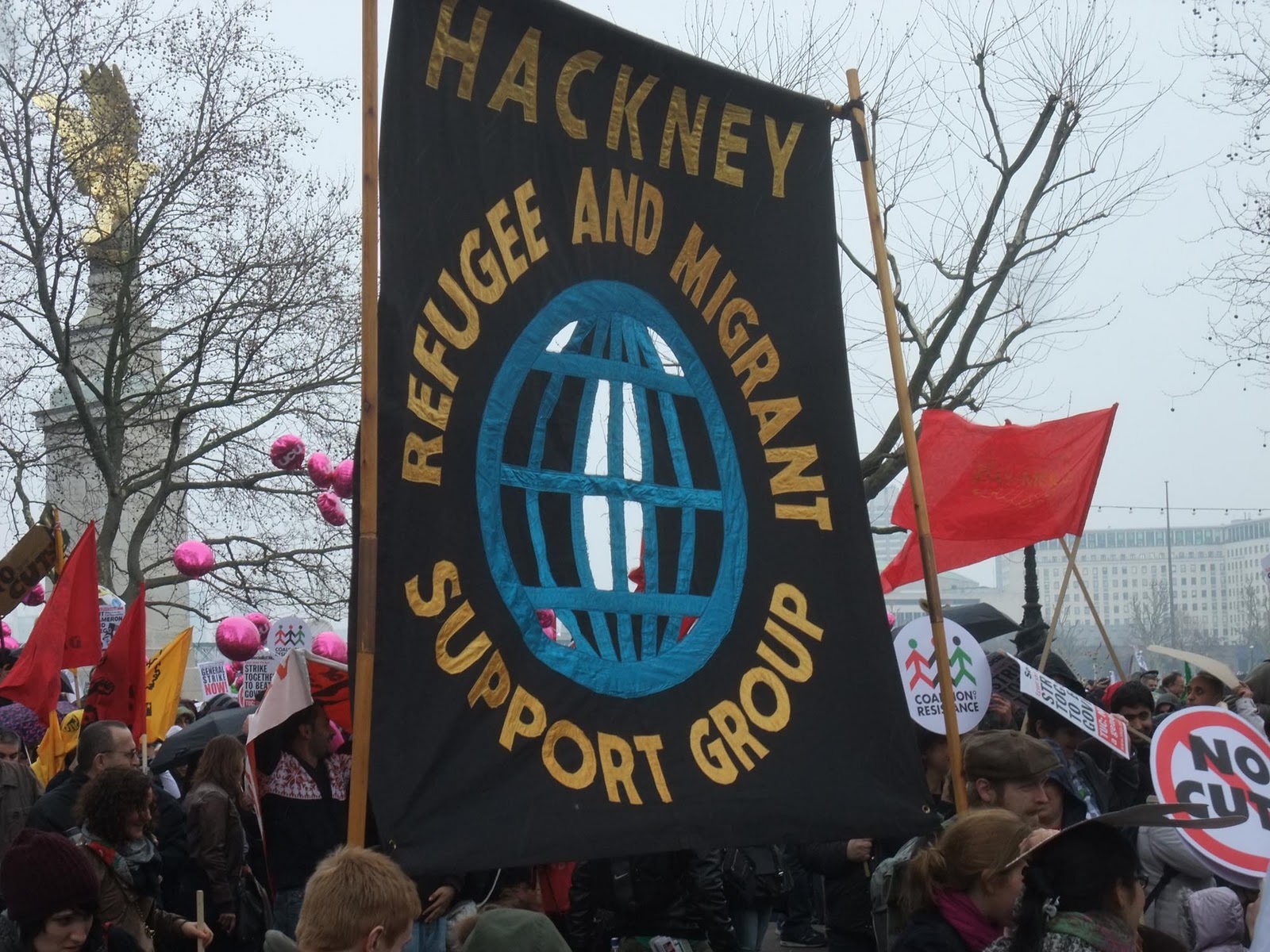
The day pretty much lived up to expectations. There was a good turnout, with people coming from an amazing variety of organisations, and from places far and wide. From what I could see the demo was a completely peaceful and yet powerful statement about the opposition to the cuts. There was a tremendous variety of banners and placards, both mass-produced and individually hand-crafted.


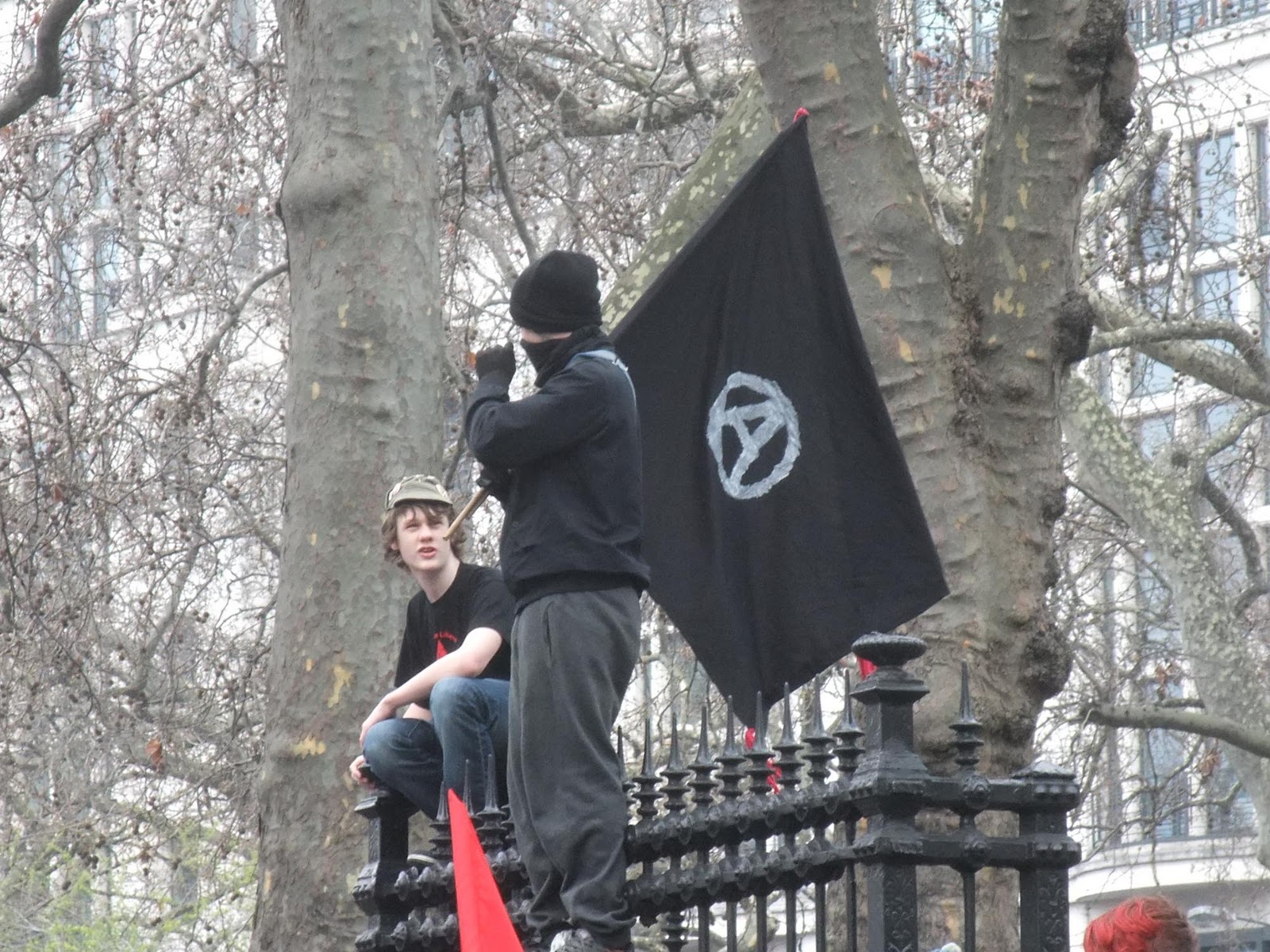
It was only afterwards that we discovered there had been a few incidents of so-called anarchists smashing windows and defacing property with spray paint. Also, UK-Uncut disrupted a few business premises with occupations and sit-ins.


So does anything now change? As ever, politics is about power and who has access to it. It's not about having a reasoned debate and arriving at "the truth", which must then be noted and acted upon. We all have our own versions of the truth. The coalition certainly has theirs, which they're able to broadcast incessantly through their easy access to the mass media. Working people can only shout loudly, or march on the streets.


As for the Labour Party's version of the truth about our economic and political situation - it hasn't shifted much from the New Labour orthodoxy. There's a sort-of acknowledgement that the financial meltdown happened on their watch, and that they were somehow complicit in the crash - owing to their continuation of broadly Thatcherite and Friedmanite economics, with light-touch (ie hardly any) regulation of the City and the banks, and hardly any radical attempt to deal with growing inequality and poverty.


As to what needs to happen now - what credibility do any of our current politicians really have? On the one hand we have the Bullingdon Club, the Etonites and the millionnaires, aided and abetted by Clegg & chums (who admit that there are no substantial political differences between them and the Tories). On the other hand we have the young, Oxbridge-educated, professional politicians who now run the Labour Party and were part of the New Labour gang, even if they don't call themselves that any more.


Ed Milibean - nice, clever, posh boy with zero charisma and zero leadership ability. Ed takes the rap for being so stupid as to appoint Alan Wotsit as Shadow Chancellor - a man with no grasp of economics whatsoever, and who thankfully did a bunk as soon as he could. So Ed then rightly replaces him with the appalling (but economically savvy) Ed Balls, but stupidly replaces Balls with the even more appalling Douglas Alexander - a tosspot of the very first order. Meanwhile we hear nothing whatsoever from Mrs Balls - I can't remember her real name (Yvonne something? Cooper?) - about the great world issues, including Libya and the rest of the Arab world.


These people are basically clever prats, who have failed to differentiate themselves sufficiently from the Tories and Libdems, and failed to associate themselves with the very people the Labour Party was created to support. Power-seeking missiles, born to manuever their way to positions of influence and power in the People's Party, but not to rock the boat, or to promote or create any radical change. They're not even proper social democrats, let alone socialists. They have neither the gifts nor the intention to change the terms of the political debate and cause people to think differently about politics, social justice and social policy. They're political pygmies, and are hard, if not impossible, to support and vote for, even if you're a lifelong Labour supporter.


So who should we vote for? Ideally a new political party, a new political movement, which comes into being as a true party of the Left in Britain. A party that is led by people of conviction who can make the case for social justice, greater equality and decent public services; a party that will argue for a fair tax system and the eradication of poverty; a party that will rebalance the economy and properly regulate the banks and the City; a party that will do all the things that the Labour party was initially set up to do, and can no longer claim with any credibility that it will do, if it ever returns to power.


I don't even care if that party turns out to be non-electable - it's the party I want to vote for. As things stand, the present Labour party is the lesser of the evils on offer, but it's not a party I want to vote for. It's time for politics in this country to move on, and we need a party that's led by people who are untainted by New Labour and is led by people with experience, maturity, gravitas, imagination, wisdom, idealism, conviction and credibility.


If UKIP can appear out of nowhere on the right of the political spectrum, then it must be possible for a new party to do so on the left - providing they have good leadership and a programme that matches reality and matches the expectations of large sections of the population who are sick of what the Labour Party continues to be and to do, or not do.


The only possible alternative (for we anti-Tories) is for masses of people to stop work and peacefully occupy public spaces, withdrawing our consent to be governed by people who have no legitimate mandate for what they're doing to the country - to follow the example of the courageous Egyptians and Tunisians.


We should be clear that there is absolutely no mandate for what this government is doing since Cameron, Clegg and co totally misled the country as to their intentions to introduce and support massive changes to public services that weren't even proposed at the time of the election. Who the hell agreed that the health service should be turned upside down and largely privatised or outsourced? Who agreed that "free schools" could be set up and run by oddballs like Toby Young with handouts of large wads of public money? Who agreed to the closure of libraries and children's centres? Who agreed that bankers could carry on paying themselves massive bonuses, and banks could remain unregulated?

Sadly there will be NO mass demonstrations, NO occupations, NO irresistable demands for fresh elections, NO new government with a real mandate, and almost certainly NO new political parties. This is the pathetic reality of Britain today, in spite of the dire state of the country and the massive political coup that has taken place. The shock doctrine lives on, and most people are too confused and scared, or too damn comfortable and complacent, or  too selfish and arrogant, to do anything about it.

Here's my solution for action to raise awareness.

It has to be action taken by "the people" and must not be led by the political parties or the unions. It has to be taken by people from across the awareness spectrum and the political spectrum.

We pick a Saturday in May - or possibly May Day - and call it DO NOTHING day. On that day as many people as possible should do nothing. No work. No rallies. No marches. Stay at home if you wish - but preferably gather in public spaces, hang about, chat to one another, read newspapers or books, and DO NOTHING. People who do nothing on this day will be deemed to be supporting the call for new elections on the grounds that this government has NO MANDATE for their spending cuts and changes to public services.

If the day is successful in getting people to stop work and do nothing, then the following weekend should be designated the DO NOTHING weekend. If it's successful in getting mass support then the following weekend should be designated the NO MANDATE weekend. From that weekend onward as many people as possible should continue to DO NOTHING (apart from hang around peacefully and have fun in public spaces) until the government agrees to call a new election.

The only people who should continue to DO SOMETHING should be people who work in schools, people who run hospitals and services for the elderly, etc. In other words, essential public services. Suitably qualified and experienced people who would otherwise join in with the call to DO NOTHING could volunteer to help those who are keeping the essential services going, thereby making those services even more effective. They could even volunteer to run creches and discussion groups at the DO NOTHING gatherings. Other sorts of creative and worthwhile activities could also be set up at the DO NOTHING gatherings.

It's worth a try.


All photos (c) Oxzen Pics

.

Tuesday, March 8, 2011

Layer 453 . . . International Women's Day, Angry and Unafraid

.
It's International Women's Day, and the good old Guardian has made sure that all six of its opinion page articles today are written by women. Also, the whole of G2 is filled with pieces on the "100 Most Inspiring Women".

Fair enough. Except . . . the cover of G2 includes a photo of  . . . Margaret Thatcher.

And there's another, even bigger, photo on Page 5, along with a column of text that contains stupidities such as, "Like her or loathe her, Britain's first female prime minister made her way in a man's world and changed the way we think of women politicians."

Emine Saner (?) - what are you thinking of? "A man's world"? What ridiculous cliches.

So how did we used to think of women politicians before Thatcher? Personally I thought very positively about Barbara Castle, for example. She was a brilliant example of a thoughtful, decent, compassionate, well-balanced, sane, non-prejudiced politician. Did Thatch have any of those qualities?

Even Emine Saner has to admit that "Thatcher froze child benefit and refused to invest in affordable childcare . . . she promoted no women to her cabinet and no women above junior minister . . . " As if these are the worst of her crimes and misdemeanors!

So what positive things does Ms Saner have to say about Thatch?

"And yet she is an inspiration, partly for showing that the daughter of a greengrocer could progress through education, determination and hard work."

Really? What about if the daughter of a greengrocer didn't go to Cambridge and didn't marry a millionnaire? As for "progress" through education, determination and hard work - who'd have thought before Thatch came along that that such things could be helpful to an individual? Revelatory.

Mind you, I reckon I've also had a decent education, plus I've shown plenty of determination and I've worked hard. And so did our old mate David Miliband, for that matter - but I can't see either of us two making it to PM any time soon.

Anything else, Emine, luv?

"Having a woman in the most important job in the country for the first time changed the cultural idea of what was possible for women. Thatcher was ambitious, tough and uncompromising, qualities rarely associated with, or admired in, women before her. She may not have done much for the careers of individual women, but she changed the way female politicians were thought of – her decisions, such as waging war on the unions, or in the Falklands, may have been ruthless, but nobody now questions whether women politicians can be strong."

Strong? Ambitious? Tough? Uncompromising?

Ridiculous buzz-words, meaning absolutely nothing. As if "uncompromising" is a good quality in a politician. Hitler was uncompromising. As was Stalin.

As for "ruthless" - that word alone ought to have made Thatcher ineligible for inclusion in this supplement about "most inspiring women". Who needs to be inspired to be ruthless? Candidates/contestants to be The Apprentice?

http://www.guardian.co.uk/world/2011/mar/08/margaret-thatcher-100-women

.......................................

This, on the other hand, is an excellent piece by Selma James, who has clearly been inspired by the events in Egypt -

http://www.guardian.co.uk/commentisfree/2011/mar/08/international-womens-day-sexual-division

International Women's Day: how rapidly things change


Women in Egypt have called for a million women to occupy Tahrir Square today. Who would have predicted that a month ago?


Feminism has tended to narrow its concerns to what is unquestionably about women: abortion, childcare, rape, prostitution, pay equity. But that can separate us from a wider and deeper women's movement. In Bahrain, for example, women lead the struggle for "jobs, housing, clean water, peace and justice" – as well as every demand we share.


The revolution is spreading.


New boldness allows us to face what Marx and Engels called "our real conditions of life and our relations with our kind". Women refusing to be trapped at home, and demanding that men not be trapped out of home, takes us immediately beyond the market, which only considers work that leads to profit for others, not to equity nor to happiness nor even to survival.


To undermine once and for all the sexual division of labour, we – women and men – must aim to work less. We can then begin where we all began, with children. What do they need? First of all, adults (not just parents) who love them and work to make a relationship with them. That is after all what caring is. We need time for this. Prime time.


We cannot be punished for our involvement in this civilising life process. Nor can we allow men to be excluded from it. So this International Women's Day, we must at least consider claiming the money from banks and wars to pay for the society of carers that only we together can devise. Taking the lead of the women in Tahrir Square, we can change the world.


• Selma James is organiser of the Global Women's Strike Mothers March

................................................

I've blogged about previous Nina Power columns in the Guardian. This one is also excellent -

They're angry and unafraid – and terrify middle England


When young women feel they are no longer held back by their gender, one outcome is an increase in political confidence


http://www.guardian.co.uk/commentisfree/2011/mar/08/terrify-middle-england-young-women


In the buildup to what looks likely to be the biggest trade union demonstration in recent history, on 26 March, the role of women in organising and participating in protest will continue to be central. Nevertheless, for the usual suspects the participation of so many young women – in the education protests in particular – has given rise to a certain moral panic. See, for example, the hilarious Daily Mail cover: "Rage of the Girl Rioters".


The attempted pillorying of these young women – accused of "lacking respect" – by the Mail is the latest in a long line of attacks on women who campaign directly against the state: the suffragettes; women involved in the 1926 general strike; the miners' protests in the mid-80s; those who fought for reproductive rights and against domestic violence. Just as with the attack on "ladettes" in the 1990s, what looks to be a moral criticism frequently masks a deeper political and economic fear – what shall we do when young women are academically successful, economically independent, socially confident and not afraid to enjoy themselves? Could there be anything more terrifying?


Whatever the 1990s tried to tell us was over – from inequality to political commitment – has most definitely not gone away; and the idea that one would simply have a passive, ironic or otherwise disinterested stance towards the brutal and brutalising policies of a government hell-bent on removing any vestige of a social bond now looks historically outmoded.


Many of the schoolkids who played truant to attend anti-war protests have grown into articulate and politically passionate adults, rightly incensed that education is being transformed into something insanely expensive, increasingly exclusive and socially divisive.


The explosive mix of single-issue campaigns (such as UK Uncut), broader anti-cuts struggles and a growing worldwide recognition that the corruption and complicity of governments are no longer tolerable means that everywhere men and women are realising that what unites them is far greater than what divides them.


When young women feel they are no longer held back by their gender, that they can take on any job, that they are more likely to do well in education than their male peers, that they don't have to think of themselves as wives and mothers first, one outcome is an increase in political confidence. If you tell women they can be and can do anything they want, and then let them down – by taking away their education maintenance allowance, by making university prohibitively expensive, by forcing them to stay in poverty – they, along with their male peers, will make you pay for your lies and hypocrisies.


While the Mail presumably thought that "girl rioters" would terrify its middle England readership, this should only serve to encourage us to recognise that female emancipation – and political emancipation more generally – will start with those most angry about its incompletion.

.......................................

Jayati Ghosh is a professor of economics -

Big Oil wins in the latest price spurt. So why don't we take our share in tax?


War in Libya and protests across the Middle East are exploited by companies too quick to pass costs to vulnerable consumers

http://www.guardian.co.uk/commentisfree/2011/mar/07/oil-price-rise-tax-big-oil

.....................................

A Guardian editorial today takes up the issues I wrote about a couple of blogs ago - whether the LibDems rank and file will finally take a stand against the appalling policies of their leaders and their Tory coalition partners:

http://www.guardian.co.uk/commentisfree/2011/mar/08/liberal-democrats-coalition-nick-clegg

Liberal Democrats: Call for a lost voice


If the Lib Dems, of all parties, will not fight back and make the case for rights, who can?


The Lib Dems are not making their voice heard on issues where their voice ought to be. If the party is true to its liberal roots, as well as alive to its own self-interest, it must be willing to stand up for the values that helped raise the party to a position of power in the first place. If not now, when?
.