Tuesday, March 27, 2012

Layer 532 . . . The Guardian, Banks of Ideas and a Progressive Counterculture


For years I've put up with people going on about my apparent obsession with the Guardian. This has nothing to do with the political stance of the paper. It's more the fact that I have piles of old copies lying around, some of them half or a quarter read, some with articles highlighted in various shades of green, yellow, blue and magenta. (And no - I'm not organised enough to use any thought-out colour-coding  scheme as such - the shades are random depending on which highlighter is closest to hand.)

The point I'm getting to is this. I don't have an obsession with the Guardian - I get enormous enjoyment and stimulation from reading the paper. Every day is like the Saturday and Sunday of the Guardian's "Open Weekend" - there's an amazing feast of brilliant brain food on offer. What's not to like, and to want to keep in a collection? [OK - you can go online and 'clip' favourite articles to a virtual file - and I do that as well - but it's not the same thing at all as having real bits of hard copy. Don't ask why - it just isn't.]

As for throwing away brilliant articles - I've never understood why people would throw away or give away brilliant books, or brilliant DVDs for that matter. Life of Brian? Oh yes - I watched that last week. Threw it away yesterday. Shakespeare? Read it already. Thrown it away. What's not to like about having a fantastic library, or libraries, at home?


And you don't have to be 'an intellectual' to enjoy the Guardian, any more than you needed to be an intellectual to enjoy the Guardian Open Weekend. All you need is to allow good stuff to enter your brain. Take yesterday's paper, for example.

* A front-page story about the latest Tory party funding scandal and cash-for-access to Cameron and Osborne - "Two hundred grand to 250 is premier league - the first thing we want to do is get you at the Cameron/Osborne dinners."
* Four pages on the Open Weekend at Guardian HQ.
* An article on Obama's healthcare reforms being challenged by more than half of the states in the Supreme Court.
* An article on the latest moves to privatise education and to make it 'for profit'.

Plus a wealth of 'Comment' articles by the usual array of brilliant and not so brilliant columnists, plus the editorials, plus the letters page. So what is not to bloody like?

And then there's the sports section, and of course there's G2, which yesterday featured

* A four page Decca Aitkenhead interview with Grayson Perry
* A two page feature on Julian Baggini's 'Heathen Manifesto'
* A column by Ian Martin, who's a writer for 'The Thick of It:

Life under the Tories: don't say you weren't warned
Some of us saw it coming – but it doesn't have to be this way
by Ian Martin
http://www.guardian.co.uk/commentisfree/2012/mar/25/tory-nightmare-dont-say-werent-warned
The anxiety of living under a Tory government is that you're only ever a few days from the next national bad luck lottery draw. You know something spectacularly horrible will be announced next week. You just don't know whose unlucky balls they'll be holding.
Don't say you weren't warned. We told you what the Tories were like, we of the wilted generation, two years ago. We'd seen it all before. We were struggling young parents ourselves in the 80s when Thatcher's deregulation of the market led to class war, video nasties and Bananarama. We told you. You wouldn't listen.
Come on, you simpered, the Tories can't be any worse than that other crate of soft fruit, with the Britpop on their iPods and their impenetrable jargon. And, OK, I too froze in horror when I heard Labour's schools minister Jim Knight announce through his trimmed facial ladygarden that the challenge was "not simply how to divide the cake, but how to grow the cake". They've made him a Lord now, by the way. Presumably for services to advanced metaphor.
This is why we warned you about the Tories. We knew it would be easier for them to deconstruct the welfare state this time round as they spent much of their last time in office loosening the bolts. The print unions and the miners were defeated early on. The rest of the Tory era was spent dismantling a working class power base it had taken a century and a half to build. They had plenty of time. My son was born in 1979, the year Thatcher became prime minister. He was 18 before the Tories were turfed out again.
Local authorities were humiliated, their stock of affordable housing sold in a right-to-buy fire sale, their powers gradually whittled down to bins and dog waste. The Public Finance Initiative, greatly expanded under the auspices of Blair, was originally introduced as a buccaneering Tory programme, an innovative way of "synergising" public and private sectors. In much the same way that partnerships are forged between a desperately broke family and a loan shark.
Look, the reason this government's moving so quickly to divide the NHS into privatised contractual fiefdoms for its mates, and to divert education budgets into "free" schools for its mates' children, is because it can. Resistance has been atomised. Working-class rage, once articulated by powerful unions representing people doing proper jobs, has dissipated. 
There's no hope of reunionising the country is there? You might as well try to unionise comedy writing, and … oh, wait.
I'm a member of two writers unions. One here, and one in the US I had to join for an American gig last year.
If you can unionise joke-writing you can unionise anything. People who do "silly" jobs of the world unite, you have nothing to lose but your chains.
It would be interesting to see how long Westminster could function if the Amalgamated Union of Baristas and Sandwich Fillers called a strike. And the civil servants came out in sympathy. And the drivers and the cleaners and the couriers and the receptionists and the child-minders and, now I come to think of it, the grandparents.
All this guff the government's spinning about choice and the individual: that's what they want. The last thing they want is collective action. They're always sneering about "Guardian readers". Well, we pay our daily sub of £1.20, let's call ourselves a union. Comrades, to the barricades! Or if you're a Times reader, the paywall!

http://writing.ie/meet-the-authors/special-guests/358-ian-martin-and-the-coalition-chronicles-.html

..............................................

Coincidentally I'd spent time at the Open Weekend thinking about the cumulative benefits of all those people at the event taking part in all those discussions on such a wide range of subjects - political, social, cultural, educational, psychological, scientific, economic, etc.

In the early part of the last century - pre-television - people used to go in large numbers to meetings of political parties, trade unions and other interest groups. There was true citizenship in action - direct participation in discussion, debate and policy-making. People listened to speakers giving out information and opinions, and had a chance to ask questions for clarification, as well as give direct feedback with their own opinions.

Our politics and our party system is busted, and everyone knows it. There's very little difference between three dinosaur parties full of young and middle aged prats who represent the political spectrum from the centre right to the hard right. There is NO coherent progressive or alternative opinion. And of course there's little or no actual participation by regular citizens. No wonder those of us who wanted to see the back of New Labour had no-one credible or coherent to vote for. No wonder we're stuck with a government of the rich, by the rich, for the rich.

The Guardian HAS to become even more of a focal point for the positive energy of all those who took part in the weekend gathering of the tribes, plus all those who couldn't get there or didn't know it was happening. Back in the 60's - fully 50 years ago - we built a counterculture and a movement. This has to happen again. Glastonbury's fine, but it's not enough. Music isn't enough. We need ideas to shift a moribund culture and kick it into new life. We now have the Internet, email, Skype, Facebook and Twitter to help build links. We are the many - and the one percent are the few. We need a government that's genuinely of the people, by the people, for the people. We've had enough of rule by Westminster and the City.

We need regular gatherings and debates all over the country. We need young people and old people to be involved in them. We need to make connections and we need to form affiliations. The Open Weekend had no particular agenda and no identifiable leaders. It had organisers. It was led by ideas and opinions. Thank goodness.

Television and radio are more or less closed shops - run by professionals for professionals. We need organised gatherings and spontaneous gatherings where people actually talk to one another, learn from one another and enlighten one another. We need to learn the arts of participation and discussion. The Bank of Ideas needs to have branches in all our towns and cities, and the Guardian can surely help with this.

Love Me Do was released on 5 October 1962. This was the first record released by The Beatles, and was more or less the beginning of the Sixties. By the 5th October 2012 at the latest we need to make sure we've organised a 50th anniversary party, which will recognise the beginning of a whole new era and a whole new way of running a vibrant and progressive culture, one in which progressive ideas are as important as they were back in the Sixties. Get on the bus, tune in and turn on.

Knowledge is power. Watch this video

http://www.youtube.com/watch?v=g_fIjX1_gLw&feature=related

http://www.youtube.com/user/freedominfonetwork

http://www.freedominfonetwork.org/

http://www.youtube.com/watch?v=uf5nVk5MU70

*  "Love Me Do" with its stark "blunt working class northerness" rang "the first faint chime of a revolutionary bell" compared to the standard tin pan alley productions occupying the charts at the time. - Wikipedia

Monday, March 26, 2012

Layer 531 . . . The Guardian, Open Weekend and a Festival of Truth and Reasonableness


                                                                               Oxzen Pics

There's a wall inside the Guardian's HQ where various front pages from the paper's illustrious past are prominently and proudly displayed. The one that stands out for me is the one featuring the outcome of the Jonathan Aitken case. The headline says, starkly and simply: 'A Liar and a Cheat'.

Mr Aitken is no longer a liar and a cheat, as far as anyone knows, and his fight with the Guardian ('with the simple sword of truth and the trusty shield of British fair play') was arguably the beginning of his journey towards becoming a decent human being. Had he fraudulently won his case, then there could have been dire repercussions for the Guardian. Had he won his case - then he'd have remained a liar and a cheat for the remainder of his life. However, he lost his case and went to prison for perjury and perverting the course of justice.

Mr Aitken is currently honorary president of Christian Solidarity Worldwide.

..................................................

In post-modern times we understand that 'absolute truth' is difficult to establish, and that individual truth is somewhat relative: it depends to a great extent on one's standpoint and mindset.

What's true to one person is not true to another. For a Christian, God exists. To an atheist, God does not exist - but this doesn't mean Christians are liars. They just see truth differently. Their truth is based on belief, hope, faith, intuition, etc. In other words, "truth" is sometimes  a matter of opinion and belief.

"Comment is free," wrote Guardian editor CP Scott in 1921, "but facts are sacred".

                                                           Oxzen Pics


...........................................

On Radio 4's 'Start The Week' this morning Werner Herzog spoke about "the ecstacy of truth". "Ecstatic truth illuminates something deep inside you."

............................................

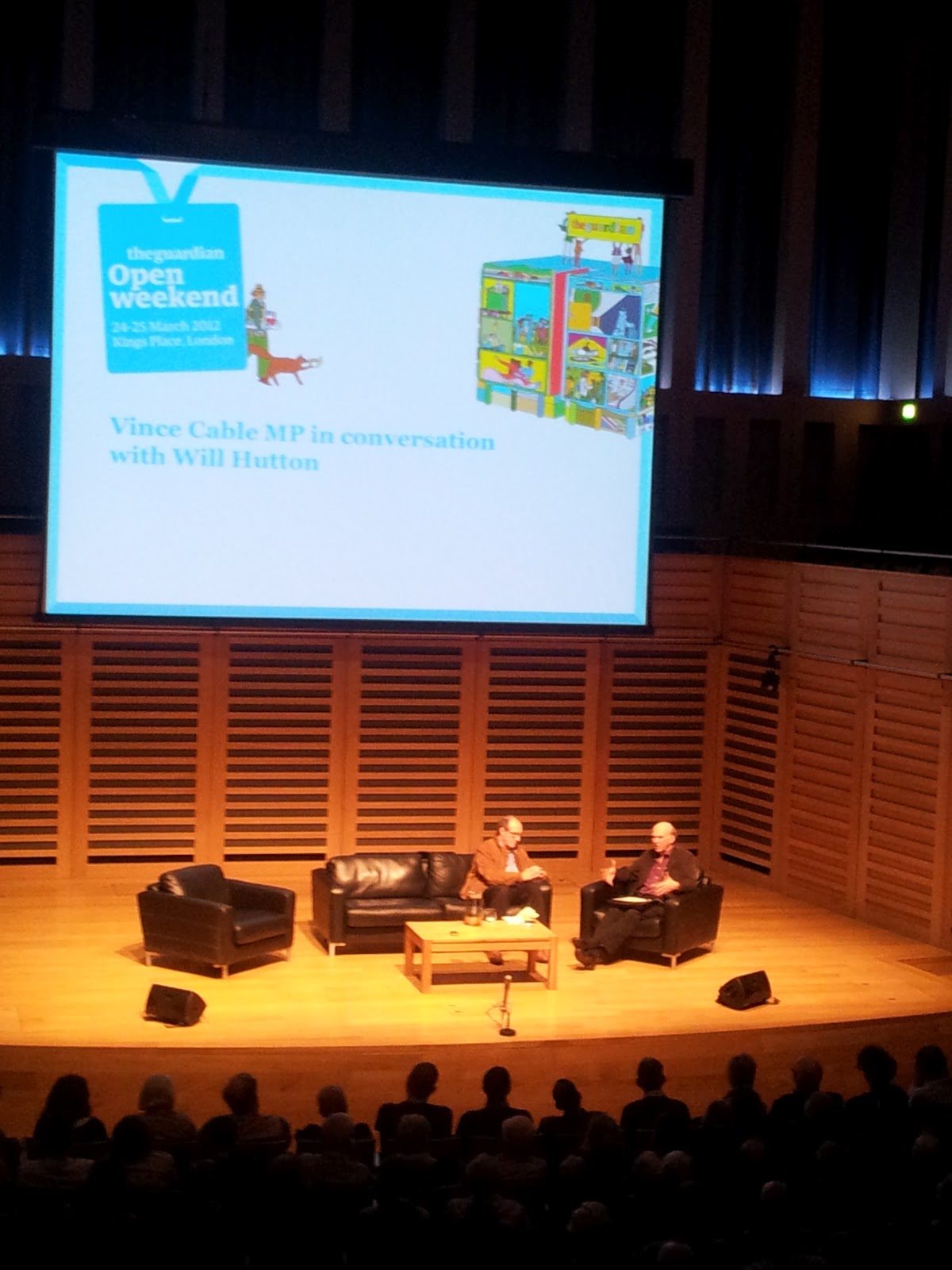
Last weekend the Guardian held its first ever "Open Weekend" at its HQ and the adjoining Kings Place centre.


Will Hutton and Vince Cable                Oxzen Pics

The Guardian's weekend appears to have been a complete sell-out of the hundreds of lectures, seminars, discussions and debates that were on offer - 10 of them per hour throughout both Saturday and Sunday. At £30 per day it wasn't exactly cheap, but compared with an average concert at the O2 or a show in the West End it was, hour for hour, incredible value - and probably far more stimulating and enjoyable than the average concert or show for the kind of people who regularly read the Guardian.

Jayati Ghosh, John Lanchester, Will Hutton, Heather Stewart        Oxzen Pics

The open weekend was organised by a team led by Madeleine Bunting, and they can take enormous credit for the range of things on offer, and also for the festival-like atmosphere, which was no doubt aided by two days of blue skies and sunshine. It was good to see the outdoor areas alongside the canals also being well used for refreshment, relaxation and conversation, as well as for the other attractions on offer, such as various food stalls, narrowboat trips, a cheese barge and a book barge.


Larry Elliott and Jeffrey Sachs                                    Oxzen Pics

Apparently about 5,000 people attended, and watching the crowd walk up York Way from Kings Cross in the morning and back again in the evening, one was reminded of the crowds at other great festivals such as Woodstock and Glastonbury. The Guardianistas' Woodstock, indeed.

http://www.guardian.co.uk/open-weekend

http://www.guardian.co.uk/news/gallery/2012/mar/25/grayson-perry-davidmiliband#/?picture=387850628&index=0

http://www.guardian.co.uk/news/2012/mar/25/guardian-open-weekend-round-up

Guardian Open Weekend: a festival of readers and reasonableness
Imagine if you can Richard Littlejohn's worst nightmare – with cheese, crosswords and Clay Shirky thrown in
by Stephen Moss
"Curiosity and conviviality, the two Cs, were our watchwords," explained Madeleine Bunting, director of the Guardian's Open Weekend.
It was Richard Littlejohn's worst nightmare . . . 5,000 Guardianistas gathered under one roof at Kings Place in London at the weekend for a festival of reasonableness. The weather was perfect, proving that God, whatever the Bible might suggest, is a centrist.
The philosophical starting point for the weekend was, where does the Guardian go from here? How do we carry on in a world where newspapers are dying and social media are becoming ever more central? Here made manifest was the community which might eventually replace the traditional us-and-them relationship.
Should media organisations offer a product, a service, or strive to build a different sort of organisation – a group of like-minded people who thought "God forbid that the Guardian should ever go out of business?" 
It was clear what shape the 300-strong audience thought the Guardian of the future should take. These, after all, were the loyalest of the loyal, people who had given up their lost-hour Sunday to ponder existential media questions and eat a lot of free cheese.
The weekend was principally about those readers, and meeting Cathy Robertson, who had come down from Liverpool with her Guardian-agnostic husband, summed up its purpose.
"It's a fantastic opportunity to get closer to the paper I've read for years," she said. "After this I'll be reading it with new insight. I'll feel closer to it; feel it's even more my paper and that it reflects my values. It's been a wonderful experience."

    Kings Place                                  Oxzen Pics
 .

Gary Younge & Linton Kwesi Johnson                     Oxzen Pics
.
Guardian Open Weekend                    Oxzen Pics

.

Sunday, March 18, 2012

Layer 530 . . . The Questioning of Capitalism, and Culture after the Credit Crunch


There was an interesting piece in the Guardian yesterday which readers of Layer 528 might want to pick up on. It sheds some more light on the state of post-apartheid South Africa, and the reasons why a country that so many of us had such great hopes for is so fucked. You just have to wonder what Mandela and Tutu make of it all. Are they writing about it now? And do their views carry any weight?

On page 5 of The Review, in "The Week In Books", John Dugdale writes about Nadine Gordimer, who was in London this week.
What Gordimer, 88, was keen to talk about was censorship, and a current threat to freedom of expression in her country, which she called "an updated version of the gags under apartheid". 
One element of this is a media tribunal that requires journalists to seek permission before, for example, investigating a government minister's activities.
Then there is the Protection of State Information bill, which clamps down on whistle-blowing. For Gordimer, both moves are designed to shield an ANC elite who have "betrayed all they fought for".

As pointed out in the recent blog, the betrayal took place almost from the outset, and it continues to this day - thanks to the stupidity, greed, selfishness and ignorance of those who were supposed to be the leaders and liberators.

...........................

Also in this weekend's Review is a brilliant whole-page article by Marilynne Robinson, which is almost too depressing to read. The USA, like South Africa, was supposed to be a new light in the world - a beacon of hope which showed the way forward for people to overthrow oppression and colonialism and build a society based on freedom and justice. Instead, it's fucked.

Culture after the credit crunch
The financial crisis has not led to a questioning of capitalism. Rather, hard times have brought even sharper attacks on 'big government'. In the US anything public equals 'socialism'
 http://www.guardian.co.uk/books/2012/mar/16/culture-credit-crunch-marilynne-robinson
Fear is the motive behind most self-inflicted harm. Western society at its best expresses the serene sort of courage that allows us to grant one another real safety, real autonomy, the means to think and act as judgment and conscience dictate. It assumes that this great mutual courtesy will bear its best fruit if we respect, educate, inform, and trust one another. 
This is the ethos that is at risk as the civil institutions in which it is realised increasingly come under attack by the real and imagined urgencies of the moment. We were centuries in building these courtesies. Without them "western civilisation" would be an empty phrase.
Austerity is the big word throughout the west these days, with the implicit claim that what ever the Austerity managers take to be inessential is inessential indeed, and that what ever can be transformed from public wealth into private affluence is suddenly an insupportable public burden and should and must be put on the block. 
Everywhere the crisis of the private financial system has been transformed into a tale of slovenly and overweening government that perpetuates and is perpetuated by a dependent and demanding population. This is an amazing transformation of the terms in which our circumstance is to be understood. 
For about 10 days the crisis was interpreted as a consequence of the ineptitude of the highly paid, and then it transmogrified into a grudge against the populace at large, whose lassitude was bearing the society down to ruin.
Austerity has been turned against institutions and customs that have been major engines of wealth creation, because they are anomalous in terms of a radically simple economics. [See all previous blogs on Disaster Capitalism, Chicago-School economics, The Shock Doctrine and Naomi Klein.]
As a professor at a public university I feel the effects of this. Of course legislators are also state employees, but for the moment they are taken to act in the public interest when they attack the public sector. If they were to tell us taxpayers how they spend their time, fiscal demolition would account for a great part of it. 
The phenomenon is national, indeed global, since every entity with leverage on any other is bringing the same sort of pressure to bear. The countries we now call "developing" have dealt with this for many years – as often as the international financial institutions have decided that their economic houses need to be put in order. Their cultural and political integrity has been overridden whenever these agencies have invoked the supposedly unanswerable authority of economics. And now the west is seeing its own cultures and politics, indeed its modern social history, erased on these same grounds.

[Of course the 'agencies' and institutions referred to here are the International Monetary Fund, the World Bank and the World Trade Organisation.]

It is this supranational power . . . that failed us all in fairly recent memory. It has emerged from the ashes with its power and its prestige enhanced even beyond the status it enjoyed in the days of the great bubble. The instability and the destruction of wealth for which it is responsible actually lend new urgency to its behests. 
This makes no sense at all. Certainly its authority with the public aligns badly with any conception of rational choice, which is supposedly a pillar of this self-same economic theory. It can proceed confidently, and moralistically, in the face of common sense and painful experience because it is an ideology, the one we are supposed to believe was the champion of freedom and prosperity in the epic struggle called the cold war. 
If there was such a champion, might it not have been freedom itself, as realised in the institutional forms of democracy? That is not how the story has been told. We are to believe it was an economic system, capitalism, that arrayed its forces against its opposite, communism, and rescued all we hold dear. Yet in the new era, market economics – another name for the set of theories and assumptions also called capitalism – has shown itself very ready to devour what we hold dear, if the list can be taken to include culture, education, the environment, and the sciences, as well as the peace and wellbeing of our fellow citizens.
The wealth that was once frozen in appreciated value and thawed at the discretion of the owner, in homes, notably, is now, increasingly, liquid in the hands of international financial institutions. 
To project debt forward as the Austerity mongers do is to assume a predictable future economy, essentially a zerosum economy which can only increase wealth by depressing costs – wages, safety standards, taxes – that is to say, by moving wealth away from the general population. This prophecy will fulfil itself as education is curtailed and "reformed" to discourage intellectual autonomy, and so on. The new sense of insecurity, the awareness that the rules have suddenly changed, has a meaningful segment of the population furious at government and desperate to be rid of the institutions that enable a culture of innovation.
In any case, in America an abstraction called capitalism has truly begun to function as an ideology. The word is not included in the 1882 edition of Webster's dictionary, and in the latest Oxford English Dictionary capitalism is simply defined as "a system which favours the existence of capitalists", as the self-declared socialisms of western Europe have always done. 
In contemporary America it has taken on the definition, and the character, Marx gave it, and Mao, and all the pro-Soviet polemicists. This despite the fact that Marx did not consider the United States of his time essentially capitalist. This despite the fact that the United States as a society is structured around any number of institutions that are not, under this definition, capitalist. 
Suddenly anything public is "socialism", therefore a deviancy, inevitably second-rate, and a corruption of, so to speak, the public virtue. If I could find any gleam of intelligence or reflection in all this, or any sign of successful education, I would be happy to admire it, so passionate are my loyalties. Failing this, I am left to ponder again the fact that this post-Soviet America has turned against its own culture and has seen cleavages in its own population that can only rejoice its most fervent ill-wishers. This is an ideal atmosphere for the flourishing of Austerity, punitive yet salvific, patriotic in its contempt for the thought and the values of those of its countrymen who have doubts as to its wisdom, especially if they express their doubts in the press or at the polls.
At very best there are two major problems with ideology. The first is that it does not represent or conform to or even address reality. It is a straightedge ruler in a fractal universe. And the second is that it inspires in its believers the notion that the fault here lies with miscreant fact, which should therefore be conformed to the requirements of theory by all means necessary. To the ideologue this would amount to putting the world right, ridding it of ambiguity and of those tedious and endless moral and ethical questions that dog us through life, and that those around us so rarely answer to our satisfaction. 
Anger and self-righteousness combined with cynicism about the world as he or she sees it are the marks of the ideologue. There is always an element of nostalgia, too, because the ideologue is confident that he or she is moved by a special loyalty to a natural order, or to a good and normative past, which others defy or betray.
The march of Austerity, with all that means, is international. Historically there is nothing new about it. It is an assertion and a consolidation of power, capable of cancelling out custom and social accommodation. It claims the force of necessity. And when necessity is to be dealt with, other considerations must be put aside. We in the west have created societies that, by historical standards, may be called humane. We have done this gradually, through the workings of our politics. Under the banner of necessity it can all be swept away.